

© Geni USThe Phenomenon

Global dimmingHe later goes onto to explicate how a rise in cosmic rays accelerates cloud formation, global dimming and global cooling, and that, while this appears to be a more recent phenomenon, with an increase of 13% in just 3 years, their impact on further cooling the planet will also likely have an affect on tree growth in the Arctic, a factor also not accounted for in the study above.
Global dimming is the reduction in the amount of solar radiation received on Earth's surface during fair weather. One of the main causes of global dimming is atmospheric dust. Numerous scientists have demonstrated that a global dimming trend has been in
process for decades.
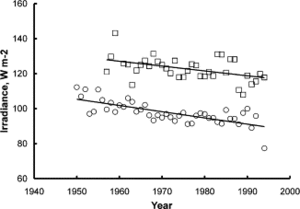
There's been some debate as to whether atmospheric dust induces a net warming effect on the planet (because it absorbs more than it reflects radiation), or whether it induces a net cooling effect (because it reflects more than it absorbs radiation). In 2008, atmospheric scientist Richard Hansell tested and measured the net effect of atmospheric dust particles on temperatures and concluded that although atmospheric dust both absorbed and reflected solar radiations, it induced an overall cooling effect:The analysis showed that over half of dust's cooling effect is compensated for by its warming effect. The finding, published in the Journal of Geophysical Research, Atmospheres, could clarify scientists' understanding of how dust influences moisture fluctuations in the atmosphere and surface temperatures around the planet.As shown in the diagram below, researchers from the Institute of Soil, Water and Environmental Sciences found a significant reduction, globally averaged 2.7% per decade, in solar radiation reaching the Earth's surface over the last 50 years.In the 90's an inversion occurred and our planet experienced a global brightening in some regions. Then, after the year 2000, global dimming restarted in certain areas and became overall more chaotic with different continents experiencing opposite trends.© Stanhill & CohenReduction in solar irradiance over the period 1950-2000.
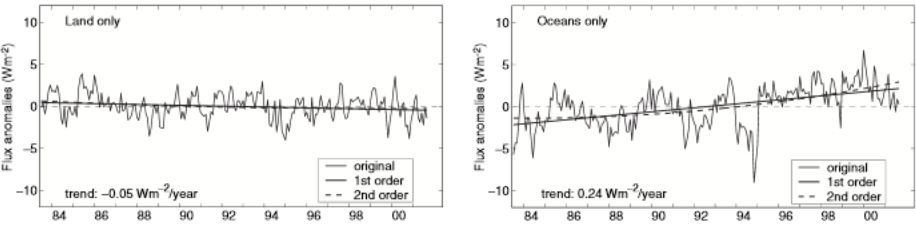
Now, according to mainstream science, global dimming is man-made, caused by the accumulation of aerosol particles in the atmosphere due to industrialization. The trend inversion noticed in the 90s is attributed to the ban of several types of aerosols and other anti-pollution measures. However, a paper published in 2005 showed that over the period 1986-2000, although a slight dimming was occurring over land, a brightening occurred over the oceans.If human activity was indeed the cause of global dimming, and the reduction in human aerosol use the cause for the brightening observed in the 1990s, a brightening over land should have been observed and, possibly, a delayed brightening over the oceans (due to air circulation), since most industrial sources are located on continents. But the paper referenced here shows exactly the opposite.© Pinker et alIrradiance over the period 1982-2002. Land measurements on the left (global dimming), ocean measurements on the right (global brightening).
Since 2000, dimming has been observed in numerous places, including China, India and the whole southern hemisphere, despite the relatively lower presence of anthropogenic pollution in this less industrialized hemisphere. We can deduce from this that while human pollution might indeed affect the amount of sunlight reaching the surface, it's obviously not the only cause and its effects are probably negligible in the larger context.
Unlike human pollution, cometary activity could, at least partly, explain both the global dimming observed above the oceans during the 1990s and the dimming since 2000.
Between 40 and 400 tons of extraterrestrial material is estimated to enter the Earth's atmosphere daily 214,215 most of it arriving in the form of cometary dust. These estimates calculated years ago do not, however, take into account the recent surge in cometary activity. If we factor in the 655% increase in confirmed fireballs (see AMS statistics above) over the past eight years, the quantity of cometary dust entering Earth's atmosphere should be at least six times higher than that generally estimated; that is, daily incoming dust measuring between 260 and 2,600 tons.

Ras Sig
I noticed a faintly glowing object that stood out against the background of the sky. It was flying 10 degrees above the horizon. A bright white glow with increasing intensity, the brightness increased to a magnitude of -3 or -4 - like the brightness of Jupiter or Venus.
It took me about 15 seconds to pick up a 5x magnification with night-vision device. The UFO originated in the south over the sea, 5 km near the coast - filmed from the village of Kotovsky. The object moved towards the city of Odessa and Zhivakhova Mountain - small mountain by the sea that in ancient times was a place of cult worship for Greek colonists.
I rotated focus on the night-vision device in an attempt to sharpen the perspective and capture the possible outlines of an object emitting light, but I saw nothing but a bright circular sphere. Even as the object faded, the sphere shrank to a small point and disappeared.
I filmed for a further minute, in case the object should suddenly reappear, but it disappeared from sight and even disappeared from the infrared radiation - invisible to humans, though visible to the device.






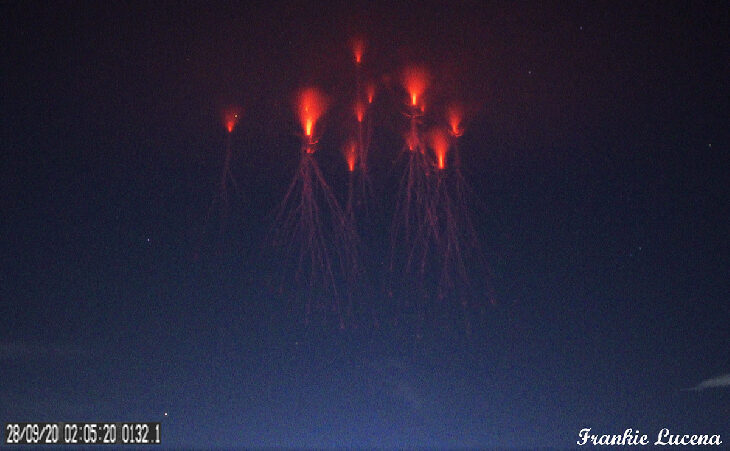
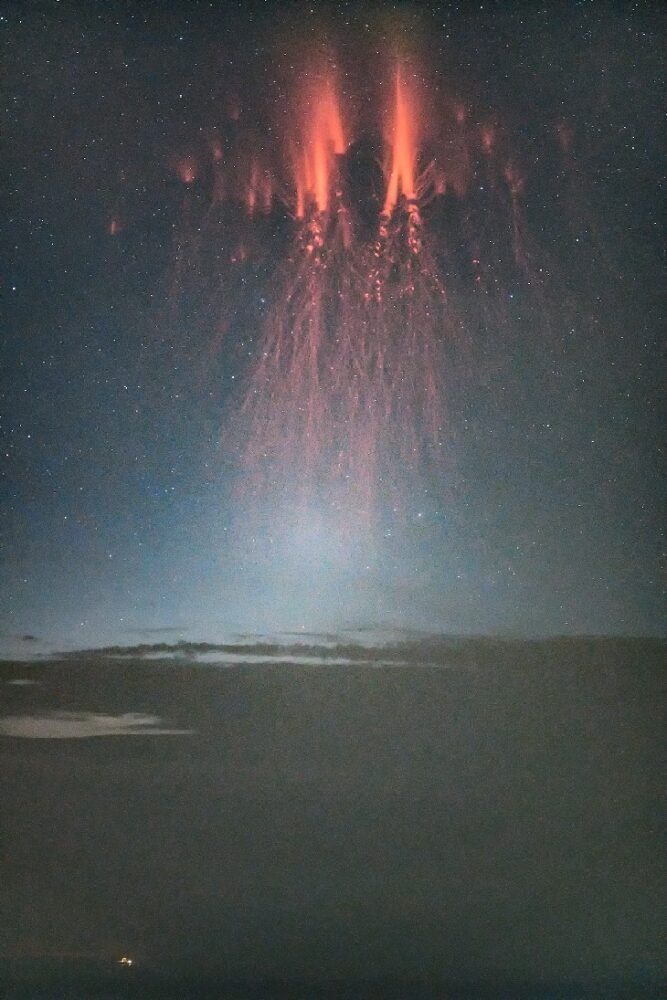
Comment: With the surge in sightings of red sprites in recent years (which are still considered 'rare' by some) it seems the electrical nature of our weather and changing atmosphere is becoming more apparent: