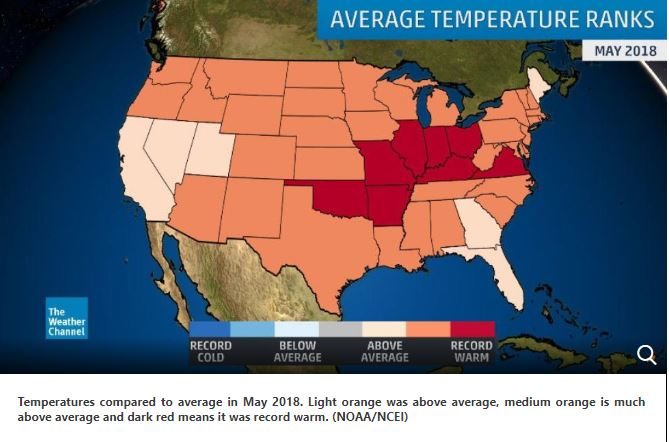
© NOAA/NCEI
The average temperature for the Lower 48 states last month was 65.41 degrees Fahrenheit, 5.21 degrees Fahrenheit above the 1901-2000 average, according to the
state of the climate report released by NOAA on Wednesday.
That knocked out May 1934 for the warmest May on record. Rounding out the top five warmest Mays are 1936, 2012 and 2000.
Eight of the 12 calendar months have now notched warmth records since 1998: January (2006), March (2012), April (2006), May (2018), June (2016), September (1998), November (1999) and December (2015).
Last month, Arkansas, Illinois, Indiana, Kentucky, Missouri, Ohio, Oklahoma and Virginia broke state warmth records. Another eight states from Washington to Rhode Island had their second-warmest Mays.
All told, May 2018 ranked among the top 10 warmest on record for 40 of the Lower 48 states. No state was colder than average in May.
More than 8,590 warm temperature records were broken or tied last month at individual weather stations across the U.S., NOAA said. The number of cold temperature records broken or tied in May pales in comparison at just over 450.
Last month was a reversal from April 2018, which
ranked as the coldest in more than two decades.
The waves of cold air that kept the central and eastern states shivering in April gave way to record or near-record warmth in some of the same areas.

















Comment: The world is seeing a rapid upsurge in extreme weather according to a recent report. For more information on these events from around the world, check out our Earth Changes Summaries. The latest video: SOTT Earth Changes Summary - April 2018: Extreme Weather, Planetary Upheaval, Meteor Fireballs
Related articles include:
- Cosmic rays found to be a trigger for explosive volcanic eruptions
- Scientists predict upsurge in major earthquakes for 2018 due to slowdown in Earth's rotation
- Volcanoes are erupting all over the place right now. Scientists have figured out why: A minute slowdown in the planet's rotation
- Ice age on the way: Gulf Stream is slowing down faster than ever, scientists say
- As we approach solar minimum, cosmic ray flux continues upward trend
- Solar-system-wide 'climate' change: More galactic cosmic rays are reaching Earth than normal
To understand how and why these extreme weather events are occurring read Earth Changes and the Human Cosmic Connection by Pierre Lescaudron and Laura Knight-Jadczyk.