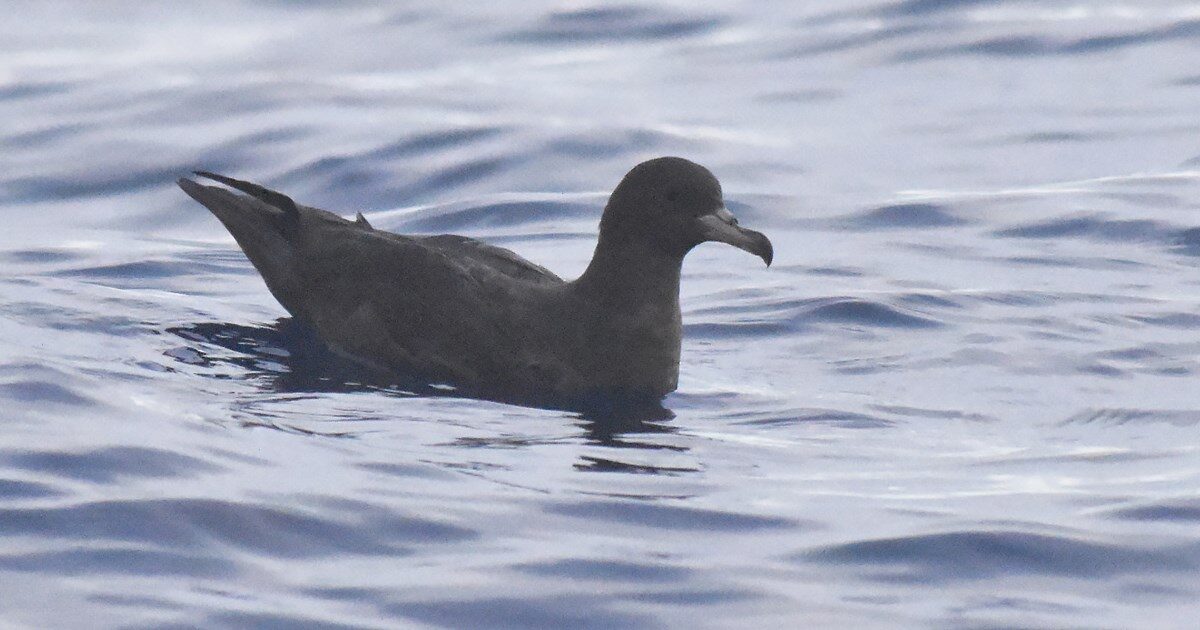
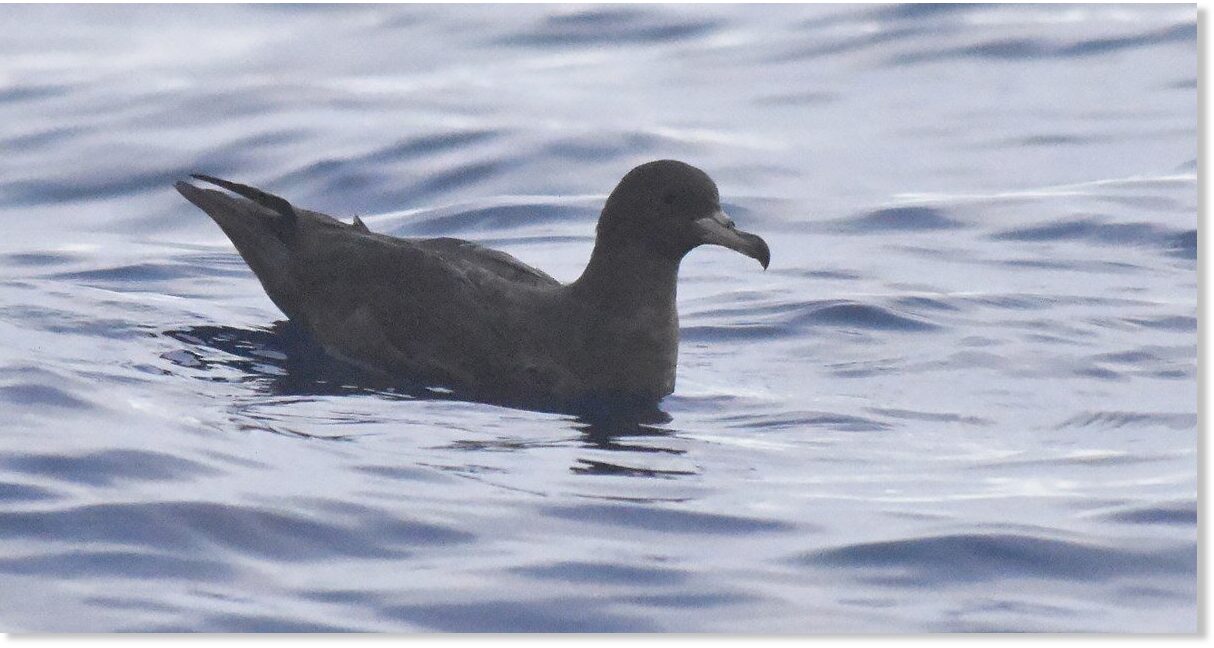
© Susana SimiãoIn the swimming images, the uniform dark brown colour and greyish bill with dark tip are visible, as is the bird's smaller size than Cory's Shearwater.
I work as a marine biologist and nature guide for a whale-watching company, Espaço Talassa, which is based at Lajes do Pico, Azores. On one of our whale-watching tours, on 7 August 2020, late in the afternoon, one of our crew members noticed an anomalous-coloured shearwater sitting in the water, in a raft of Cory's Shearwaters. They were close to a group of Atlantic Spotted Dolphins that we were watching, but the birds were not interacting directly with the dolphins.
The dark-coloured shearwaters or petrels that we regularly see in this area are Bulwer's Petrel and Sooty Shearwater. However, the bird was larger than a Bulwer's and showed a completely different bill and leg/foot colour to Sooty.
We approached the birds to try and identify what it was. It would let us approach, while the surrounding Cory's Shearwaters flew away, and we noted how when it flew it landed shortly after taking off, not far away (this being unusual behaviour for Cory's). At first we thought it could be a melanistic Cory's Shearwater, but it was noticeably smaller in size.

















Comment: See also:
- Gulf Stream is 15% weaker, region south of Greenland coldest in 1,000 years
- Scientists say a fluctuating jet stream may be causing extreme weather events
- Professor Valentina Zharkova explains and confirms why a "Super" Grand Solar Minimum is upon us
- Is the Gulf Stream about to collapse and is the new ice age coming sooner than scientists think?
- Extreme winter storms and wave heights have been increasing over the last 70 years in the Western Europe
- Mysterious, massive and deadly algae bloom 'whirlpool' discovered in the Baltic Sea
- Scientists warn of suffocating oceans as huge dead zones quadruple since 1950
And check out SOTT radio's: