
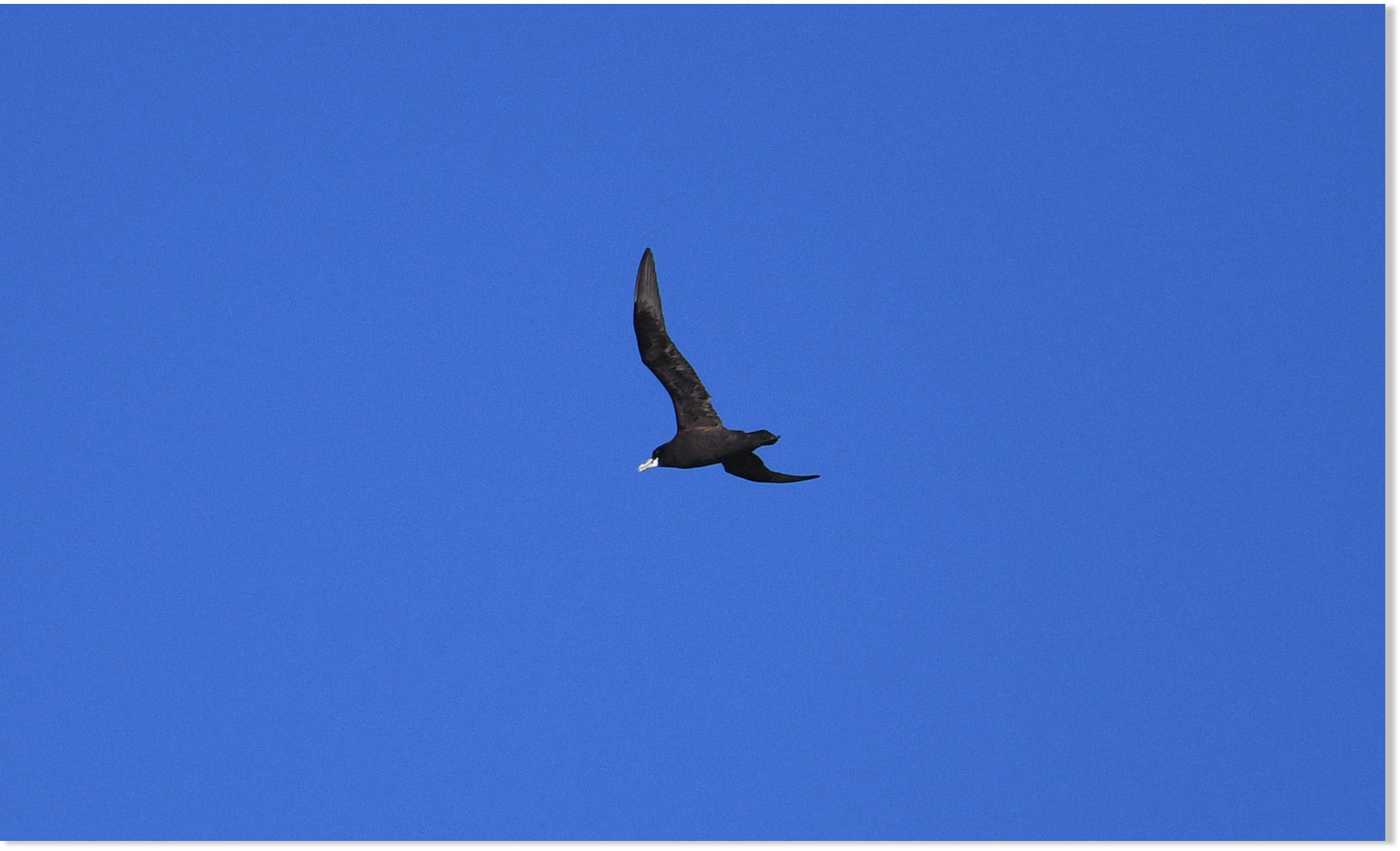
© Robert FoubisterRobert's excellent photos managed to capture the white 'chin' and silvery appearance to the primaries
A white beak was the first thing I noticed as being unusual - it was almost eagle-like - but I knew it wasn't bird of prey and more likely a skua of some description, so I decided to get some photos. The bird had first appeared at approximately 7.30 am along the east coast of Scapa Flow just below Gaitnip Farm and headed over Scapa Bay, to the west coast of the flow, and up over Lingro Farm where it gained height, circling above the fields in an almost Common Buzzard-like manner.
As I was watching it I started thinking that it was something different to normal, as it had an unusual wingbeat and flying style (almost reminscent of an owl!) and a white beak and black body with long wings. What was this? The bird then started to head east again back over Scapa Bay, before flying up over the hill towards the airport. That was the last I saw of it.
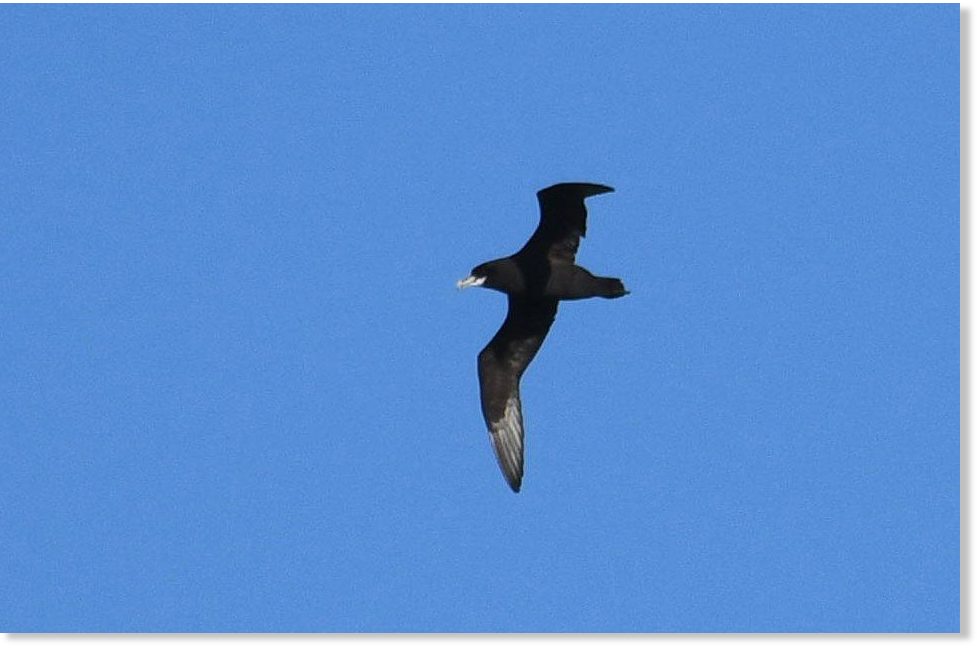
© Robert FoubisterThere is only one previous record of White-chinned Petrel in the North Atlantic – a bird off Maine, United States, on 24 August 2010
This flight path was basically a criss-cross of the bay while heading north and using the wind to ride west or east. The flying motion was more of a glide, as it used the wind and only really beat its wings when climbing to get height to glide back in the opposite direction. It was only viewable for a couple of minutes as it took no time for it to glide west then back east. It looked like it was scanning the sea as it went.
After reviewing one of the photos on my camera I began to wonder if it was just a skua, due to the tail shape. I thought it could wait until later and so I carried on with my walk, where I was lucky to find a Golden Oriole an hour or so later. At the time I thought this was the main find of the my morning - how wrong was that!
Once I got home, I put the oriole pictures on a local birding group on Facebook and thought I will just add the 'other' bird, just in case. Within a few minutes a couple of the local guys - Alan Leitch and Paul Higson - were asking what on earth it was! Word soon spread and it was swiftly identified as a White-chinned Petrel. A big thanks goes to them and everyone else for recognising the species and getting the news out.
I never expected to find something like this, so it just goes to show that keeping your eyes open and taking a photo of anything unusual just in case is a good idea. It's also great to get the first UK and Western Palearctic sighting of White-chinned Petrel, especially in Orkney, as there are so many keen wildlife enthusiasts living here who inspire others to get out there to see what they can find.
Stats & facts
White-chinned Petrel is a distinctive seabird of the Southern Ocean, normally ranging only as far north as southern Australia, Namibia and Peru. There are no previous Western Palearctic records, but a single documented sighting from the Atlantic coast of North America concerns a bird photographed from a boat off Bar Harbour, Maine, USA, on 24 August 2010.




Or, perhaps, we've got a dyslexic petrel?
RC