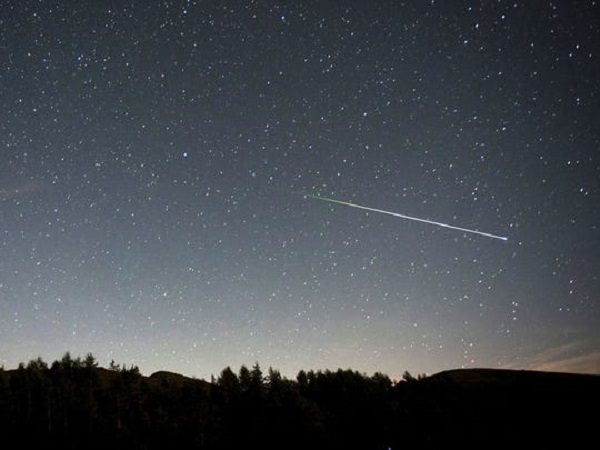
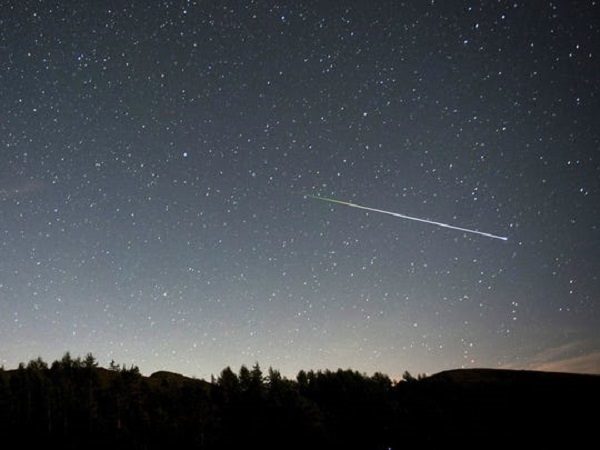
© Pedro Puente Hoyos, European Pressphoto Agency)A meteorite burns up in the atmosphere above San Miguel de Aguayo village, in Cantabria, northwest Spain.
Every day, about 100 metric tons of
space debris falls onto Earth. That includes pieces of asteroids, comets or other extra-terrestrial material raining down on our planet. The larger ones, you can see as shooting stars or meteors streaking across the nighttime sky. Once they hit Earth, they're called meteorites.
Tons of falling space rocks sounds really scary, but how many people are struck and killed by meteorites each year? In the last 100 years? The answer to both questions is zero.
In fact, there is only one case of a human being hit by a meteorite in the 20th and 21st centuries - and she lived! The unlucky victim was Ann Hodges of Sylacauga, Alabama. In 1954, she was lying on the couch taking a nap when a softball-sized rock broke through the roof, punched through the ceiling, bounced off her radio, and hit her on her left side. Despite minor injuries and one heck of a bruise, Hodges lived to tell the tale. The space rock, now known as the Hodges Meteorite, is owned by the Smithsonian Institution.
Murderous Meteorites in HistoryMay 1, 1860, New Concord, Ohio: Farmers around the area heard loud noises and witnessed meteorites raining down from the sky.
This was one of the most widely witnessed meteorite falls in history and people immediately crowded around the many impacting rocks. When they dug them out of the ground, they still felt warm to the touch. A rumor started that one stray rock fell and killed a colt. Whether or not it's true, the New Concord Meteorite is still known as the "Colt Killer."
Comment: The number of meteors falling to Earth is
growing every day. The likelihood of them doing some serious damage is real. From a historical perspective, it's' nothing new. You can read a list of events throughout history in Laura Knight-Jadczyk's article,
Meteorites, Asteroids, and Comets: Damages, Disasters, Injuries, Deaths, and Very Close Calls. It's a long list!
NASA recognizes the threat is serious and is raising the alarm. NASA chief Jim Bridenstine
warned meteors that can destroy an entire state or country were a real threat:
Speaking at the Planetary Defense Conference in Washington, D.C., NASA Administrator Jim Bridenstine warned that the risk posed by meteor crashes was not being taken seriously.
"This is not about Hollywood, this is not about movies, this is about ultimately protecting the only planet we know right now to host life," he said.
Bridenstine pointed to the meteorite that exploded over the Russian city of Chelyabinsk in 2013, which had "30 times the energy of the atomic bomb at Hiroshima" and injured around 1,500 people. Just 16 hours after the crash, NASA detected an even larger object that approached the earth but did not land on it, he revealed.
"I wish I could tell you that these events are exceptionally unique, but they are not," Bridenstine said. "These events are not rare - they happen. It's up to us to make sure that we are characterizing, detecting, tracking all of the near-Earth objects that could be a threat to the world."
See also:














Comment: See also: