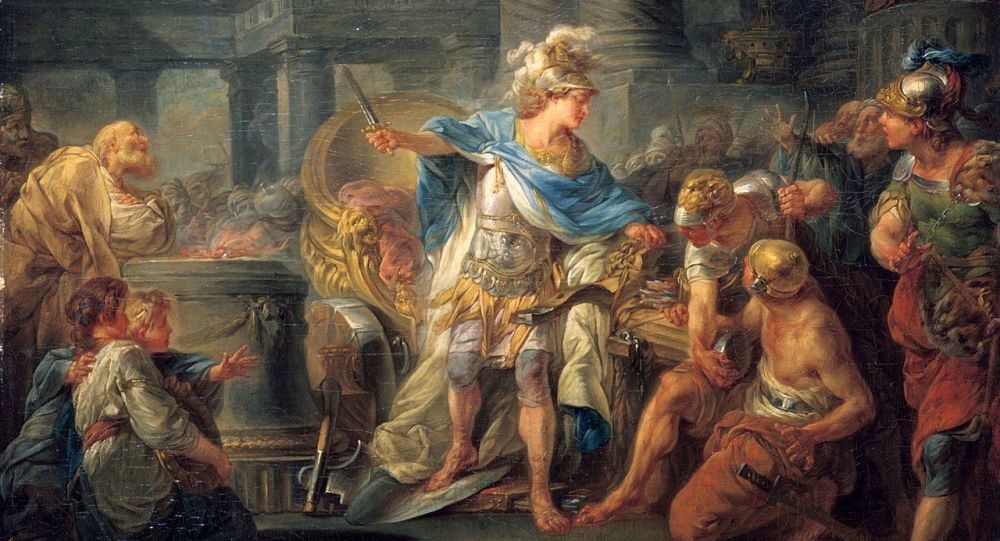
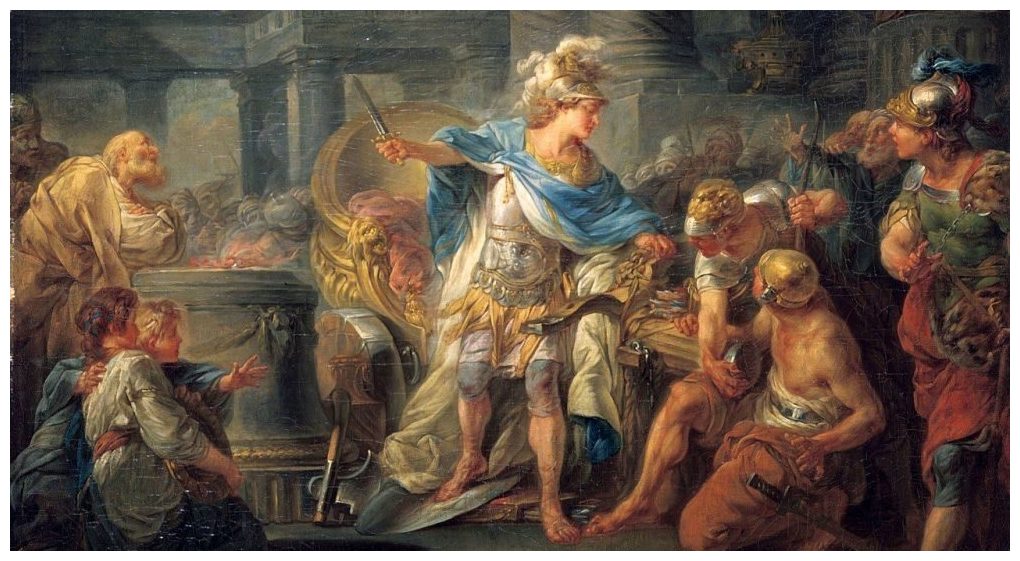
© CCOAlexander cuts the Gordian knot.
Between 334 and 323 BC, the great military commander and king of the ancient Greek kingdom of Macedon forged the largest empire in the ancient world, with his kingdom stretching from modern day Greece, Bulgaria and Turkey to Syria, Lebanon, Israel, Egypt, Iraq, Iran, India and much of Central Asia. And he did it all by his early 30s.
A team of researchers led by Dr. Thomas Gerasimidis of Aristotle University of Thessaloniki has completed nearly a quarter of a century of painstaking studies on the last days of Alexander the Great's life,
concluding that the conqueror died of pancreatic necrosis, and not malaria, typhoid fever or pneumonia, as previously thought, Sputnik Greece has reported.Dr. Gerasimidis, a veteran professor of medicine, began studying Alexander's final days in 1995, carefully analysing the symptoms experienced by the Macedonian king, as described by ancient historians including Arrian, considered one of the best sources on Alexander's campaigns, and others ranging from Ptolemy and Plutarch to Quintus Curtius. He called this approach "evidence-based medicine."












Comment: It would appear that trade throughout Europe and beyond was much more extensive than archeologists initially assumed: Beads found in Nordic grave reveal trade connections with Egypt 3,400 years ago
See also: