Secret HistoryS


Bullseye

Discovery of oldest bow and arrow technology in Eurasia

Fa-Hien Lena
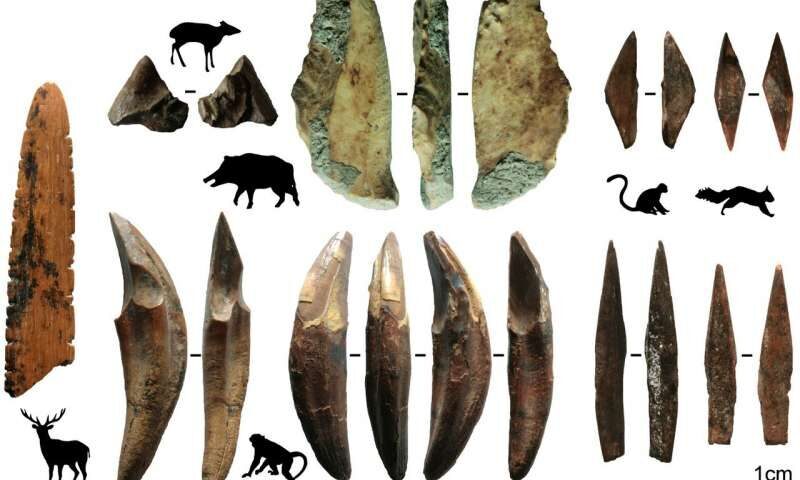
© Langley et al., 2020Fa-Hien Lena has emerged as one of South Asia's most important archaeological sites since the 1980s, preserving remains of our species, their tools, and their prey in a tropical context.
The origins of human innovation have traditionally been sought in the grasslands and coasts of Africa or the temperate environments of Europe. More extreme environments, such as the tropical rainforests of Asia, have been largely overlooked, despite their deep history of human occupation. A new study provides the earliest evidence for bow-and-arrow use, and perhaps the making of clothes, outside of Africa ~48-45,000 years ago, in the tropics of Sri Lanka.

The island of Sri Lanka in the Indian Ocean, just south of the Indian subcontinent, is home to the earliest fossils of our species, Homo sapiens, in South Asia. It also preserves clear evidence for human occupation and the use of tropical rainforest environments outside of Africa from ~48,000 to 3,000 years ago — refuting the idea that these supposedly resource-poor environments acted as barriers for migrating Pleistocene humans. The question as to exactly how humans obtained rainforest resources — including fast-moving food sources like monkeys and squirrels — remains unresolved.

Comment: See also:


Map

London's oldest theatre discovered in East End excavation

archaeologist
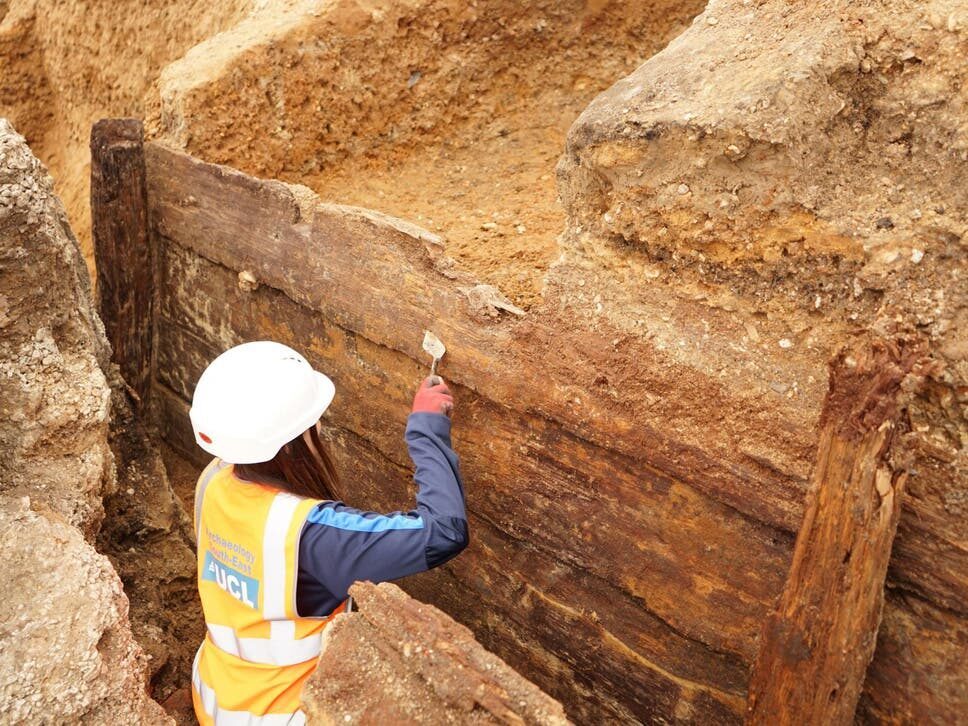
© PAAn archaeologist excavates the remarkably well-preserved timbers of the inner face of the theatres dog-fighting pit
Archaeologists have discovered London's oldest theatre - an Elizabethan playhouse constructed in the mid-16th century.

Known as the Red Lion, it represents a major "missing link" in the history of English drama.

In medieval, and indeed often in Tudor times, performances that were dominated by Biblical subject matter - while by the time of Shakespeare, many purely secular plays were being performed, often in purpose-built theatres. They were usually staged in inn courtyards and in university and other halls.

Comment: See also:


Magnify

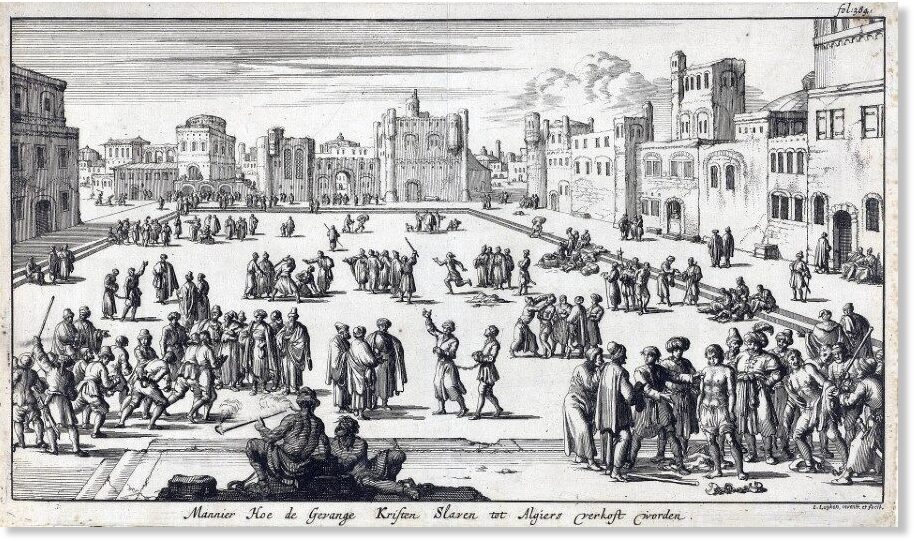
Whites were slaves in North Africa before blacks were slaves in the New World

Christian prisoners
© Jan Luyken, 1684Christian prisoners are sold as slaves on a square in Algiers
Things that used to be true before political correctness set in:

More whites were brought as slaves to North Africa than blacks brought as slaves to the United States

Before sending ignorant hate mail, consider these Wikipedia entries:
"The Barbary slave trade refers to the slave markets that were lucrative and vast on the Barbary Coast of North Africa, which included the Ottoman provinces of Algeria, Tunisia and Tripolitania and the independent sultanate of Morocco, between the 16th and middle of the 18th century. The Ottoman provinces in North Africa were nominally under Ottoman suzerainty, but in reality they were mostly autonomous. The North African slave markets were part of the Berber slave trade.

"Ohio State University history Professor Robert Davis describes the White Slave Trade as minimized by most modern historians in his book Christian Slaves, Muslim Masters: White Slavery in the Mediterranean, the Barbary Coast and Italy, 1500-1800. Davis estimates that 1 million to 1.25 million Europeans were enslaved in North Africa, from the beginning of the 16th century to the middle of the 18th, by slave traders from Tunis, Algiers, and Tripoli alone (these numbers do not include the European people who were enslaved by Morocco and by other raiders and traders of the Mediterranean Sea coast),[3] and roughly 700 Americans were held captive in this region as slaves between 1785 and 1815.[4]

Blue Planet

Por-Bajin: Insights into abandoned, 1,300 year old, Uyghur island complex in Siberia revealed by radiocarbon dating spikes

Por-Bajin
© Andrei PaninThis is an aerial view of Por-Bajin from the west. The complex is situated on an island in a lake. Scientists have pinned its construction on the year 777 CE, using a special carbon-14 dating technique, based on sudden spikes in the carbon-14 concentration
Dating archaeological objects precisely is difficult, even when using techniques such as radiocarbon dating. Using a recently developed method, based on the presence of sudden spikes in carbon-14 concentration, scientists at the University of Groningen, together with Russian colleagues, have pinned the date for the construction of an eighth-century complex in southern Siberia to a specific year. This allows archaeologists to finally understand the purpose for building the complex - and why it was never used. The results were published in Proceedings of the National Academy of Sciences.

The Por-Bajin complex, on the border of the Russian Federation and Mongolia, measures 215 x 162 metres and has outer walls of twelve metres high. All of the walls are made of clay (Por-Bajin translates as 'clay house') on a foundation of wooden beams. The complex was created by nomadic Uyghurs, sometime in the eighth century. But archaeologists did not know the purpose of the complex and why it appears to never have been used.

Comment: See also:


Palette

13,000 year old bird figurine is earliest Chinese artwork ever discovered

Henan
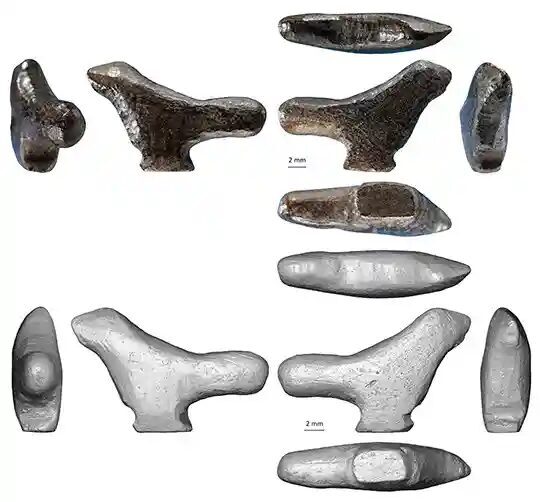
The bird statuette, photographed here from different angles, is made from burnt bone. The style suggests it is an original artistic tradition, separate from analogous western or Siberian art
A tiny figurine of a bird, carved from burnt bone and no bigger than a £1 coin, is the earliest Chinese artwork ever discovered, according to an international team of archaeologists.

The carving, less than 2cm in length, has been dated to the palaeolithic period, between 13,800 and 13,000 years ago, which pushes back the earliest known date of east Asian animal sculpture by more than eight millennia.

It was found at Lingjing in the Henan province of China, and takes the form of a bird standing on a pedestal, which researchers say indicates it may belong to an entirely original artistic tradition, unconnected to other ancient styles found in Europe or Siberia.

Comment: It's notable that the earliest known cave art discovered recently in Indonesia features depictions of humans and animals, including bird imagery:
The animals are being pursued by human-like figures with some animal features (academics call these therianthropes), who seem to be wielding long swords or ropes. Their bodies are human-shaped but one appears to have the head of a bird and another has a tail.
See also: Also check out SOTT radio's:


Sherlock

Best of the Web: The youth of China were the enforcers of Mao's cultural revolution

maoists
"Nobody is more dangerous than he who imagines himself pure in heart," wrote James Baldwin, "for his purity, by definition, is unassailable." This observation has been confirmed many times throughout history. However, China's Cultural Revolution offers perhaps the starkest illustration of just how dangerous the "pure in heart" can be. The ideological justification for the revolution was to purge the Chinese Communist Party (CCP), and the nation more broadly, of impure elements hidden in its midst: capitalists, counter-revolutionaries, and "representatives of the bourgeoisie." To that end, Mao Zedong activated China's youth — unblemished and uncorrupted in heart and mind — to lead the struggle for purity. Christened the "Red Guards," they were placed at the vanguard of a revolution that was, in truth, a cynical effort by Mao to reassert his waning power in the Party. Nevertheless, it set in motion a self-destructive force of almost unimaginable depravity.

The Cultural Revolution commenced in spirit when Mao published a letter indicting a number of Party leaders on May 16, 1966. But it was a seemingly minor event nine days later that ignited the revolution in effect: a young philosophy professor at Peking University named Nie Yuanzi placed a "big-character poster" (a handwritten propaganda sheet featuring large Chinese characters) on a public bulletin board denouncing the university president and others in the administration as bourgeois revisionists. Mao immediately endorsed her protest, which set off a chain reaction of student revolt that swept through China.

Satellite

Complete map of Roman city revealed by radar for first time

Roman
© L Verdonck/PAGround-penetrating radar image of newly-discovered temple in the Roman city of Falerii Novi, Italy
Archaeologists have mapped a complete Roman city for the first time using ground-penetrating radar, revealing highly detailed images that they say could revolutionise our understanding of how such sites worked.

As well as a bath house, theatre, shops and several temples, the team from the universities of Cambridge and Ghent have discovered a large public monument of a kind never seen before, which may relate to the religious practices of the people who lived in the area before the Romans.

The detailed scanning of the town of Falerii Novi, just over 30 miles (50km) north of Rome, has uncovered the layout of the city's water system, offering new clues to how it was planned and laid out.

Comment: See also:


Magnify

The CIA Coup against 'The Most Loyal' Ally' is history's warning in 2020

Gough Whitlam
© Unknown
The Australian High Court has ruled that correspondence between the Queen and the Governor-General of Australia, her viceroy in the former British colony, is no longer "personal" and the property of Buckingham Palace. Why does this matter?

Secret letters written in 1975 by the Queen and her man in Canberra, Sir John Kerr, can now be released by the National Archives - if the Australian establishment allows it. On November 11, 1975, Kerr infamously sacked the reformist government of prime minister Gough Whitlam, and delivered Australia into the hands of the United States.

Today, Australia is a vassal state bar none: its politics, intelligence agencies, military and much of its media are integrated into Washington's "sphere of dominance" and war plans. In Donald Trump's current provocations of China, the US bases in Australia are described as the "tip of the spear".

Comment: See also from 2014: Prime minister Whitlam and Australia's forgotten US coup against him


Blue Planet

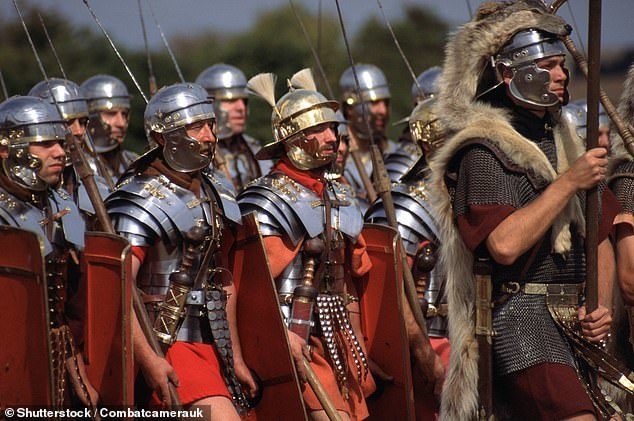
Saxons did not invade Britain after Romans left

Romans
Romans occupied England for hundreds of years after their invasion in the first century BC (pictured). After this Empire fell, it was thought Saxons invaded Britain in the 5th century. However, one expert claims this is a myth
The 'Anglo-Saxon era' that is widely believed to have followed the withdrawal of the Romans from Britain in 410AD may have never existed, according to a University of Cambridge expert.

Schools teach that, after Romans left Britain, Britain was invaded and colonised by a throng of German-speaking barbarians from Europe, known as the Saxons.

This, common wisdom dictates, then gave birth to the so-called Anglo-Saxon era which endured in some guise until the Norman conquest of 1066.

This theory is based on the prevalence of German-based languages and questionable interpretations of historical records.

However, Professor Susan Oosthuizen believes the invasion and colonisation, which is thought to have occurred in the 5th century, never happened.


Comment: As noted in the link above, the island experienced cataclysmic events in the period that followed the Roman departure, and it's likely these depopulation events were the primary driver of the eventual shift in demographics in the country. In Meteorites, Asteroids, and Comets: Damages, Disasters, Injuries, Deaths, and Very Close Call s Laura Knight-Jadczyk writes:
Until that point in time, the Britons had held control of post-Roman Britain, keeping the Anglo-Saxons isolated and suppressed. After the Romans were gone, the Britons maintained the status quo, living in towns, with elected officials, and carrying on trade with the empire. After AD 536, the year reported as the "death of Arthur", the Britons, the ancient Cymric empire that at one time had stretched from Cornwall in the south to Strathclyde in the north, all but disappeared, and were replaced by Anglo-Saxons. There is much debate among scholars as to whether the Anglo-Saxons killed all of the Britons, or assimilated them. Here we must consider that they were victims of possibly many overhead cometary explosions which wiped out most of the population of Europe, plunging it into the Dark Ages which were, apparently, really DARK, atmospherically speaking.

[...]

Gildas, who was writing at approximately 540 AD, says that the island of Britain was on fire from sea to sea " ... until it had burned almost the whole surface of the island and was licking the western ocean with its fierce red tongue."[5] . In "The Life of St. Teilo" contained in the Llandaf Charters, of St. Teilo, who had recently been made Bishop of Llandaf Cathedral in Morganwg, South Wales, it says:

" ... however he could not long remain, on account of the pestilence which nearly destroyed the whole nation. It was called the Yellow Pestilence, because it occasioned all persons who were seized by it to be yellow and without blood, and it appeared to men a column of a watery cloud, having one end trailing along the ground, and the other above, proceeding in the air, and passing through the whole country like a shower going through the bottom of valleys. Whatever living creatures it touched with its pestiferous blast, either immediately died, or sickened for death ... and so greatly did the aforesaid destruction rage throughout the nation, that it caused the country to be nearly deserted".
See also:


Sherlock

The Sword of Damocles over Western Europe: Follow the trail of blood and oil

obama killer
In Part 1, we left off in our story at the SIS-CIA overthrow of Iran's Nationalist leader Mohammad Mosaddegh in 1953. At this point the Shah was able to return to Iran from Rome and British-backed Fazlollah Zahedi, who played a leading role in the coup, replaced Mosaddegh as Prime Minister of Iran.

Here we will resume our story.

An Introduction to the 'Shah of Shahs', 'King of Kings'

One important thing to know about Mohammad Reza Shah was that he was no fan of British imperialism and was an advocate for Iran's independence and industrial growth. That said, the Shah was a deeply flawed man who lacked the steadfastness to secure such a positive fate for Iran. After all, foreign-led coups had become quite common in Iran at that point.

He would become the Shah in 1941 at the age of 22, after the British forced his father Reza Shah into exile. By then, Persia had already experienced 70 years of British imperialism reducing its people to near destitution.