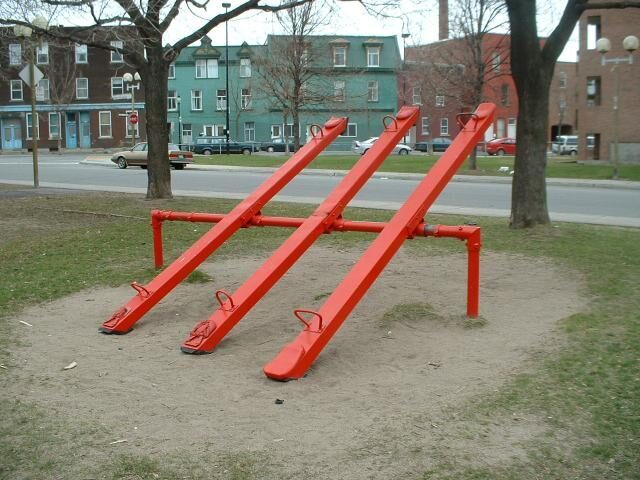
About a decade ago, toddler son in tow, I found myself in a playground for the first time in 35 years. It was not what I remembered. The colors were far more vibrant. Plastic had replaced wood and metal. Sharp edges had been rounded, chains and hinges softened. Cushioned ground had replaced the asphalt.
What struck me most, however, was that it was full of adults. It seemed that every child had a minder within arms length. I was perplexed. I knew why I was there — my son was still a bit wobbly. Many of the kids appeared to be about 6-8 years old. Why did they need minders?
I soon learned the two cardinal rules of contemporary playgrounds (or at the very least, playgrounds on Manhattan's Upper West Side):
One, your child may not get hurt. Two, your child may not hurt another child. Violate the first rule, and you're negligent. Violate the second and you're antisocial — borderline criminal. Also, and just for good measure, "hurt" is given the broadest possible definition to include potentially hurtful language.The stories about fragile college snowflakes crumbling in the face of microaggressions and provocative ideas suddenly made sense. Children raised in a cocoon will demand similar protection when they begin to think of themselves as adults.
That initial shock was hardly the end of my education. I soon learned the corollary to the playground rules: Today's children never learn to engage in disintermediated play. The natural, if often rough, society of 3-to-5 years olds never gets to form. When my son hit that age, I was stunned to have other kids approach me to report that he was being annoying. When I was a child, running to a parent was the equivalent of a 911 call. We might have approached with a message like "your kid is bleeding" or "we think he broke something," but annoying? That was like calling the Fire Department because you couldn't find the remote.





















Comment: It is in the nature of evil to destroy beauty: