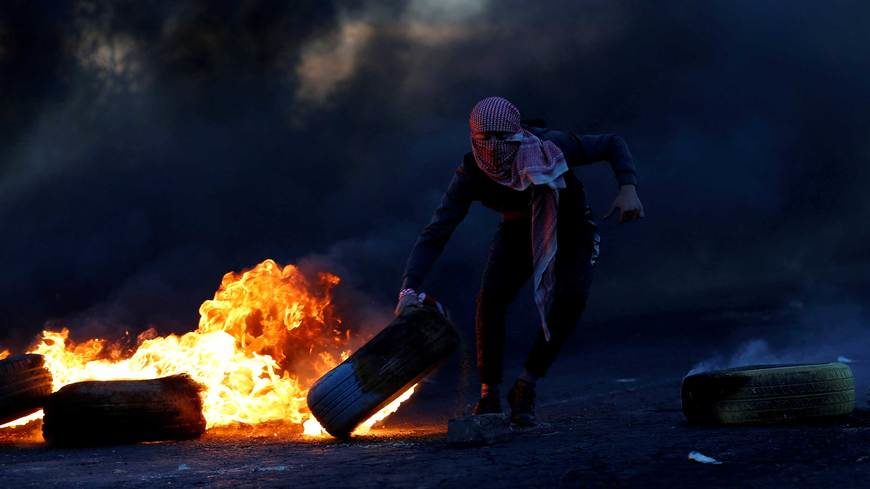
© REUTERS/Mohamad TorokmanRamallah, Dec. 9, 2017
Leaders of Islamic countries have called for East Jerusalem to be recognized as the capital of Palestine, stating that Donald Trump's move last week had voided the status of the US as a mediator in the Palestinian-Israeli peace process.
The Muslim leaders had gathered in Istanbul, Turkey on Wednesday for an emergency summit of the Organization of Islamic Cooperation (OIC). They condemned the US decision to recognize Jerusalem as the capital of Israel. The controversial move was branded "an attack" on the rights of Palestinian people in the final declaration by the summit.
The declaration states that the US decision on Jerusalem is
equivalent to its withdrawal from the Israeli-Palestinian peace process, NTV broadcaster reported. In its final declaration,
the OIC formally recognized East Jerusalem as the capital of Palestine, according to the broadcaster.
"The US administration should give up its role in the peace process, and if the US does not step back, it will be responsible for all the consequences," the declaration states, as
quoted by NTV.
The organization promised to take the discussion on Trump's Jerusalem move to the UN General Assembly if the UN Security Council fails to take any action.
Comment: Arab leaders - including those who have previously signed agreements with Israel - are also
planning responses:
In Jordan, the lower house of parliament has decided unanimously to carry out a comprehensive review of the various agreements signed with Israel. Khalil Attiyeh, the deputy speaker of the Jordanian parliament, initiated the bill to review Jordan's agreements with Israel. He told Al-Monitor that the parliament had to act big. "When the issue is as big as Jerusalem, the reaction has to be at the same level."
The Jordanian parliamentary bill introduced by Attiyeh calls on the judiciary committee to review all agreements signed with Israel and "to list all violations to the agreements, providing suggestions about them in light of Israeli violations of international agreements."
...
Leading Arab commentator Oraib al-Rantawi, writing in Jordan's Ad-Dustour paper, said that in light of the popular anger in the entire region, Arab governments have only one choice: "To ride the wave and to be as quiet about actions as possible until the ominous month of December is over."
Rantawi hinted in the same article that after the wave passes, Arab leaders will return to the need for "realism" and will come back to the US mediator. Being "quiet" means that no major decisions should be made.
Meanwhile, in Egypt, widespread protests have made it impossible for Abdel Fattah al-Sisi's administration not to take a strong stand. On Dec. 9, Cairo hosted an emergency meeting of the Arab League, which all foreign ministers of Arab countries, including the feuding Gulf countries, attended.
The Arab League adopted a 16-point resolution rejecting the US decision and calling on all countries to recognize Palestine based on the June 4, 1967, borders. Iraqi Foreign Minister Ibrahim al-Jaafari argued that the decision didn't go far enough, and called for even tougher diplomatic measures to be taken, a possible hint to the countries who have peace agreements with Israel.
The OIC's full statement can be read
here. Erdogan is this years chairman for the OIC. During his speech, he
went on the offensive, showing maps of regions illegally occupied by Israel, calling Israel a child-murderer and terrorist state, criticizing Israel's rogue nuclear weapons program... Iran's President Rouhani even
extended an olive branch of sorts to Saudi Arabia, saying Iran "is willing to cooperate with ALL MUSLIM COUNTRIES over defending Al-Quds without any precondition." Now it just remains to be seen how united the OIC nations can remain.
As
Andrew Korybko points out, this is the perfect move for Russia to step in as a facilitator:
By doing what he did, Trump compelled the OIC to respond by reaffirming many of its members' existing positions in recognizing East Jerusalem as the capital of the State of Palestine, which implies the existence of a West Jerusalem that could potentially be the capital of Israel following its formal recognition by the Ummah after a peace settlement is eventually reached. This holds remarkable implications because it creates the conditions for moving the peace process forward, as all of the OIC's member states just agreed to acknowledge the pre-1967 division of Jerusalem prior to Israel's full and illegal occupation of its entirety.
...Even in the unlikely possibility that this was part of a "master plan" by the US to restart the peace process, which it doesn't seem to have genuinely been in any case, it's certainly not unfolding as Washington may have wanted.
The OIC also declared in its joint statement that the US is no longer welcome to participate in negotiations over the two-state solution unless Trump reverses his decision, which isn't likely given his personal predisposition and disinclination to publicly appear as though he's backing down over anything, let alone a demand issued by a group of Muslim countries. That, however, opens up an historic window of opportunity for Russia to step in and take the role in leading this process instead, seeing as how it enjoys excellent relations with both Israel and the Ummah.
It also shouldn't be forgotten that the Russian Ministry of Foreign Affairs declared in April of this year that it will recognize West Jerusalem as Israel's capital so long as East Jerusalem is made the capital of a future Palestinian state. Seeing as how the OIC implicitly agreed to this through its joint statement without directly saying as much, the door is now open for Russia to replace the lost American role in leading the two-state solution by "balancing" between both competing parties and helping to breathe new life into this stalled process.
Trump injecting a little bit of that "Art of the Deal" chaos seems to have opened up a bunch of possibilities:









Comment: There is one name missing from the article that should always be mentioned when discussing the influence of the Israel lobby on the Trump administration: Jared Kushner.