OF THE
TIMES
"In recognition of his recent actions in support of democracy and the rule of law, I'm announcing today that the United States of American is removing all sanctions on General Manuel Cristopher Figuera effective immediately."The US Treasury Department's Office of Foreign Assets Control (OFAC) designated Figuera on 15 February under the heading current or former official in the Maduro government. The Treasury Department said in a statement on Tuesday that the decision to remove all of Figuera's sanctions demonstrates Washington's intent to bring a positive change of behavior through sanctions.
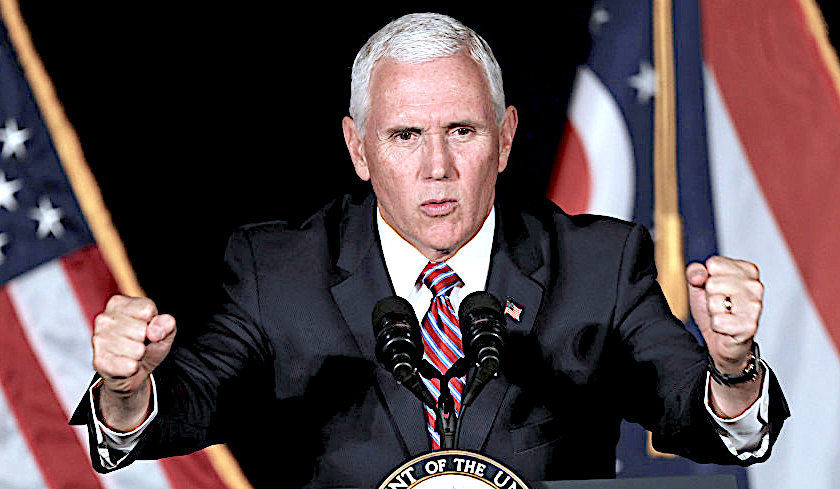
"It is time for the Supreme Court in Venezuela to return to its founding purpose. If the Supreme Court of Venezuela does not return to its constitutional mandate to uphold the rule of law, the United States of America will hold all 25 of its magistrates accountable for their actions".Pence said the Venezuelan Supreme Court has undermined its constitutional mandate and become a political tool.
A joint statement issued Thursday by the EU and Foreign Ministers of France, Germany and the UK reaffirmed their collective commitment to the Iran deal. It also strongly hints that potential US intrusion on the issue is unwelcome.See also:
"We call on countries not party to the JCPOA to refrain from taking any actions that impede the remaining parties' ability to fully perform their commitments," the statement outlined.
On Wednesday, Tehran announced that it would no longer adhere fully to commitments made as part of the original nuclear deal with the P5+1 (the permanent members of the UN Security Council and Germany).
The EU statement comes after the Trump administration responded to Tehran by imposing a raft of new sanctions on entities trading in steel, iron, copper and aluminum and related products with Iran. The decision was taken exactly one year after the US withdrew from the Obama-era Iran deal.

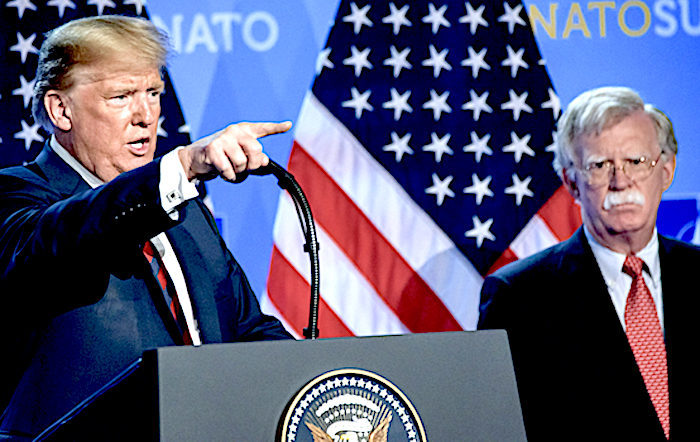
Is John Bolton about to get the Iran war he's always wanted, or is he on the verge of losing his job?There is an understandable desire to see Bolton and Trump sharply at odds over foreign policy, but I'm not sure why anyone thinks it is happening. In the L.A. Times article I cited earlier, there is a quote from former ambassador Christopher Hill where he says something similar:
Over the past several days, President Trump's national security adviser has made comments and issued statements about Iran and Venezuela that are usually reserved for the run-up to military campaigns.
Yet Bolton's boss doesn't seem to be playing along.
"The president is so dead set against military engagement anywhere, and Bolton is so dead set on military engagement, it has left the administration speaking without one voice and overall being sort of feckless."If Trump and Bolton disagreed with each other this much, it is difficult to explain why Bolton is still allowed to have free rein in making the administration's foreign policy.

Attorney General William Barr is facing a second House subpoena, this one from intelligence committee chair Adam Schiff, as Democrats double down on their quest for the unredacted Mueller report and the evidence behind it.
Barr's Justice Department "has repeatedly failed to respond, refused to schedule any testimony, and provided no documents responsive to our legitimate and duly authorized oversight activities," Schiff said in a statement on Wednesday.
Schiff's subpoena follows on the heels of the House Judiciary Committee's decision to hold Barr in contempt for refusing to provide an unredacted copy of the special counsel's report in response to committee chair Jerrold Nadler's own subpoena, issued last month after the release of the (redacted) Mueller report failed to satisfy impeachment-hungry Democrats. The full House will vote on whether to refer Barr's contempt charge to the US Attorney for the District of Columbia, who would decide on prosecution.
Barr has until May 15 to produce documents related to the Mueller probe for the Intel Committee. President Donald Trump invoked executive privilege over the unredacted report and the materials behind it on Wednesday morning, calling Nadler's subpoena a "blatant abuse of power," prompting the charges against Barr.
The Justice Department did offer select lawmakers the option to look at a less-redacted version of the report in a secure location, but only Republicans took the offer. Nadler, meanwhile, denounced the president's stonewalling as an "assertion of tyrannical power" and a "constitutional crisis."
Last week, Barr opened an investigation into allegations the FBI and Justice Department spied on Trump's campaign in 2016, hinting in his announcement that he was targeting senior figures in both agencies and planned to concentrate on when intelligence collection had begun and how many spies the FBI had inside the campaign. The probe is in addition to Justice Department Inspector General Michael Horowitz's own investigation into the legality of the FISA warrant used to surveil Trump aide Carter Page, which is expected to conclude next month.
With no proof of collusion or obstruction to be found in the 90 percent of the Mueller report currently available for the public to read, House Democrats are hoping the last 10 percent holds the "roadmap to obstruction" that will pry Trump out of the White House once and for all. Barr, who redacted the document in cooperation with Special Counsel Robert Mueller, says the redactions were necessary to avoid interfering with ongoing criminal cases or revealing investigative techniques, as well as to protect grand jury testimony and the privacy of tangentially-related individuals.
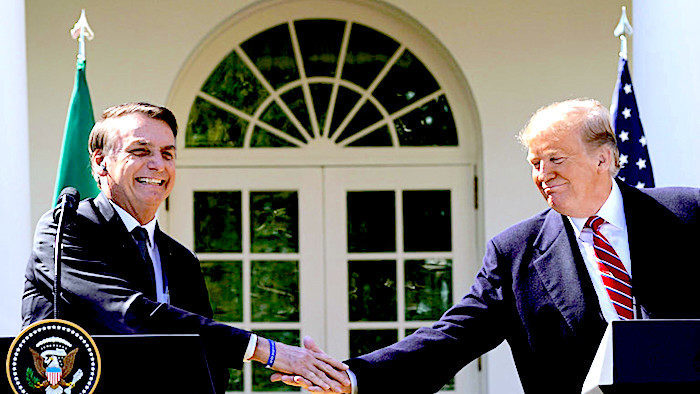
Comment: See also: Trump: US strongly looking at Brazil for NATO membership