Science & TechnologyS


Flashlight

Massive sinkhole in forest leads to discovery of "world class" cave complex in China

China sinkhole caves
© Euronews/YouTube
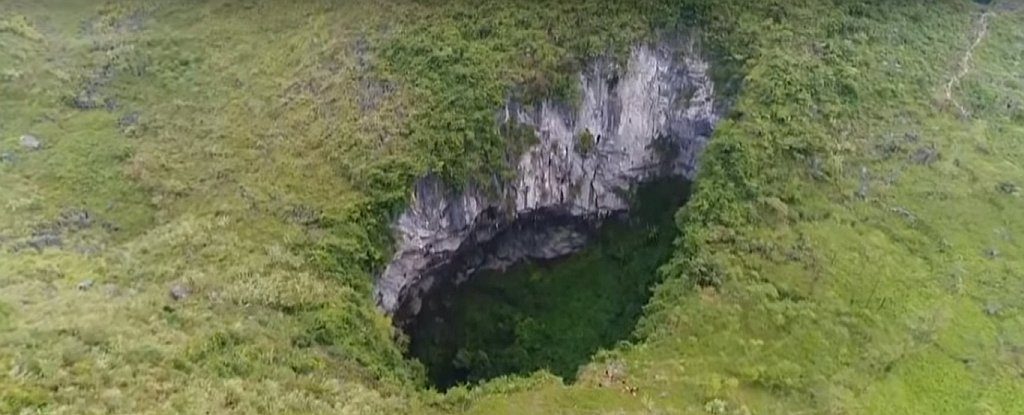
An expedition to explore a giant sinkhole in the forest of Guangxi, China has resulted in the discovery of a tremendous cave hall complex under the ground.

At 6.7 million cubic metres (236 million cubic feet), the cave's volume is of a rare enormity, making it 'world class,' geological experts are reported as saying.

The expedition was a joint venture between China and the UK, led by Zhang Yuanhai of the Institute of Karst Geology of the Chinese Academy of Geological Sciences, and British Caving Association chairman Andy Eavis.

From 4 to 8 October, the 19-member team lowered themselves into the tiankeng - the Chinese name given to this type of unusually large sinkhole - using just a single rope. Once inside, they set about mapping the interior.

Comment: See also:


Binoculars

Huge unexplored cave discovered in British Columbia, Canada

cave BC canada
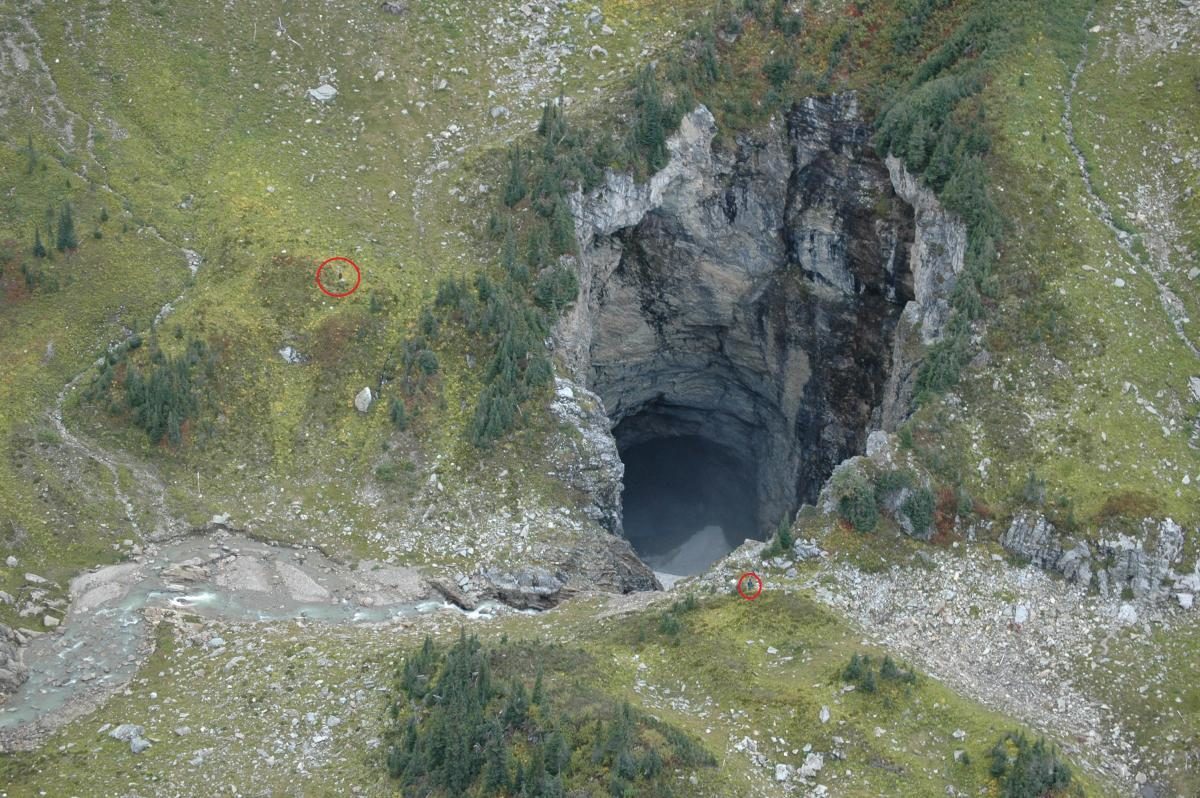
© Catherine HicksonThe entrance to the massive cave that was spotted earlier this year in British Columbia's Wells Gray Provincial Park. Two members of the Canadian team that conducted a preliminary exploration of the site in September are circled in red to give an idea of the size of the entrance of the cave, which measures 100 metres long by 60 metres wide.
A massive pit that was spotted in a remote high alpine valley in British Columbia's Wells Gray Provincial Park earlier this year is the entrance to a previously unexplored cave of "national significance," say two members of a Canadian team that helped conduct a preliminary exploration of the site in September.

The cave "has a number of features that when combined indicate a cave of national significance" and constitutes "a major new find in Western Canada, and promises a dramatic new chapter in the story of Canadian cave exploration," say John Pollack and Chas Yonge in a document they co-wrote that summarizes the significance of the find.

Pollack, who is a archeological surveyor, further explained the significance of the cave in an exclusive interview with Canadian Geographic. "I've been in some of the biggest caves in the world, and this thing has an entrance that is truly immense, and not just by Canadian standards," he said. "The opening is 100 metres long by 60 metres wide, and when you're standing on the edge looking down into it, your line of sight is nearly 600 feet [183 metres]. You don't get lines of sight of 600 feet in Canadian caves - it just doesn't happen. And this is a shaft. It goes down quite precipitously, it had a large amount of water flowing into it and is wide open for as far down it that we've gone. The scale of this thing is just huge, and about as big as they come in Canada."

Comment: Discoveries like these are a good reminder that there are vast areas of our planet we have yet to explore:


Cow

Skeleton of extinct sea cow unearthed on remote Russian Island

siberia sea cow
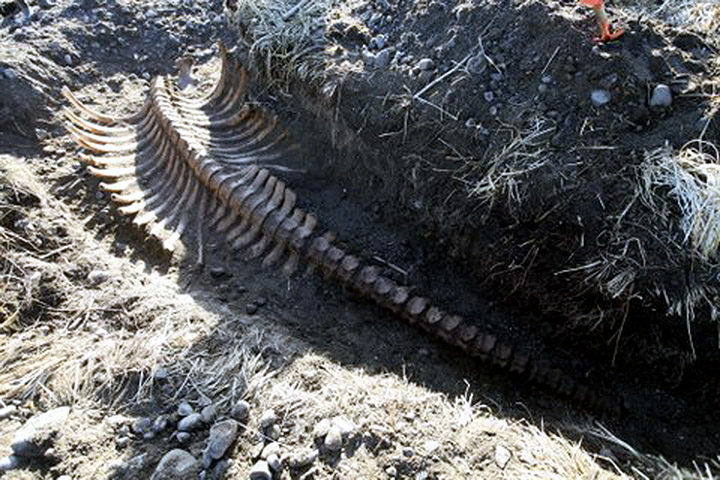
© Evgeny MamaevA precious find at the Commanders (Komandory) islands just off Kamchatka peninsula.
Skeleton of extinct 6 metre-long sea cow spotted and dug up on seashore of Commander Islands in Kamchatka region.

The headless remains of the beast at first appeared like a 'fence' but local officials on a nature reserve survey soon realised they had made a remarkable find - the ribs of this ancient creature.

Digging down 70 centimetres below the surface uncovered the headless skeleton of the Steller's sea cow, a mammal endemic to this region which became extinct in the 18th century.

Comment: Siberia is proving to be a treasure trove for archaeological finds:


Solar Flares

Space weather and the very real risks the Sun poses to Earth

space weather
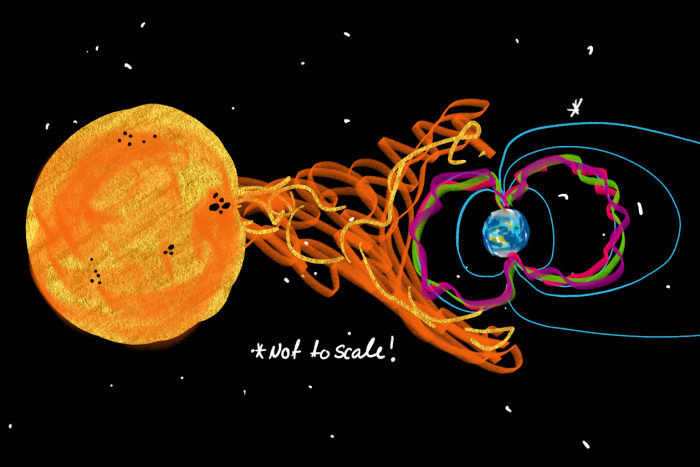
© ABC Weather: Kate DoyleThe Sun is far away but has the potential to strike at systems we take for granted.
During the depths of the Vietnam War a series of American mines exploded, apparently without cause. No ships were in the area to trigger them and espionage was ruled out.

The official explanation reads like a science-fiction novel: a cloud of plasma ejected from the Sun collided with and compressed Earth's magnetic field, causing the spontaneous explosions.

A recent research paper has reconfirmed the long-held suspicions that space weather was to blame.


And according to Dr Richard Marshall from the Bureau of Meteorology's space weather team, who wasn't part of the study, the results are far from fictional.

So how does space weather work and what are the potential consequences for our increasingly tech-dependent world?

Dr Marshall says the Vietnam incident wasn't the first time space weather impacted Earth and it won't be the last.

Comment: New Executive Order points to devastating space event, unprecedented government response - and public's lack of preparedness

While 'space weather events' do in fact present the dangers presented here, and may quite probably occur, it seems just as likely that 'space weather events' has become a euphemistic description for the destruction caused by neo's, meteors, comets, etc. - which have their own electrical properties. Whatever the case, being prepared for such an eventuality (and others in the offing) seems like a very good idea!

See also:


Cassiopaea

New supernova discovered in the M77 galaxy

Supernova in M77
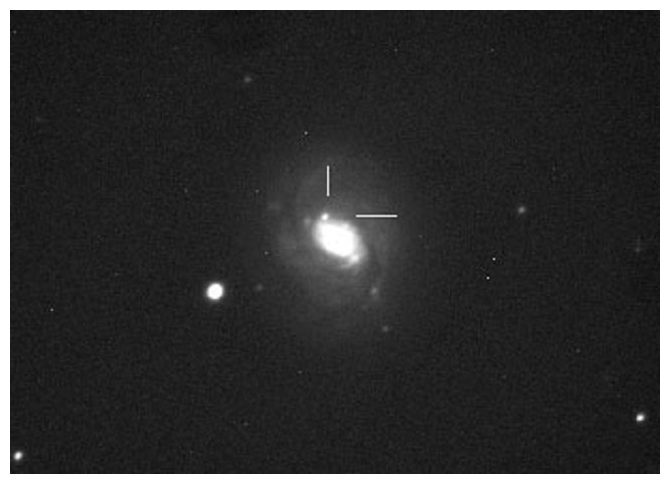
© Koichi ItagakiNew supernova 2018 ivc recently appeared in the bright Messier galaxy M77 located in Cetus at R.A. 2h 42′ 41″, Dec. -00° 00′ 48″. The object is northeast of the core along the edge of the bright inner disk.
On November 24th, the DLT40 Survey picked up a 15th magnitude supernova in M77, a bright, barred spiral galaxy in Cetus located 50′ southeast of 4th magnitude Delta Ceti. Whenever a supernova is discovered in a Messier galaxy, I get excited. Messiers are among the closer and brighter galaxies and often host supernovae visible in smaller telescopes.

With an apparent magnitude of 9.6, M77 is easy to find in telescopes as small as 3 inches though a 10-inch or larger scope will be needed to ferret out this supernova - at least at the moment.

Designated 2018 ivc, the new supernova has brightened to about magnitude 14.5 and appears as a tiny pinprick of light 8.7″ east and 16.1″ north of the center of the galaxy along the edge of the bright inner disk. Spectroscopy reveals the "new star" as a Type II supernova in its early stages, implying that the object could brighten further. Not to throw water on the fire, but intervening dust within the galaxy has dimmed and reddened the explosion, so it's difficult to predict how bright it might become. One outlier observation from November 25th put it at about magnitude 13.6.

Comet 2

Newly discovered supernova complicates origin story theories

Supernova ASASSN-18bt
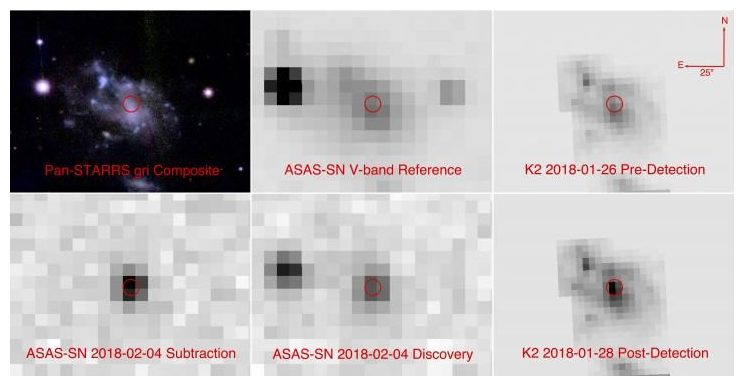
© Carnegie Institution for ScienceSix images showing the host galaxy of the newly discovered supernova ASASSN-18bt. The top row shows three images from before the explosion taken by Pan-STARRS, ASAS-SN, and Kepler. The bottom row shows images from ASAS-SN and Kepler after the supernova was visible. The discovery image from the ASAS-SN team is in the bottom middle. To its left is a version with all the surrounding stars eliminated, showing only the new supernova’s light output. On the bottom right is a Kepler image from after the supernova was detected. Kepler’s precision was crucial to understanding the light from ASASSN-18bt in the early hours after the explosion.
Pasadena, CA - A supernova discovered by an international group of astronomers including Carnegie's Tom Holoien and Maria Drout, and led by University of Hawaii's Ben Shappee, provides an unprecedented look at the first moments of a violent stellar explosion. The light from the explosion's first hours showed an unexpected pattern, which Carnegie's Anthony Piro analyzed to reveal that the genesis of these phenomena is even more mysterious than previously thought.

Their findings are published in a trio of papers in The Astrophysical Journal and The Astrophysical Journal Letters. (You can read them here, here, and here.)

Type Ia supernovae are fundamental to our understanding of the cosmos. Their nuclear furnaces are crucial for generating many of the elements around us, and they are used as cosmic rulers to measure distances across the universe. Despite their importance, the actual mechanism that triggers a Type Ia supernova explosion has remained elusive for decades.

That's why catching them in the act is crucial.

Astronomers have long tried to get detailed data at the initial moments of these explosions, with the hope of figuring out how these phenomena are triggered. This finally happened in February of this year with the discovery of a Type Ia supernova called ASASSN-18bt (also known as SN 2018oh).

Arrow Up

Crimea: Russia aims to build new state-of-the-art radar station boosting coverage of its southwest

Russian Radar systems
© Sputnik/Igor Zarembo • Wikipedia/mil.ru/L: Voronezh-class radar station seen in the region of Kaliningrad • R: Voronezh-M radar
Moscow is set to start building a new cutting-edge radar station in Crimea in place of a deprecated Soviet-era one. The facility will significantly boost Russia's capabilities in detecting and tracking missiles and other objects.

"The place and time for deployment of the new station is already set: its construction is expected to begin next year outside Sevastopol, where the old 'Dniepr' radar is located," chief designer of the missile attack early warning system, Sergey Boev, told Interfax, confirming long-rumored plans of construction of a Voronezh-class radar in Crimea.

The Dniepr station, which fell to the hands of Ukraine after the collapse of the Soviet Union, had been leased to Russia for a period of time. The lease agreement, however, fell apart and the facility was abandoned for more than 10 years, decaying and ultimately becoming non-operational.

The new facility "will significantly surpass the Dniepr station, which covered, among others, the Middle East region and was able to 'see' launches of ballistic missiles up to 3,500 kilometers away," he added.

Rainbow

Siberian 'unicorn' lived at time of modern humans, wiped out by climate change

siberian unicorn
© W. S. Van der Merwe/Natural History MuseumArtist's impression of Elasmotherium.
New research has shed light on the origin and extinction of a giant, shaggy Ice Age rhinoceros known as the Siberian unicorn because of its extraordinary single horn.

An international team of researchers from Adelaide, Sydney, London, the Netherlands, and Russia, have settled a long-standing debate about the relationship of the Siberian unicorn to living rhinos, and revealed that it survived much later than previously believed, overlapping in time with modern humans.

Published in the journal Nature Ecology and Evolution and led by London's Natural History Museum, the researchers say the Siberian unicorn became extinct around 36,000 years ago. This was most likely because of reduction in steppe grassland where it lived - due to climate change rather than the impact of humans.

Today there are just five surviving species of rhino, although in the past there have been as many as 250 species.

Comment: Could the Siberian 'Unicorn' have succumbed to similar events which befell the Mammoth? See also:


Better Earth

Ancestor of modern primates may have come from North America, not Asia, and during a period of global warming

Teilhardina brandti
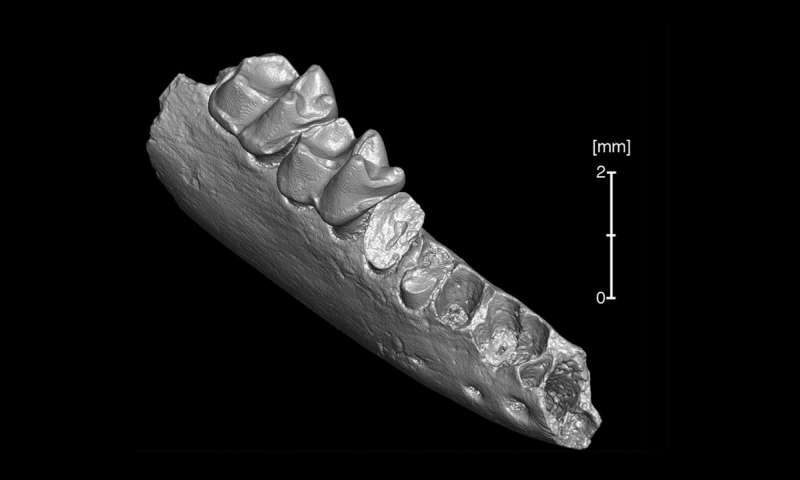
© Florida Museum image by Paul MorseTeilhardina brandti, a 56-million year-old primate found in Wyoming, may be older than its Asian cousin, previously thought to be the earliest ancestor of modern primates. Unusual tooth sockets in this lower jaw of Teilhardina brandti helped make the determination.
About 56 million years ago, on an Earth so warm that palm trees graced the Arctic Circle, a mouse-sized primate known as Teilhardina first curled its fingers around a branch.

The earliest-known ancestor of modern primates, Teilhardina's close relatives would eventually give rise to today's monkeys, apes and humans. But one of the persistent mysteries about this distant cousin of ours is where it originated.

Teilhardina (ty-hahr-DEE'-nuh) species quickly spread across the forests of Asia, Europe and North America, a range unparalleled by all other primates except humans. But where did its journey begin?

New research shows that Teilhardina brandti, a species found in Wyoming, is as old or older than its Asian and European relatives, upending the prevailing hypothesis that Teilhardina first appeared in China.

Teilhardina's origins, however, remain a riddle.

Comment: See also:


Moon

NASA head says US is within 10 years of on-going manned presence on the moon

moon colonization
NASA Administrator Jim Bridenstine says the U.S. is within 10 years of having a continuous manned presence on the moon, which will lay the groundwork for expanding space exploration to Mars.

"Right now we're building a space station, we call it 'Gateway,' that's going to be in orbit around the moon - think of it as a reusable command module where we can have human presence in orbit around the moon. From there we want reusable landers that go back and forth to the surface of the moon," Bridenstine told Hill.TV's Jamal Simmons and Buck Sexton on "Rising."

"We think we can achieve this in about 10 years, the idea being prove the capability, retire the risk, prove the human physiology and then go on to Mars," he continued.

Bridenstine joined "Rising" to detail NASA's plans to partner with nine U.S. companies to travel to the moon, a key component of NASA's plan to extend human space exploration.