
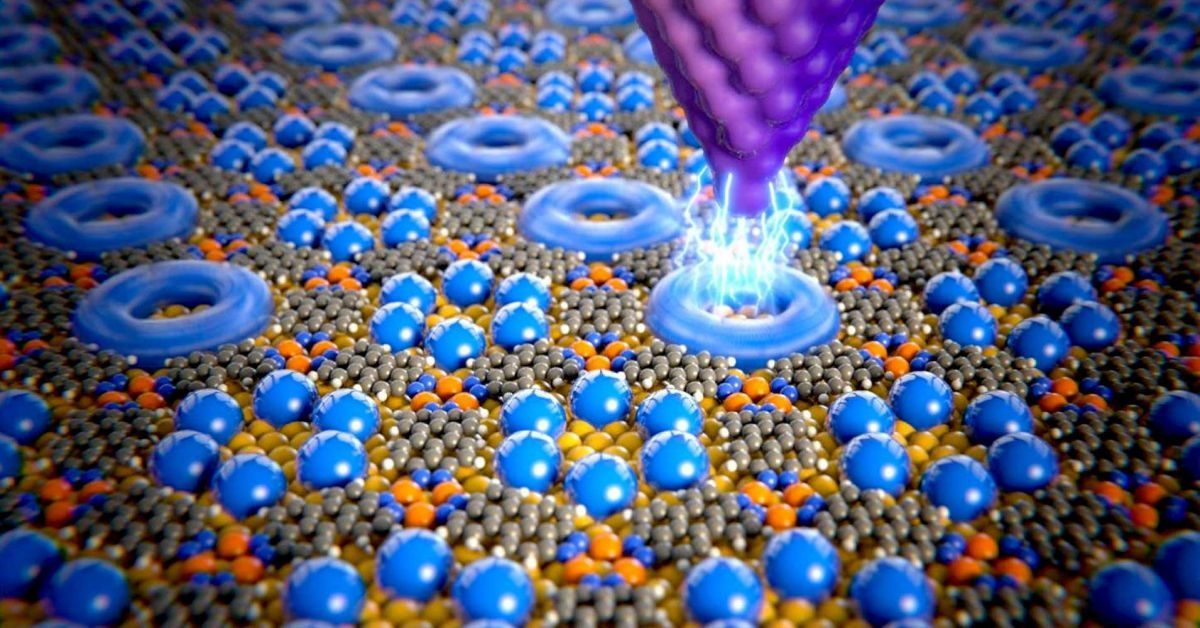
© University of Basel, Department of PhysicsGraphic animation of a possible data memory on the atomic scale: A data storage element -- consisting of only 6 xenon atoms -- is liquefied by a voltage pulse.
In data storage, the perpetual goal is to find ways to store greater amounts of information on devices that take up less physical space. Taken to its extreme end, that goal recently has led to physicists cracking the code of storing digital information into specially-crafted molecules, using individual atoms as the ones and zeroes of binary code.
For the past several years, scientists have been refining the nanotechnology that lets them accomplish all that. It's a promising concept, but building the actual storage systems - assembling molecules to hold atoms that are manipulated to one state or another - is still too difficult and costly to be practical.
A new technique could change that, according to new research published Monday in the academic journal Small. A team of physicists developed a self-assembling metallic molecular network - meaning that the lattice pieced itself together once its building block molecules were arranged in the right order and subjected to the right temperature and pressure - so scientists no longer need to expend huge amounts of work and money building the tiny structures themselves.



















Comment: See also: