Science & TechnologyS


Cassiopaea

Observations of young stars are overturning theories of planet formation

planetary nursery
© ESO/L. CalçadaAn artist’s impression of a planetary nursery, in which growing planets etch rings in the disk of dust and gas around a young star.
An artist's impression of a planetary nursery, in which growing planets etch rings in the disk of dust and gas around a young star.Credit: ESO/L. Calçada

Some 100,000 years ago, when Neanderthals still occupied the caves of southern Europe, a star was born. It appeared when a ball of gas collapsed and ignited within a stellar factory known as the Taurus Molecular Cloud. Then, leftover material began to cool and coalesce around it, forming dust grains and a hazy envelope of gas.

In September 2014, some of the light from that hot young star and its surroundings landed inside 66 silvery parabolas perched on a plateau in Chile's Atacama desert - the driest on Earth. The photons had taken 450 years to make the journey. Astronomers were waiting. They were conducting a test of the Atacama Large Millimeter/submillimeter Array (ALMA), which features radio antennas separated by distances of up to 15 kilometres. With such long spans between them, the antennas work as a high-resolution receiver that can discern cool objects less than a millimetre across.

When the telescope team trained ALMA on the young star, named HL Tauri, they expected to see a bright smear of dust and gas. Instead, when ALMA's supercomputer stitched together those photons, the image resolved into a disk with a well-defined ring structure, with gaps seemingly etched by small, infant planets orbiting a central star. It looked like a furry, orange Saturn1. It looked like nothing astronomers had ever seen.

"I kept flipping through their paper, and I was like, 'Where is the real image? This is obviously a model'," says Kate Follette, an astronomer at Amherst College in Massachusetts.

Comment: It seems that part of the reason for that these theories don't stand the test of time is because they're missing some fundamental pieces of the puzzle: Also check out SOTT radio's: Behind the Headlines: Earth changes in an electric universe: Is climate change really man-made? as well as Pierre Lescaudron and Laura Knight Jadczyk's book: Earth Changes and the Human Cosmic Connection


Galaxy

Bringing balance to the universe: New theory could explain missing 95 percent of the cosmos

Dark matter map
© KiDS surveyUniversity of Oxford Dark matter map of KiDS survey region (region G12).
Scientists at the University of Oxford may have solved one of the biggest questions in modern physics, with a new paper unifying dark matter and dark energy into a single phenomenon: a fluid which possesses 'negative mass." If you were to push a negative mass, it would accelerate towards you. This astonishing new theory may also prove right a prediction that Einstein made 100 years ago.

Our current, widely recognised model of the Universe, called LambdaCDM, tells us nothing about what dark matter and dark energy are like physically. We only know about them because of the gravitational effects they have on other, observable matter.

This new model, published today in Astronomy and Astrophysics, by Dr. Jamie Farnes from the Oxford e-Research Centre, Department of Engineering Science, offers a new explanation. Dr. Farnes says: "We now think that both dark matter and dark energy can be unified into a fluid which possesses a type of 'negative gravity," repelling all other material around them. Although this matter is peculiar to us, it suggests that our cosmos is symmetrical in both positive and negative qualities."

Comment: Mainstream science often gives the impression that it's so close to figuring things out, but when we consider that it has yet to truly explain what gravity is, it's likely we're still a long way off:


Fire

New model suggests volcanoes fed by 'mush' reservoirs not molten magma chambers

Fuego volcano
© Johan Ordonez/Agence France-Presse
Volcanoes are not fed by molten magma formed in large chambers, finds a new study, overturning classic ideas about volcanic eruptions.

Instead, the study suggests that volcanoes are fed by so-called 'mush reservoirs' - areas of mostly solid crystals with magma in the small spaces between the crystals.

Our understanding of volcanic processes, including those leading to the largest eruptions, has been based on magma being stored in liquid-filled 'magma' chambers - large, underground caves full of liquid magma. However, these have never been observed.

The new study, by researchers at Imperial College London and the University of Bristol and published today in Nature, suggests the fundamental assumption of a magma chamber needs a re-think.

Comment: We'll see if this new model leads to better predictions on volcano behaviour. Our understanding of their eruptive potential has never been so urgent:


Microscope 1

Scientists develop blood test designed to detect cancer within just 10 minutes

gold nanoparticles
© ALAMYThe test uses gold nanoparticles which bind together when cancer is present
A blood test can detect cancer within just 10 minutes, scientists have found, raising hopes that hard-to-spot diseases could be picked up early when treatment is most effective.

Currently doctors use symptoms and a raft of tests and biopsies to determine if cancer is present which can sometimes take months.

The new method from the University of Queensland looks for differences in the genetic code of cancerous and healthy cells.

The team found that the DNA of cancer cells sticks strongly to nanoparticles of gold giving a quick indication whether disease is present or not to the naked eye.

And because the same changes occur in all cancerous cells, the test should work on all cancer types, the team believes.

Health

Medical breakthrough: Woman gives birth after receiving a uterus from a deceased donor

staff with baby
© Hospital das Clínicas da Faculdade de Medicina da USPThis baby girl, shown shortly after birth with her doctors in Brazil, is a medical first. Her mom is the first woman to give birth with the help of a uterus transplanted from a deceased donor.
For the first time, a woman has given birth after receiving a uterus from a deceased donor.

A reported 11 women have had babies after uterus transplants from living donors. But this breakthrough, described online December 4 in the Lancet, could boost the availability of viable organs for women who want to become pregnant but lack a womb.

"Everyone was waiting to see whether [a deceased donor] would work with the same success" as a living donor, says abdominal transplant surgeon Giuliano Testa. Testa, who was not involved in this case, was a member of the team at Baylor University Medical Center at Dallas that reported earlier this year the first U.S. baby born, in 2017, after a living donor uterus transplant. The first such birth worldwide occurred in Sweden in 2014.

An estimated 1.5 million women worldwide suffer from infertility because their uterus is missing - from a congenital condition, for example - or the organ is abnormal or damaged. In the deceased donor case, the recipient was born without a womb due to Mayer-Rokitansky-Küster-Hauser, or MRKH, syndrome, which affects 1 in 4,500 women. The donated uterus came from a 45-year-old woman who'd had three vaginal deliveries and died of a stroke.

Gold Bar

Palladium likely to break more records, boosting automakers' costs

An employee places ingots of 99.98 percent pure palladium on a table
© Reuters / Ilya Naymushin
An employee places ingots of 99.98 percent pure palladium on a table.
Automakers aren't likely to catch a break on palladium prices anytime soon as the metal used to reduce exhaust emissions is poised to extend its record-breaking rally.

Auto-industry demand for the silvery-white metal -- especially from China -- will probably keep supplies tight for the foreseeable future, as reflected by surging lease rates for the metal, said Steven Dunn, head of exchange-traded funds at Aberdeen Standard Investments, which oversees about $736 billion.

Oil Well

M4.5 earthquake and aftershock in B.C., Canada, "very likely" caused by fracking

earthquake near Fort St. John, B.C.
© Google MapsThe location of the Nov. 29, 2018 earthquake near Fort St. John, B.C.
An earthquake that struck northeastern B.C. on Thursday evening was "very likely" caused by fracking, a preliminary investigation has found.

Earthquakes Canada said the quake had a preliminary magnitude of 4.5, with the epicentre about 16 kilometres southwest of Fort St. John.

It hit around 5 p.m. PT, followed by another tremor of similar magnitude, classified as an aftershock, less than an hour later.

Comment: This quake is reported to have occurred around 5pm, and earlier in the day, at around 8am, Alaska was hit with a strong M7. And so, when we considering the evidence linking fracking induced earthquake activity, along with the 2000% increase in major earthquakes since the 1900s, the rise in sinkholes, landslides and so on, it's clear society is suicidal in its pursuit of profit.

See also:


Fireball 5

Video simulations show what would happen if asteroids crashed into Earth's oceans

Asteroid Impact Simulation
© YouTube/NCAR VisLab
In films like Armageddon, Hollywood has tried (and failed) to take on the question of what would happen if a comet or asteroid plunged into the oceans on Earth, but what has scientific research actually determined it may look like?

America's National Center for Atmospheric Research (NCAR) has posted a new video illustrating what could happen if an asteroid crashed into one of our oceans, and it's fascinating.

Based on data collected by Los Alamos National Laboratory scientists Galen R. Gisler and John M. Patchett, referred to as the Deep Water Impact Ensemble Data Set, these simulations show asteroids of various sizes entering the water from different angles. It's the scale and size of the aftermath that's the truly stunning part.


Grey Alien

Professor at NASA admits some UFO sightings can't be "explained or denied"

NASA ufo
A NASA scientist admits that it's entirely possible aliens have already visited Earth - and we simply never noticed.

The space expert also noted that not all UFO sightings can be "explained or denied", and said scientists should be more open-minded about the possibility of alien visitors.

Nasa has long been investing in SETI, the "search for extraterrestrial intelligence" - better known as aliens.

And in a recently publisher paper on SETI, Professor Silvano P. Colombano suggested that alien life may have already visited us.

He suggested that aliens could look so different from how we expect, and that they may be able to travel huge distances - because we simply can't comprehend their make-up or technology.

Comment: The acknowledgement of the UFO reality has been gaining prominence in recent years and by many high profile people. With the question of whether they exist out of the way, the next step for mainstream science, as noted by the Professor, would be to assess their possible make up and technology. And the evidence points to something altogether stranger and more unsettling than many would have us believe: Also check out SOTT radio's: The Truth Perspective: Powers, principalities and UFOs


Satellite

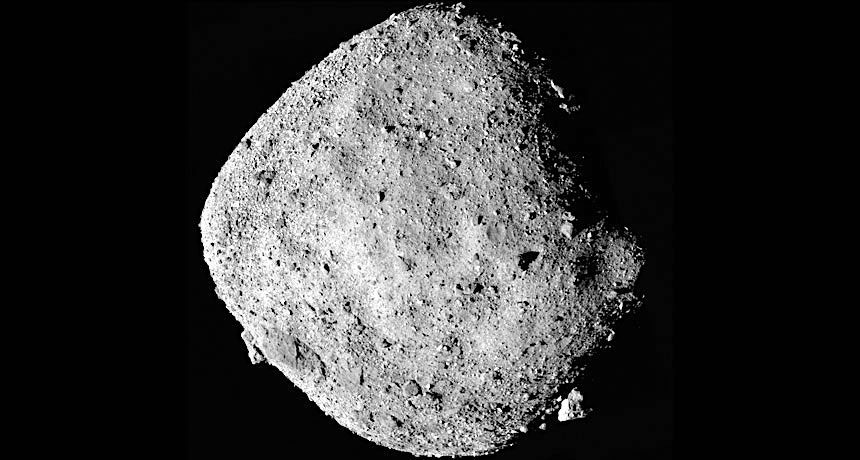
NASA's Osiris-Rex arrives at asteroid Bennu after a two-year journey

asteroid Bennu
© NASA/Goddard/University of ArizonaAn image of the asteroid Bennu taken by the Osiris-Rex spacecraft Nov. 16.

The spacecraft now begins a close study of the primitive space rock, seeking clues to the early solar system.


Launched two years ago, NASA's Osiris-Rex spacecraft pulled alongside the asteroid Bennu on Monday. Its mission is to survey the asteroid ahead of retrieving pristine bits of the solar system from the rock's surface and then bringing them back to Earth in the years ahead.

With a short engine burn, the spacecraft matched the speed and direction of Bennu.

A few minutes after noon, Javier Cerna, a communications systems engineer at Lockheed Martin, which built and operates the spacecraft, announced, "We have arrived."

Comment: See also: