Science & TechnologyS


Sun

'Superflares' could threaten Earth says study

Superflare
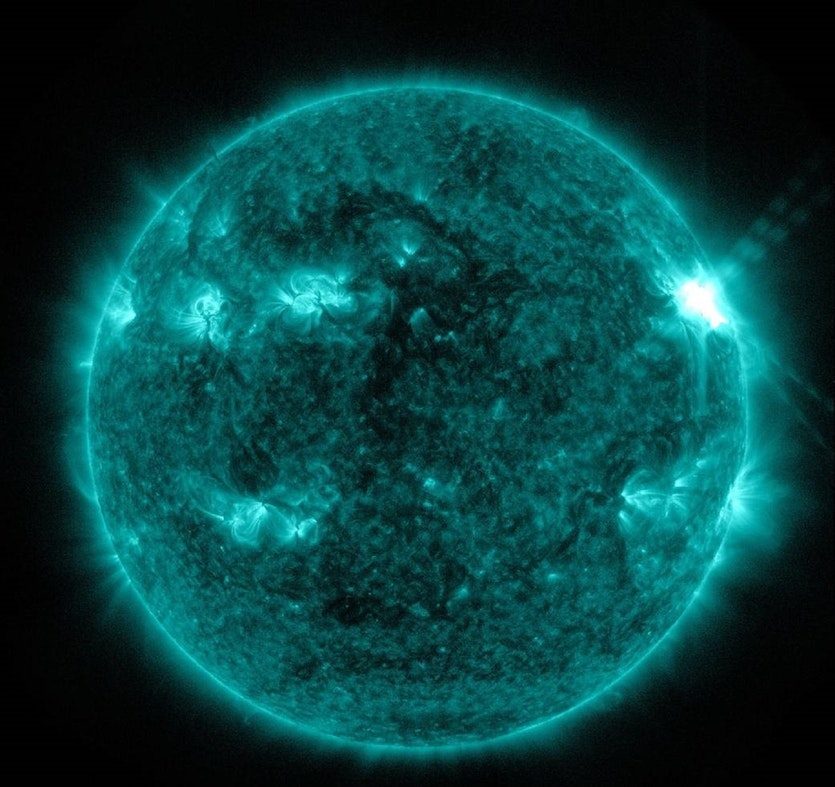
© NASA, ESA and D. PlayerAn artist's depiction of a superflare on an alien star.
Astronomers probing the edges of the Milky Way have in recent years observed some of the most brilliant pyrotechnic displays in the galaxy: superflares.

These events occur when stars, for reasons that scientists still don't understand, eject huge bursts of energy that can be seen from hundreds of light years away. Until recently, researchers assumed that such explosions occurred mostly on stars that, unlike Earth's, were young and active.

Now, new research shows with more confidence than ever before that superflares can occur on older, quieter stars like our own-albeit more rarely, or about once every few thousand years.

The results should be a wake-up call for life on our planet, said Yuta Notsu, the lead author of the study and a visiting researcher at CU Boulder.

If a superflare erupted from the sun, he said, Earth would likely sit in the path of a wave of high-energy radiation. Such a blast could disrupt electronics across the globe, causing widespread black outs and shorting out communication satellites in orbit.

Notsu will present his research at a press briefing today at the 234th meeting of the American Astronomical Society in St. Louis.

"Our study shows that superflares are rare events," said Notsu, a researcher in CU Boulder's Laboratory for Atmospheric and Space Physics. "But there is some possibility that we could experience such an event in the next 100 years or so."

Scientists first discovered this phenomenon from an unlikely source: the Kepler Space Telescope. The NASA spacecraft, launched in 2009, seeks out planets circling stars far from Earth. But it also found something odd about those stars themselves. In rare events, the light from distant stars seemed to get suddenly, and momentarily, brighter.

Researchers dubbed those humungous bursts of energy "superflares."

Robot

The future is here: Robot cops being developed to pull over drivers and issue tickets for offenses

police robot
Engineer Reuben Brewer and SRI International, a nonprofit scientific research institute based in California, developed a police robot for traffic stops. This new robot is expected to act as a buffer between the officer and motorist during an encounter, reported The Washington Post.

The project began several years ago in Brewer's garage but has since been in development at SRI International's facilities in California. The robot, dubbed GoBetween, is designed to make it safer for both the officer and the motorist.
"The main advantage of a robot over a human is that physical danger no longer matters," Brewer wrote after being reached by email by The Post.

"The robot is purely defensive, so it can't hurt the motorist. If the motorist damages the robot, it's only money to replace it."

"People are more dangerous when they're scared, so the goal is to remove the possibility of being physically hurt so that they're less scared and less dangerous," he added.

Jet2

China's new high-frequency surface wave radar can reportedly detect stealth craft like the F-35

f-35 fighter jet f35
© Reuters/FileF-35 fighter jet
Chinese military researchers have reportedly mastered a type of radar they say can detect stealth aircraft, which are designed to be invisible to normal radars. What's more, they say the radar is protected against anti-radiation missiles, too.

The lead researcher on a maritime radar team who developed the radar system, Liu Yongtan of the Chinese Academy of Sciences and Chinese Academy of Engineering, told Naval and Merchant Ships magazine in an interview last month that their high-frequency surface wave radar (HFSWR) can detect stealth aircraft over the horizon and under any weather conditions.

It's actually not a new type of radar at all, but among the oldest that exist. However, militaries abandoned them in the 1950s as airborne early warning and control system (AWACS) radar became more popular and scientists struggled to overcome the shortcomings of HFSWR, which includes high signal-to-noise ratio and low system mobility.

However, Liu claims to have overcome all that.

Because modern stealth aircraft, like the US' F-35 and F-22, or China's J-20 and J-31, were designed to hide from the predominantly-used microwave radar systems, they have zero protection from long-wave radars, he told Naval and Merchant Ships, according to the Global Times. That same property also protects the radar stations from anti-radiation missiles, which are designed to home in on radar emissions and destroy them.

Microscope 1

Type A blood converted to universal donor blood with help from bacterial enzymes 'could double' blood bank supply

blood
Gut bacteria provide a new way to increase the type O blood supply.

On any given day, hospitals across the United States burn through some 16,500 liters (35,000 pints) of donated blood for emergency surgeries, scheduled operations, and routine transfusions. But recipients can't take just any blood: For a transfusion to be successful, the patient and donor blood types must be compatible. Now, researchers analyzing bacteria in the human gut have discovered that microbes there produce two enzymes that can convert the common type A into a more universally accepted type. If the process pans out, blood specialists suggest it could revolutionize blood donation and transfusion.

"This is a first, and if these data can be replicated, it is certainly a major advance," says Harvey Klein, a blood transfusion expert at the National Institutes of Health's Clinical Center in Bethesda, Maryland, who was not involved with the work.

Moon

Scientists discover mysterious 'mass of material' buried under Moon's South Pole-Aitken basin

Moon
© Sputnik / Vladimir Sergeev
A huge, mysterious "mass of material" has been spotted underneath the Moon.

The vast chunk is sitting underneath the biggest crater in the entire solar system, known as the South Pole-Aitken basin.

And it may be part of the material that smashed into our neighbour and formed the planet, according to the researchers who discovered it. But that is just one theory on where it may have come from, and scientists stress that it is still unknown what the material is and where it might have come from.

Cloud Lightning

Ball lightning phenomenon theorized to be 'photon bubble' by Russian scientist

Ball lightning in Maastricht, Netherlands
© Joe ThomissenA smaller 'ball of fire' than this one - shot in Maastricht in the Netherlands - was seen in Great Wakering.
As far as mysteries of nature go, ball lightning is one of the more perplexing. It seems there are as many potential explanations as there are sightings, but in spite of decades of intense interest, none stand out as a clear winner.

One of the weirder hypotheses claims these glowing balls are nothing more than light trapped inside a sphere of thin air. A new paper has added fresh details to the proposal, setting physical parameters on what such a light bubble might be like.

For centuries, people have recorded accounts of grape-fruit-sized orbs of light moving slowly a short distance above the ground, often in the middle of an electrical storm, persisting for maybe 10 seconds or so before silently winking out of existence.

Comment: It remains to be seen whether this theory will stand the test of time:


Cardboard Box

Genetic discovery surprises support the validity of Intelligent Design

Mitochondria
© Terrence G. Frey [CC BY 3.0], via Wikimedia Commons.Mitochondria, showing inner and outer membranes
Several news items reinforce ideas advanced by ID advocates regarding junk DNA, irreducible complexity, and human uniqueness.

Junk DNA

ID scientists have been disputing "junk DNA" claims for many years now. Another supportive case came to light recently. The Simons Foundation found that mutations in non-coding DNA (once considered evolutionary leftovers, or junk) can be implicated in the development of autism. While a diagnosis of autism can be devastating for a family, the important point is that transcripts of non-coding DNA, even if they do not yield proteins, still influence the health of the individual. The Simons Foundation calls this discovery a first.
Leveraging artificial intelligence techniques, researchers have demonstrated that mutations in so-called 'junk' DNA can cause autism. The study, published May 27 in Nature Genetics, is the first to functionally link such mutations to the neurodevelopmental condition. [Emphasis added.]

Cell Phone

Huawei to develop own OS to rival Android according to 'secret' plan

Huawei
© REUTERS / Aly Song
Seven years ago, in a villa facing a lake in Shenzhen, a small group of top Huawei Technologies executives headed by founder Ren Zhengfei held a closed-door meeting that lasted for several days.

Their mission was to brainstorm ideas on how Huawei should respond to the rising success of Google's Android smartphone operating system (OS) around the world - software that it used on its own handsets. The underlying concern was that dependence on Android could render the company vulnerable to a US ban in the future.

The group agreed that Huawei should build a proprietary OS as a potential alternative to Android, according to people familiar with the matter, who declined to be identified because the information is private.

This meeting was later called the "lakeside talks" internally and access to documents relating to the gathering became highly restricted last year, the sources said.

Following the talks and direction from senior management, a specialist OS team led by executives including Eric Xu Zhijun, currently one of the three rotating chairmen for Huawei, was established and began to work on an OS under conditions of tight secrecy.

A specialised zone was created inside Huawei to house the OS team, with guards on the door. Only employees on the OS team had access to the specialist area, which was accessed with registered staff cards. Personal mobile phones were not allowed and had to be kept in an outside locker.

Comment: Aside from its own OS, it looks like Huawei is considering a Russian tech solution, too:
The Chinese corporation is negotiating a replacement for Android with the Aurora operating system, currently being developed by Moscow-based firm Russian Mobile Platform, Russian news outlet the Bell reports, citing an official familiar with the issue.

Huawei Chairman Guo Ping reportedly discussed the possible deal with the Russian minister of digital development and communications, Konstantin Noskov, ahead of the St. Petersburg International Economic Forum.

"China is already testing devices with the Aurora pre-installed," the official said.

Moreover, the subject was addressed during an official meeting of Russian President Vladimir Putin with Chinese leader Xi Jinping the day before the business event. The two presidents reportedly discussed both an opportunity of installing the Aurora operating system on Huawei smartphones and localization of some of Huawei's production facilities in Russia.

Aurora is a mobile operating system that is being developed on the basis of Sailfish OS, designed by Finnish technology company Jolla. In 2014, Russian entrepreneur Grigory Berezkin became a co-owner of Jolla. Since 2016, the Open Mobile Platform company, associated with the businessman, has been developing a Russian version of the system. Last year, a 75-percent share in the Open Mobile Platform was purchased by Russia's state telecommunications company, Rostelecom.


Cell Phone

Google confirms some Android smartphones had pre-installed backdoors right out of the box

Smartphone
© Reuters/Marko Djurica
The malware was detected three years ago but was later found to have evolved. Hackers began to embed it in the firmware of low-priced Android smartphones, which were primarily sold in China.

Google has confirmed that some Android devices had come with pre-installed backdoors right out of the box.

As first reported by the Russia-based cybersecurity provider Kaspersky Lab back in 2016, the malware, called Triada, was initially a Trojan that would obtain root privileges and display intrusive ads on a user's phone.

Google virus analysts managed to wipe it out from all Android devices, but in the summer of 2017 it became clear that Triada had evolved from a rooting Trojan into a pre-installed Android framework backdoor.

Telescope

First known 'intergalactic bridge' discovered 10 million light-years away

spiral galaxy
© NASA
A so-called 'intergalactic bridge' that stretches between two galaxies has been spotted 10 million light-years away by scientists who are hailing it the first discovery of its kind.

The mysterious trail of magnetic fields and electrons connects two clusters of galaxies named Abell 0399 and Abell 0401. The find offers astronomers new insight into the "cosmic web" of filamentary structures that connect distant objects in the universe.

"Until today, a magnetic field had never been observed in the filaments that connect the clusters between them. The filaments of this web are in fact extremely rarefied and difficult to observe," read the statement announcing the findings.