
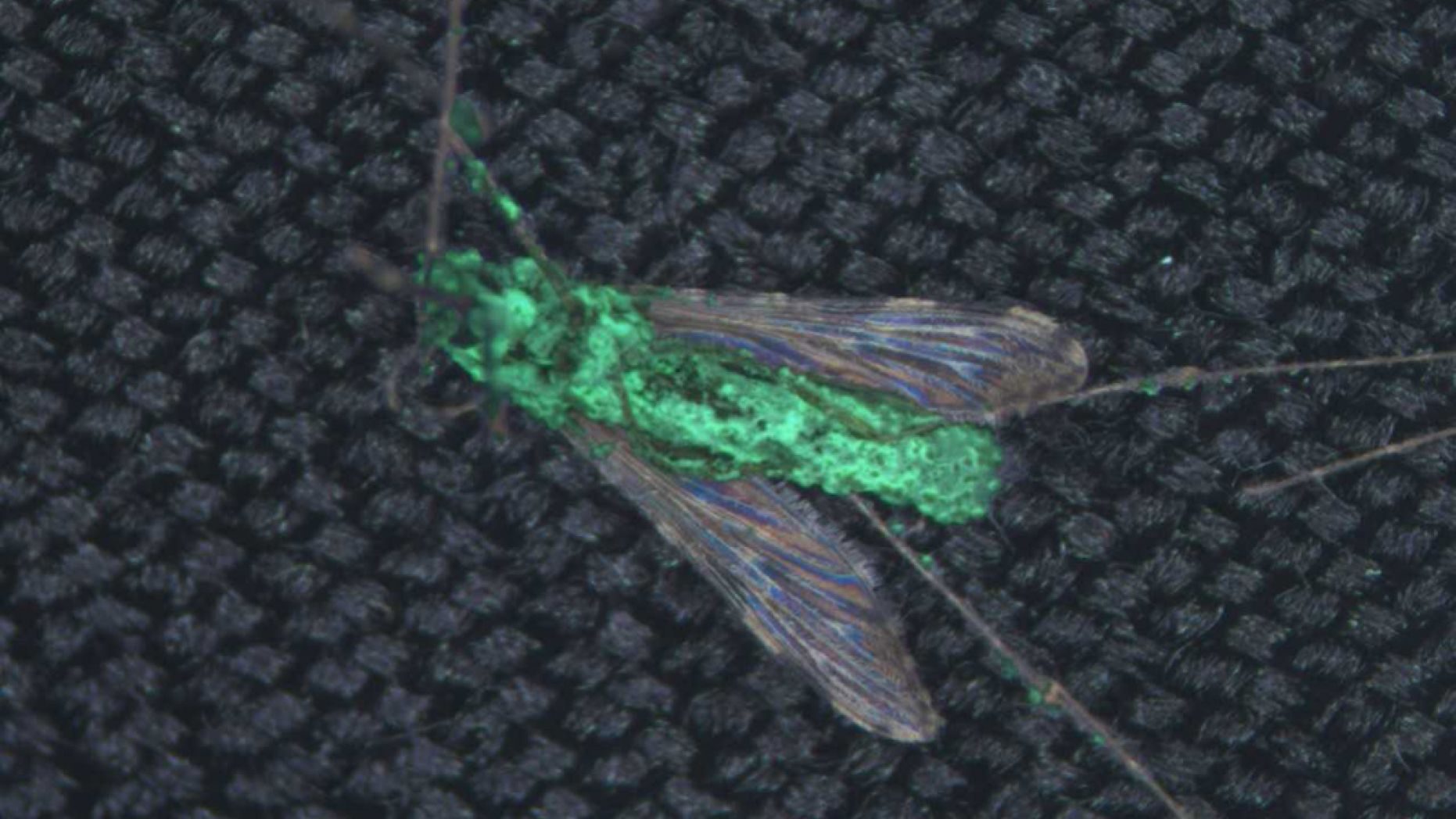
© Brian LovettAn Anopheles gambiae mosquito with our transgenic fungus emerging from its body after death. This is a merged version of a natural light image and a green fluorescent image.
Researchers from the University of Maryland and the Research Institute of Health Sciences in Burkina Faso have figured out a way to genetically alter a fungus to produce deadly spider venom that kills mosquitoes.
The fungus, known as Metarhizium pinghaense, which is already deadly to mosquitoes even without the added venom, works so well that in one trial, it nearly killed off an entire population of the pest in 45 days.
"We are using a gene encoding a single toxin, one of the many toxins in spider venom," Dr. Raymond St. Leger of UMD Entomology told Fox News.
"The toxin has been thoroughly characterized by our Australian collaborator Glenn King and approved for use as an insecticide by the EPA, so this toxin has been confirmed to be safe for everything but insects."
Comment: An A-OK by the EPA isn't exactly comforting:


















Comment: More on the 'war on mosquitoes' and genetic engineering: