
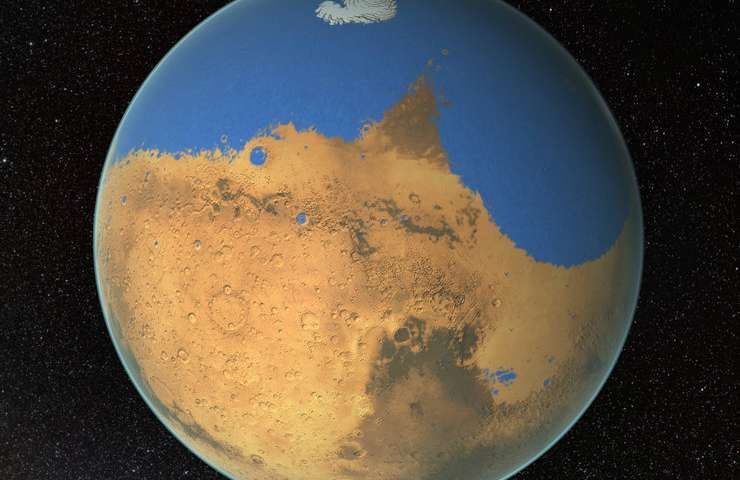
© NASA/GSFCBillions of years ago, Mars could have looked like this with an ocean covering part of its surface.
Billions of years ago, Mars was a planet rich in water with rivers, and even an ocean. Since then, our neighboring planet has changed dramatically. Today, only small amounts of frozen water exist in the ground; in the atmosphere, water vapor occurs only in traces. All in all, the planet may have lost at least 80 percent of its original water. In the upper atmosphere of Mars, ultraviolet radiation from the sun split water molecules into hydrogen (H) and hydroxyl radicals (OH). The hydrogen escaped from there irretrievably into space. Measurements by space probes and space telescopes show that even today, water is still lost in this way. But how is this possible? The middle atmosphere layer of Mars, like Earth's tropopause, should actually stop the rising gas. After all, this region is usually so cold that water vapor would turn to ice. How does the Martian water vapor reach the upper air layers?
In their current simulations, the Russian and German researchers find a previously unknown mechanism reminiscent of a kind of pump. Their model comprehensively describes the flows in the entire gas envelope surrounding Mars from the surface to an altitude of 160 kilometers. The calculations show that the normally ice-cold middle atmosphere becomes permeable to water vapor twice a day-but only at a certain location, and at a certain time of year.
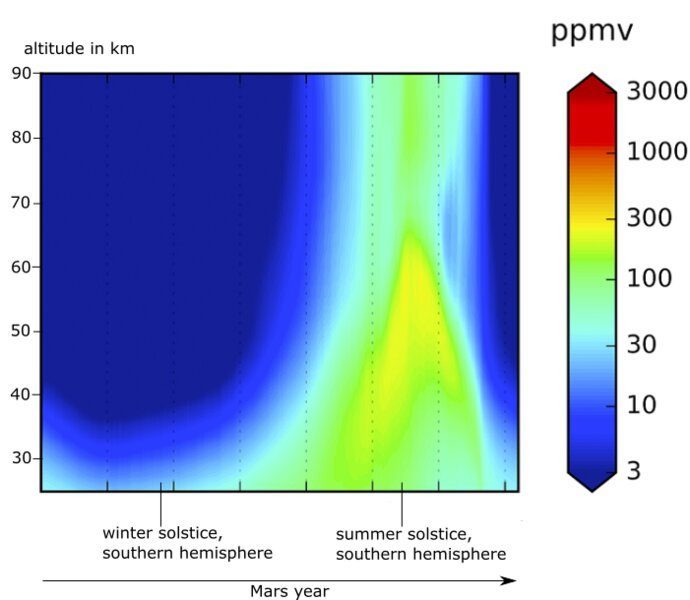
© GPL, Shaposhnikov et al.: Seasonal "Water" Pump in the Atmosphere of Mars: Vertical Transport to the ThermosphereVertical distribution of water vapor on Mars during the course of a Mars year, here shown at 3 am local time. Only when it is summer on the southern hemisphere can water vapor reach higher atmospheric layers.
"When it is summer in the southern hemisphere, at certain times of day, water vapor can rise locally with warmer air masses and reach the upper atmosphere," says Paul Hartogh from MPS, summarizing the results of the new study. In the upper atmospheric layers, air flows carry the gas along the longitudes to the north pole, where it cools and sinks down again. However, part of the water vapor escapes this cycle: under the influence of solar radiation, the water molecules disintegrate and hydrogen escapes into space.
Another Martian peculiarity can fortify this unusual hydrological cycle: huge dust storms that span the entire planet and repeatedly afflict Mars at intervals of several years. The last such storms occurred in 2018 and 2007 and were comprehensively documented by space probes orbiting Mars. "The amounts of dust swirling through the atmosphere during such a storm facilitate the transport of water vapor into high air layers," says Alexander Medvedev from MPS.
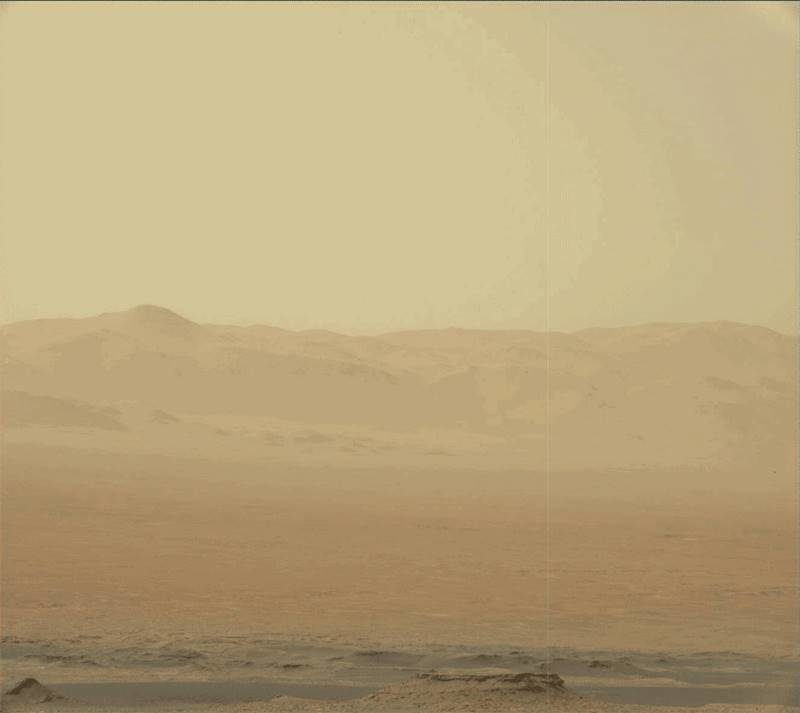
© NASATime and again, Martian dust stroms span the entire planet, as here in June 2018. The image was taken from the NASA's rover Curiosity. Storms of this kind can facilitate the transport of water into the upper atmosphere of Mars.
"Apparently, the Martian atmosphere is more permeable to water vapor than that of the Earth," Hartogh concludes. "The new seasonal water cycle that has been found contributes massively to Mars' continuing loss of water."
More information:
Dmitry S. Shaposhnikov et al. Seasonal Water "Pump" in the Atmosphere of Mars: Vertical Transport to the Thermosphere, Geophysical Research Letters (2019). DOI: 10.1029/2019GL082839


Comment:
Phoenix Mars Lander finds surprises about red planet's watery past
Mars may have been both cold and wet
New discovery: Mars found to have underground 'lake' at south pole
New study reveals Mars had a 'planet-wide groundwater system'