Science & TechnologyS


Syringe

COVID outbreak sparked by fully vaccinated patient challenges vaccine-induced herd immunity theory

faces art
A paper published Sept. 30 in Eurosurveillance raises questions about the legitimacy of "vaccine-generated herd immunity."

The study cites a COVID outbreak which spread rapidly among hospital staff at an Israeli Medical Center — despite a 96% vaccination rate, use of N-95 surgical masks by patients and full personal protective equipment worn by providers.

The calculated rate of infection among all exposed patients and staff was 10.6% (16/151) for staff and 23.7% (23/97) for patients, in a population with a 96.2% vaccination rate (238 vaccinated/248 exposed individuals).

The paper noted several transmissions likely occurred between two individuals both wearing surgical masks, and in one instance using full PPE, including N-95 mask, face shield, gown and gloves.

Of the 42 cases diagnosed in the outbreak, 38 were fully vaccinated with two doses of Pfizer and BioNTech's Comirnaty vaccine, one had received only one vaccination and three were unvaccinated.

Of the infected, 23 were patients and 19 were staff members. The staff all recovered quickly. However, eight vaccinated patients became severely ill, six became critically ill and five of the critically ill died. The two unvaccinated patients tracked had mild COVID cases.

Brain

A custom brain implant lifted a woman's severe depression

Sarah and brain activity monitor
© Maurice Ramirez/UCSFSarah's brain activity measured by an implanted device then seen on a computer screen to find the most effective dose, duration and location of her deep brain stimulation.
A personalized brain implant eased the crushing symptoms of a woman's severe depression, allowing her to once again see the beauty of the world. "It's like my lens on the world changed," said Sarah, the research volunteer who requested to be identified by her first name only.

The technology, described October 4 in Nature Medicine, brings researchers closer to understanding how to detect and change brain activity in ultraprecise ways (SN: 2/10/19).

The device was bespoke; it was built specifically for Sarah's brain. The details of the new system may not work as a treatment for many other people, says Alik Widge, a psychiatrist and neural engineer at the University of Minnesota in Minneapolis. Still, the research is "a really significant piece of work," he says, because it points out a way to study how brain activity goes awry in depression.

Jupiter

Winds near Jupiter's great red spot are speeding up and scientists don't know why

jupiter
© NASA/ESA/A. Simon & M. H. Wong & the OPAL team
The Great Red Spot visible on Jupiter is a swirling anticyclonic storm, the largest of its kind in the Solar System - large enough to fit our entire planet within. Now, a new analysis has revealed the winds around the edge of the spot are mysteriously speeding up.

Using data collected from the Hubble Space Telescope, researchers looked at the patterns of the storm from 2009 to 2020, measuring a wind speed increase in the outer edge of 8 percent over that time.

That's an increase of a little less than 2.5 kilometers (1.5 miles) per hour for every year that measurements were taken - not huge, but significant, and only measurable because of the high-resolution imagery that Hubble is able to capture.

Comment: Are we witnessing yet another sign of cosmic climate change?


Cloud Grey

Dark days: Earth has 'dimmed' by 0.5% since 2017 and scientists aren't sure why

Earthshine moon
© NASAAn image taken from the International Space Station in 2011 shows Earthshine on the moon.
Earth is dimming due to climate change Posted by October 2, 2021 Scientists used measurements of earthshine - the faint glow on the darkened portion of a crescent moon - plus satellite measurements to learn that Earth is dimming. The reason is fewer bright clouds, due to warming temperatures.


Comment: The planet isn't warming, even global warmists have had to admit that much (at least in a round about way): Texas cold snap linked to 40 years of increasing snowfall in Arctic & disruptions in stratospheric polar vortex - increase in extreme cold events likely - study


The American Geophysical Union (AGU) said on September 30, 2021, that Earth's warming oceans are causing fewer bright clouds to reflect sunlight back into space. The result is that more heat reaches the Earth's surface. The additional heat will, presumably, lead to even warmer oceans. This result is contrary to what many scientists had hoped. They'd hoped a warmer Earth might lead to more bright clouds and higher albedo (greater reflectivity), and more heat reflected away. That outcome would have helped to moderate warming and balance the climate system, they said. But their result shows the opposite is true.

Comment: The dimming could also be due to what seems to be an uptick in volcanic and cometary dust loading, the slowing circulatory systems, as well as perhaps related in some way to our quieting sun and Earth's weakening magnetic field. And there are likely other factors to take into account: Volcanoes, Earthquakes And The 3,600 Year Comet Cycle

See also: And check out SOTT radio's:


Galaxy

UNLV astronomers may have discovered first planet to orbit 3 stars

triple star system GW Orionis
© ALMA (ESO/NAOJ/NRAO), ESO/Exeter/Kraus et alAn image of GW Orionis, a triple star system with a mysterious gap in its surrounding dust rings. UNLV astronomers hypothesize the presence of a massive planet in the gap, which would be the first planet ever discovered to orbit three stars. The left image, provided by the Atacama Large Millimeter/submillimeter Array (ALMA) telescope, shows the disc’s ringed structure, with the innermost ring separated from the rest of the disc. The observations in the right image show the shadow of the innermost ring on the rest of the disc. UNLV astronomers used observations from ALMA to construct a comprehensive model of the star system.
In a distant star system — a mere 1,300 light years away from Earth — UNLV researchers and colleagues may have identified the first known planet to orbit three stars.

Unlike our solar system, which consists of a solitary star, it is believed that half of all star systems, like GW Ori where astronomers observed the novel phenomenon, consist of two or more stars that are gravitationally bound to each other.

But no planet orbiting three stars - a circumptriple orbit - has ever been discovered. Perhaps until now.

Archaeology

A volcano-induced rainy period made Earth's climate dinosaur-friendly

rainy climate dinosaurs late triassic
© Davide BonadonnaDuring a 2-million-year-long rainy period in the Late Triassic, known as the Carnian Pluvial Episode (illustrated here), dinosaurs began to grow, diversify and take over.
New evidence links ancient eruptions to climate changes that let dinos start a climb to dominance

The biggest beasts to walk the Earth had humble beginnings. The first dinosaurs were cat-sized, lurking in the shadows, just waiting for their moment. That moment came when four major pulses of volcanic activity changed the climate in a geologic blink of an eye, causing a 2-million-year-long rainy spell that coincided with dinos rising to dominance, a new study suggests.

Clues found in sediments buried deep beneath an ancient lake basin in China link the volcanic eruptions with climate swings and environmental changes that created a globe-spanning hot and humid oasis in the middle of the hot and dry Triassic Period, researchers report in the Oct. 5 Proceedings of the National Academy of Sciences. During this geologically brief rainy period 234 million to 232 million years ago, called the Carnian Pluvial Episode, dinosaurs started evolving into the hulking and diverse creatures that would dominate the landscape for the next 166 million years.

2 + 2 = 4

The NYT's partisan tale about COVID and the unvaccinated is rife with sloppy data analysis

masked couple
© Daniel Slim/AFP via Getty ImagesA masked couple waits for the train at Harpers Ferry station in West Virginia, July 3, 2020.
NOTE FROM GLENN GREENWALD: The corporate media has worked very hard to propagate the liberal-pleasing narrative that COVID has become a partisan disease due to vaccine hesitancy on the right, often ignoring the inconvenient truth that large percentages of politically diverse groups, principally African-Americans and Latinos, remain resistant to vaccination. Recent reporting from The New York Times serves to further this distorted narrative, dubbing the positive correlation between support for Donald Trump and COVID death rates "Red COVID," and brandishing it as evidence of a partisan pandemic. But the Times' report misleads readers through statistical manipulation and data games, as illustrated by this meticulous analysis, presented in an Outside Voices contribution by Jeremy Beckham:

A widely shared article recently appeared in The New York Times' "The Morning" newsletter titled "Red Covid," authored by David Leonhardt. This article, presented as news reporting and not an opinion piece, argues that deaths from COVID-19 are "showing a partisan pattern," with the worst impacts of the disease "increasingly concentrated in red America." Given that this narrative perfectly flatters a liberal sense of superiority, it has predictably gained substantial traction on MSNBC and on Twitter.

One particular claim in the Times' article caught my attention: that there is a clear and strong association on a county level between COVID deaths and support for Donald Trump in the 2020 election. Specifically, the article alleged that those counties which voted overwhelmingly for Donald Trump had more than a four-fold greater mortality rate than those counties which decisively voted against Trump. If true, that would indeed be a striking observation.

Health

Air filtration/UV light can remove airborne SARS-COV-2 from hospital wards, study finds

NHS hospital
© NHS Trust
In a study published earlier this year, Paul McKeigue and colleagues analysed data on all diagnosed cases of COVID-19 in Scotland, as well as a large number of matched controls. They found that a staggering 30% of severe cases (those that resulted in critical care admission or death) were linked to a recent hospital visit.

This suggests widespread nosocomial transmission of SARS-CoV-2. In other words, a lot of people caught their infections in hospital, and then became seriously ill.

The fact that such a large portion of severe cases were linked to a recent hospital visit is actually not so surprising. After all, people vulnerable to COVID-19 (the elderly and persons with underlying health conditions) are overrepresented among those who make frequent hospital visits.

Nonetheless, it's rather concerning that hospitals - places where people are meant to come out healthier than they go in - were a major site of SARS-CoV-2 transmission.

Given that COVID-19 patients, as well as those vulnerable to COVID-19, tend to be concentrated in hospitals, making efforts to reduce nosocomial transmission would seem like a top priority. Indeed, one would expect interventions that did reduce such transmission to have a large benefit/cost ratio. Which makes a new preprint so interesting. Andrew Conway-Morris and colleagues investigated whether airborne SARS-CoV-2 could be removed from hospital wards using portable devices that filter and sterilise the air.

Comet 2

New Comet P/2021 Q5 (ATLAS)

CBET 5029 & MPEC 2021-R98 , issued on 2021, September 06, announce the discovery of a new comet (magnitude ~17) on CCD images taken on August 29.6 UT with a 0.5-m f/2 Schmidt reflector at Haleakala, Hawaii, in the course of the "Asteroid Terrestrial-Impact Last Alert System" (ATLAS) search program. The new comet has been designated P/2021 Q5 (ATLAS).

Stacking of 58 unfiltered exposures, 30 seconds each, obtained remotely on 2021, September 03.1 from G18 (ALMO Observatory, Italy) through a 0.30-m f/4 reflector + CCD, shows that this object is a comet with a compact coma about 8" arcsec in diameter and a tail 10" long in PA 270 (Observers A. Valvasori & E. Guido).

Our confirmation image (click on the images for a bigger version; made with TYCHO software by D. Parrott)
Comet P/2021 Q5 (ATLAS)
© Remanzacco Blogspot

Comet

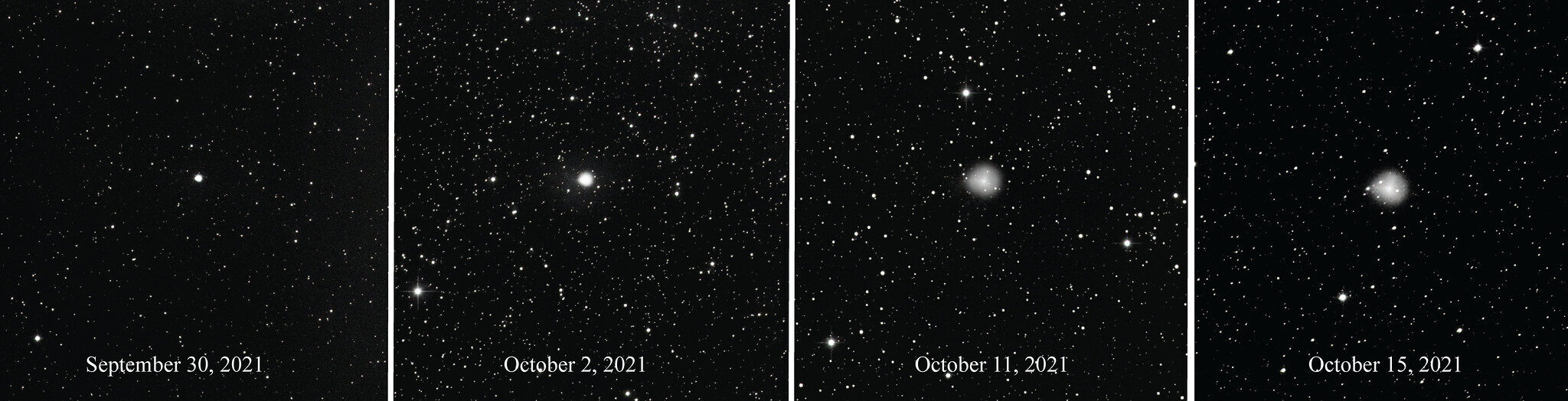
Quadruple outburst of Comet 29P - Now at its brightest for 40 years

Comet 29P
© Martin MobberleyMartin Mobberley captured this image of the bright outburst of Comet 29P/Schwassmann-Wachmann around 9:50 UT on September 29th.
Catch one of the most active small bodies in the solar system during a rare superoutburst.

A comet infamous for its explosive personality has been in near-continuous outburst since September 25th. The brightness of Comet 29P/Schwassmann-Wachmann is steadily rising, and it now appears as a tiny, 11th-magnitude object easily visible in 8-inch and larger telescopes. If you've never seen a comet masquerade as a star-like planetary nebula, don't pass up the chance — look soon. As the outburst evolves the comet's coma will expand but also fade.

Comment: The unusual outbursts of Comet 29P is just the latest in a flurry of out of the ordinary phenomena and stunning discoveries documented of late: And check out SOTT radio's: