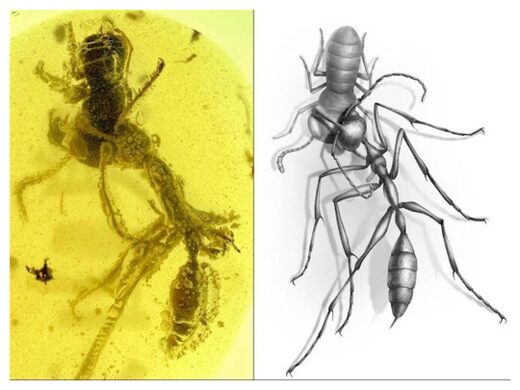
© New Jersey Institute of TechnologyA fossil recently recovered from the age of the dinosaurs is giving scientists the most vivid picture yet of how one of the most enigmatic and fearsome groups of ants to exist once used their uncanny tusk-like mandibles and diverse horns to successfully hunt down victims for nearly 20 million years, before vanishing from the planet...
In
findings published Aug. 6 in the journal
Current Biology, researchers from New Jersey Institute of Technology (NJIT), Chinese Academy of Sciences and University of Rennes in France have unveiled a stunning 99-million-year-old fossil pristinely preserving an enigmatic insect predator from the Cretaceous Period — a 'hell ant' (haidomyrmecine) — as it embraced its unsuspecting final victim, an extinct relative of the cockroach known as
Caputoraptor elegans.
The ancient encounter, locked in amber recovered from Myanmar, offers a detailed glimpse at a newly identified prehistoric ant species
Ceratomyrmex ellenbergeri, and
presents some of the first direct evidence showing how it and other hell ants once used their killer features — snapping their bizarre, but deadly, scythe-like mandibles in a vertical motion to pin prey against their horn-like appendages.Researchers say the rare fossil demonstrating the hell ant's feeding mode offers a possible evolutionary explanation for its unusual morphology and highlights a key difference between some of the earliest ant relatives and their modern counterparts, which today uniformly feature mouthparts that grasp by moving together laterally. The hell ant lineage, along with their striking predatory traits, are suspected to have vanished along with many other early ant groups during periods of ecological change around the Cretaceous-Paleogene extinction event 65 million years ago.
"Fossilized behavior is exceedingly rare, predation especially so. As paleontologists, we speculate about the function of ancient adaptations using available evidence, but to see an extinct predator caught in the act of capturing its prey is invaluable," said Phillip Barden, assistant professor at
NJIT's Department of Biological Sciences and lead author of the study. "This fossilized predation confirms our hypothesis for how hell ant mouthparts worked ... The only way for prey to be captured in such an arrangement is for the ant mouthparts to move up and downward in a direction unlike that of all living ants and nearly all insects."
"Since the first hell ant was unearthed about a hundred years ago, it's been a mystery as to why these extinct animals are so distinct from the ants we have today," Barden added. "This fossil reveals the mechanism behind what we might call an 'evolutionary experiment,' and although we see numerous such experiments in the fossil record, we often don't have a clear picture of the evolutionary pathway that led to them."











Comment: This is just the latest in a series of rediscoveries of species thought to be 'lost':