
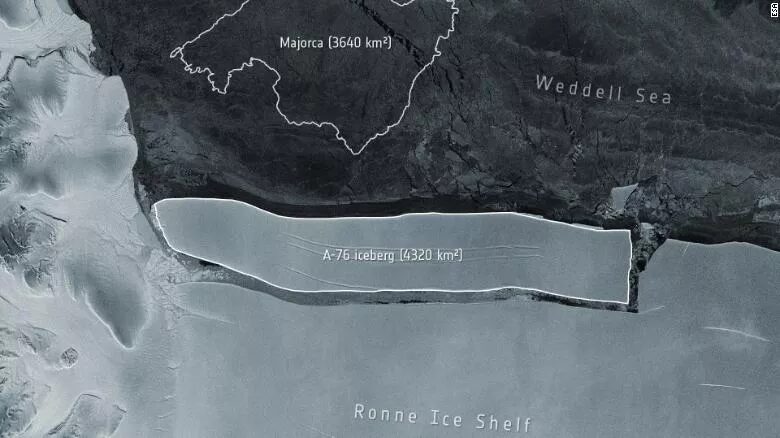
© ESA/Earth ObservationThe humongous chunk of ice calved from the western side of the Ronne Ice Shelf in Antarctica.
The finger-shaped chunk of ice, which is roughly 105 miles (170 kilometers) long and 15 miles (25 kilometers) wide, was spotted by satellites as it calved from the western side of Antarctica's Ronne Ice Shelf, according to the European Space Agency. The berg is now floating freely on the Weddell Sea, a large bay in the western Antarctic where explorer Ernest Shackleton once lost his ship, the Endurance, to pack ice.
The 1,667-square-mile (4,320 square kilometers) iceberg — which now the world's biggest and has been called A-76, after the Antarctic quadrant where it was first spotted — was captured by the European Union's Copernicus Sentinel, a two-satellite constellation that orbits Earth's poles. The satellites confirmed an earlier observation made by the British Antarctic Survey, which was the first organization to notice the breakaway.










Comment: See also:
- Landslide induced mega-tsunami 'could happen at anytime' at Alaska's Barry Glacier
- Himalayan glacier bursts in India causing flash flooding & destroying dam, 150 feared dead
- Black auroras captured over Scotland
- HUGE meteor fireball lights up western China's dark morning skies
- Professor Valentina Zharkova: "We entered the 'modern' Grand Solar Minimum on June 8, 2020"
And check out SOTT radio's: