Earth ChangesS


Cloud Lightning

Three hikers killed by lightning bolt in Java, Indonesia

LIGHTNING
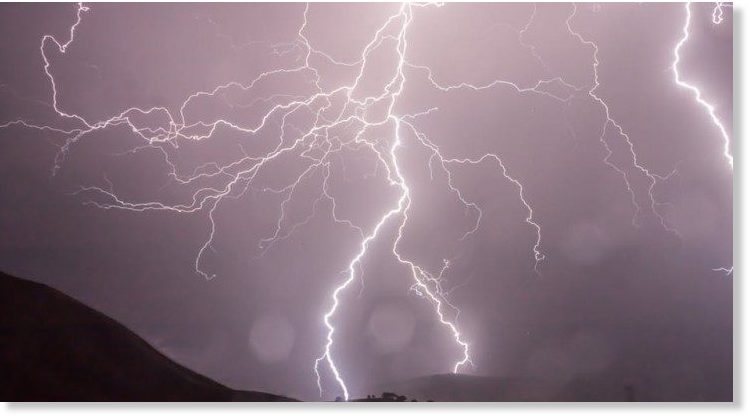
On April 23, 2017, three hikers on Mount Prau in Central Java died after being struck by lightning. The unfortunate incident occurred when a group of 11 people hiked from their base camp at Patak Banteng and decided to spend the night on Mount Prau.

The next day, the group decided to go down into the valley due to heavy rain on top of the mountain. They pitched their tents near the mobile signal transmitter tower. Not long after, lightning struck their location, killing three members of the group.

After the incident, one of the survivors said the strike may have been triggered by one of the hikers who opened his mobile phone after detecting a signal in the area.

In addition to three fatalities, the lightning strike caused severe burns to six of the hikers and minor burns to two of them. Those who died were identified as private sector workers named Deden Hidayat Maulana (31) from West Java, Aditya Agung Darmawan (30) from East Jakarta and Adi Setiawan (31) from East Jakarta.

Comment: Elsewhere in Asia: Worker dies after lightning strike in Sepang, Malaysia.

Lightning kills man at Nadanahalli, India


Cloud Precipitation

Floods displace 17,000 after 15 inches of rain in 24 hours in the Dominican Republic

Floods in Manoguayabo, Santo Domingo, April 2017.
© Fuerza Aérea de República DominicanaFloods in Manoguayabo, Santo Domingo, April 2017.
Flooding has caused major problems in at least 5 provinces in the Dominican Republic after staggering amounts of rainfall over the last few days.

According to the country's meteorological office (ONAMET), almost 400 mm of rain fell in 24 hours in Barahona between 22 and 23 April, 2017. Further heavy rain has fallen since, mostly in southern areas of the country.

In their latest report of 25 April, the Emergency Operations Centre (Centro de Operaciones de Emergencias - COE) says that flooding has affected several areas in Santo Domingo, San Cristóbal, Monte Plata, Sánchez Ramírez, Duarte and Barahona provinces. Several rivers have overflowed, including the Ozama, Yuna, Cevicos, Manoguayabo and Haina.

As many as 3,429 homes have been damaged or affected by the flooding, with around 9 houses completely destroyed. Emergency services and military have rescued 153 people.


Ice Cube

Föhn winds: New insight into what weakens Antarctic ice shelves

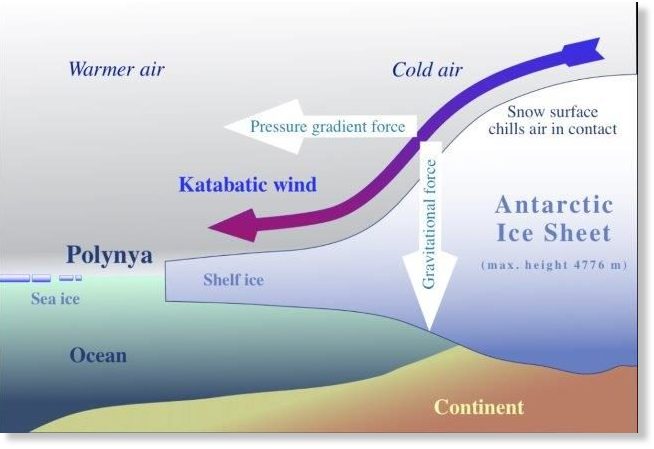
katabatic winds
New research describes for the first time the role that warm, dry winds (katabatic winds) play in influencing the behaviour of Antarctic ice shelves. Presenting this week at a European conference scientists from British Antarctic Survey (BAS) explain how spring and summer winds, known as föhn winds, are prevalent on the Larsen C Ice Shelf, West Antarctica and creating melt pools. The Larsen C Ice Shelf is of particular interest to scientists because it of the collapse of Larsen A in 1995 and Larsen B in 2002.

The researchers observed the föhn winds, which blow around 65% of the spring and summer period, extend further south and are more frequent than previously thought, and are likely to be a contributing factor that weakens ice shelves before a collapse. The results are presented this week (Tuesday 25 April) at the European Geosciences Union General Assembly (EGU) in Vienna.

In 1995 and 2002, the Larsen A and B ice shelves collapsed, depositing an area the size of Shropshire into the Weddell Sea. Whilst ice shelf collapse doesn't directly contribute to sea level rise, the glaciers which fed into the ice shelves accelerated, leading to the loss of land ice, and subsequently indirect sea level rise. The processes responsible for the collapse of these ice shelves were largely debated, and it is now thought that crevasses on the ice shelf were widened and deepened by water draining into the cracks. Föhn winds are thought to be responsible for melting the ice shelf surface and supplying the water.

Better Earth

Researchers solve the century-old mystery of Blood Falls

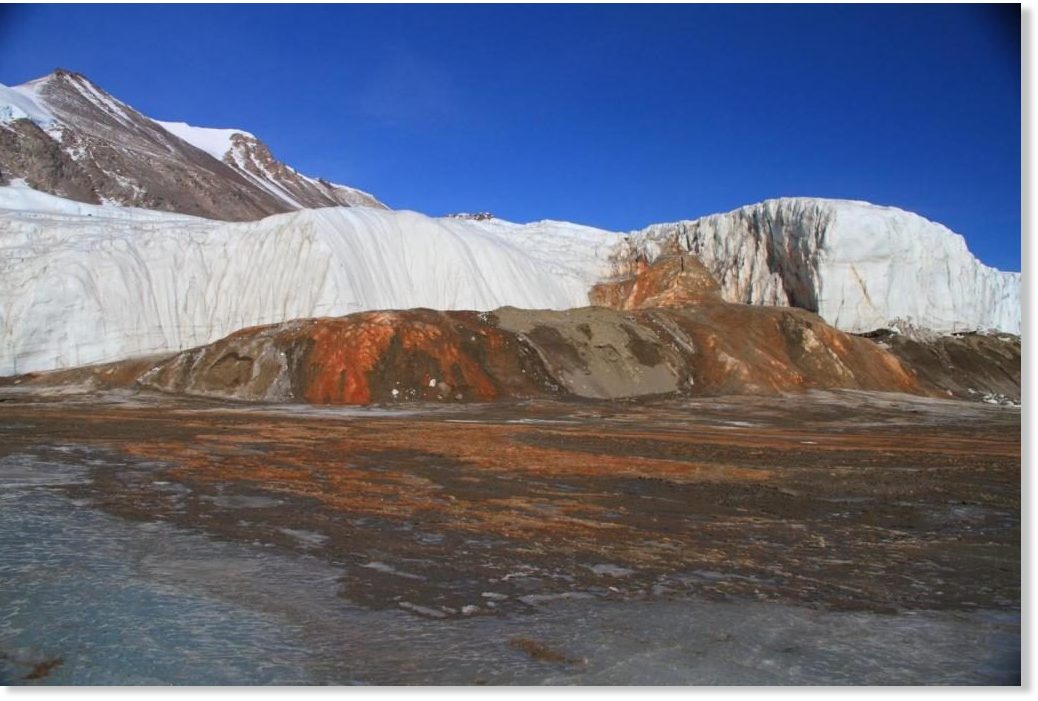
Blood Falls
© Erin PettitBlood Falls is a famous iron-rich outflow of water that scientists suspected was connected to a water source that may have been trapped under an Antarctic glacier for more than a million years.

From the University of Alaska Fairbanks, and the "at least they didn't blame climate change" department:


A research team led by the University of Alaska Fairbanks and Colorado College has solved a century-old mystery involving a famous red waterfall in Antarctica. New evidence links Blood Falls to a large source of salty water that may have been trapped under Taylor Glacier for more than 1 million years.

The team's study, published in the Journal of Glaciology, describes the brine's 300-foot path from beneath Taylor Glacier to the waterfall. This path has been a mystery since geoscientist Griffith Taylor discovered Blood Falls in 1911.

Lead author Jessica Badgeley, then an undergraduate student at Colorado College, worked with University of Alaska Fairbanks glaciologist Erin Pettit and her research team to understand this unique feature. They used a type of radar to detect the brine feeding Blood Falls.

"The salts in the brine made this discovery possible by amplifying contrast with the fresh glacier ice," Badgeley said. Blood Falls is famous for its sporadic releases of iron-rich salty water. The brine turns red when the iron contacts air.

Cloud Precipitation

Seattle just broke a 122-year-old record for rain

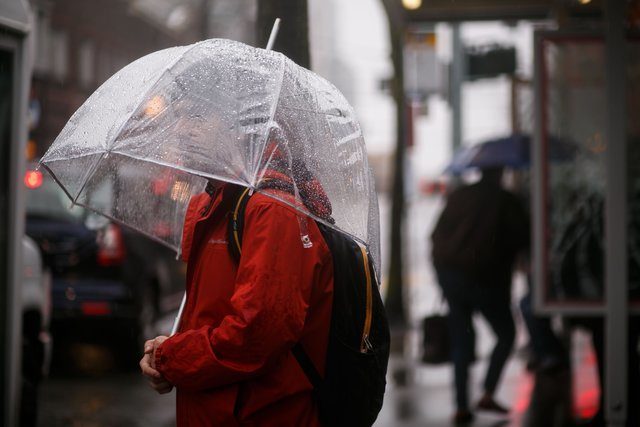
umbrella man
© Erika Schultz/The Seattle TimesJeremy Kahn waits for the bus in the rain in West Seattle last month.
The wet just won't quit.

Seattle has soaked up 44.67 inches of rain since October 1, according to the National Weather Service.

That makes this October-through-April the wettest such period since record-keeping began in the city in 1895 — and there's still another week of April left to go.

The normal amount of rainfall for the October-through-April period in Seattle is 30.9 inches, according to the service.

Cloud Precipitation

Hailstorm devastates apple, peach, walnut and apricot orchards across Kashmir, India

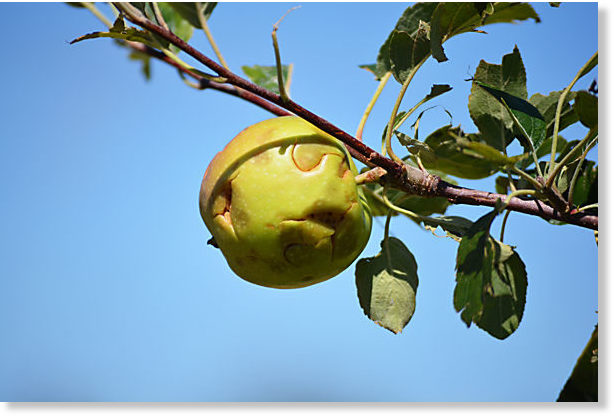
Representative image
Locals and witnesses said the hailstorm started at 9 PM on Sunday and continued for more than 15 minutes. "It caused extensive damage to the orchards and almost all the growing crop of fruit was lost,"

Heavy hailstorm caused extensive damage to apple and walnut orchards in many villages of Tral in south Kashmir's Pulwama district late Sunday night.

The affected villages include Satura, Hajin, Naristan, Deedarpora and Lam.

Locals and witnesses said the hailstorm started at 9 PM on Sunday and continued for more than 15 minutes. "It caused extensive damage to the orchards and almost all the growing crop of fruit was lost," they said.

Comment: The Spring weather is certainly behaving oddly worldwide - and just in the last day or so:

13 cm of snowfall as late-season storm hits Regina, Saskatchewan
April showers? Southern Manitoba hit with snowfall instead
Hard freeze kills 95 to 100 percent of France's Alsace vineyard buds
Turkey greenhouses collapse due to snowfall
Snow across Wales as Arctic winds sweep across the country


Attention

Woman injured in shark attack off Ascension Island

Shark attacks
A British woman attacked by a shark while swimming off the beach of an island in the South Atlantic has been named locally as Frankie Gonsalves.

The woman, who works for the government of Saint Helena, was attacked while swimming off Ascension Island, a government spokeswoman said.

The spokeswoman said she believes the woman had been living on Saint Helena island, part of the same British overseas territory, with her husband and children.

The victim is being treated at a nearby hospital, she added.

Wolf

Man mauled by dog dies in Dayton, Ohio

Dog attack
A man mauled by a dog in Dayton has died. The dog suspected in the attack was shot and killed by police.

The attack happened in an alley in the 300 block of Middle St. around 4:40 a.m. on Tuesday.

Officers went to the scene after a 911 caller reported hearing someone screaming for help and crying. The caller also reported hearing several dogs barking loudly.


Comment: Other severe canine attacks in the last few days: 8-month-old baby attacked, seriously injured by Pit Bull in Medford, Oregon

Girl, 2, hospitalized after attack by family dog in Martinsburg, Missouri

Jogger fights for his life after pitbull attack in Durban, South Africa

Boy, 4, taken to Wolfson after being mauled by dog in Arco, Georgia

4-year-old child attacked by family dog in Vista, California


Ice Cube

Hard freeze kills 95 to 100 percent of France's Alsace vineyard buds

Alsace Grand Cru
© Alsace Grand Cru stock photo
Temperatures dropped to -7 ° C, reports a reader in France. "About the frosts in different places around Europe in the last days, there have been severe frosts in France in fruit and vine too," writes Philippe in Alsace. "Severe losses in vine in Champagne and Chablis (despite fighting with burning fuel or paraffine in the fields ), Alsace and even in south of France in Languedoc and Provence.

"The crops had 2 weeks advance and the clear sky in the last days allowed these spring frosts. Main frost in Alsace on the early morning of 20th of april, and then on the 21st too. 5°C to 7 °C under zero on the 20th depending on the places.

Here are words from an article that Philippe sent.
Frost and negative (below-zero) temperatures have caused great damage in the vineyards of Alsace, France.

"In many places, there are 95 to 100% loss of buds," says Gérard Schaffar, president of the Turckheim cellar in Haut-Rhin.
Here's the article in French

Snowflake

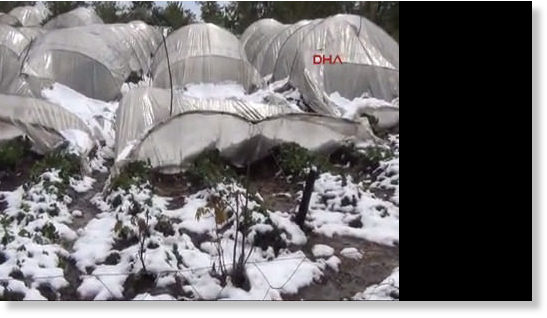
Turkey greenhouses collapse due to snowfall

turkey strawberry greenhouses
13,000 acres of strawberry production are greatly damaged. "This must be the greenhouse effect," says reader. Explaining that the greenhouses had collapsed due to snowfall, İnegöl Chamber of Agriculture President Sezai Çelik said that ​​13 thousand acres of strawberry production was damaged to a great extent.

Strawberries - the fruit called "red gold" - are one of the most important agricultural products of İnegöl, a city in the Bursa Province in Turkey.Sezai Çelik said: "The great majority of the subalterns were damaged and it was not expected to be such a snowfall on April 23."

Farmers worry that after the snowfall may come freezing, which will cause even greater damage. With 190 thousand acres of fruit in the field, we do not want to even think about it, said Celik. Ali Soldildi, a strawberry farmer, said "there is a serious damage to the products because of the untimely falling snow on April 23." Thanks to Argiris Diamantis for this link.

"This must be the greenhouse effect," says Argiris. "Heavy snowfall causes the collapse of the greenhouses."