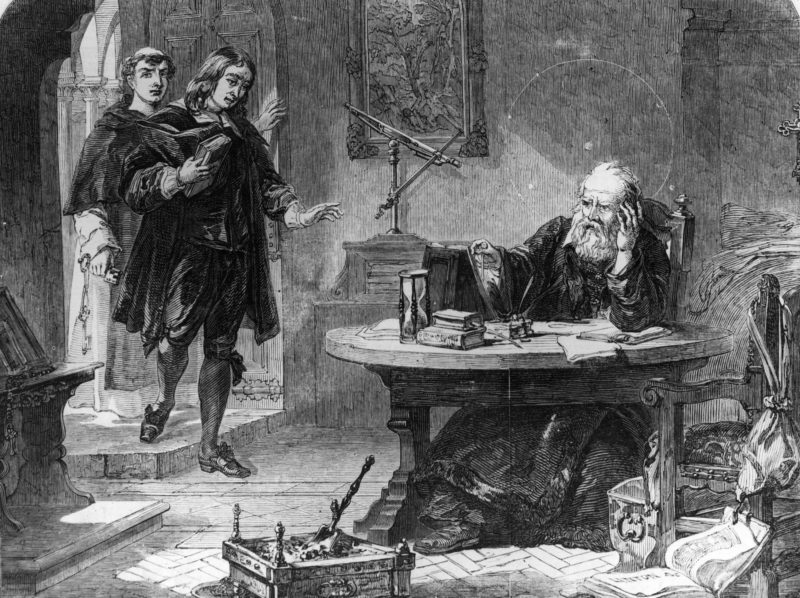
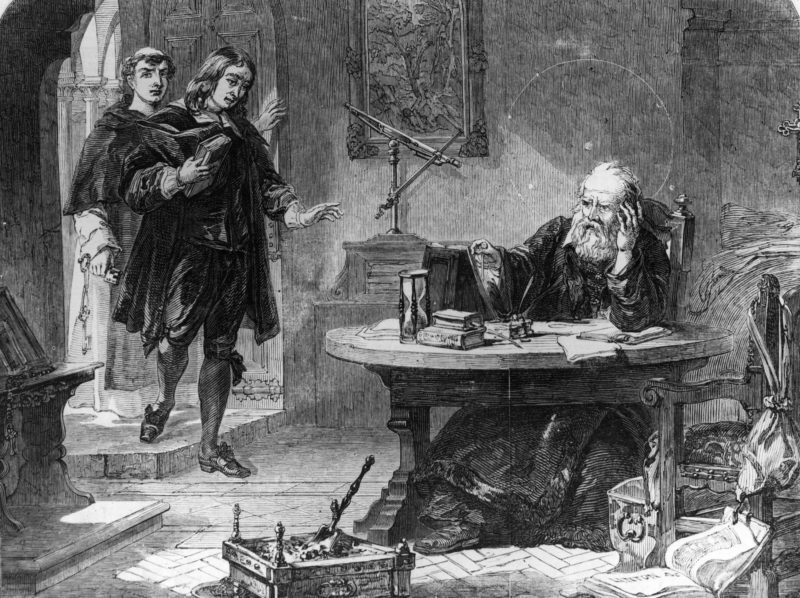
© GettyJohn Milton visiting Galileo.
To accompany the publication of his new book, Free Speech And Why It Matters, Andrew Doyle explains why censorship impoverishes us all.Our scene begins on a lake of fire. Satan has been cast into Hell after a failed rebellion against God, and is fixed in chains along with his cohort of fallen angels. He assures his second-in-command, Beelzebub, that their defeat is only temporary, and that he intends to recover and continue the struggle against the 'tyranny of heaven'. He breaks free and flies to dry land where he calls on his army to reassemble.
This is the dramatic opening of
Paradise Lost (1667), John Milton's epic poem about the fall of man. Amid Satan's company of demons and counterfeit pagan gods there is an unexpected cameo which takes the form of a topical allusion. As Satan strides across the fiery landscape, Milton focuses our attention on his mighty stature by comparing his spear to 'the tallest pine / Hewn on Norwegian hills', and his shield to 'the moon, whose orb / Through optic glass the Tuscan artist views'. This is Galileo, the only one of Milton's contemporaries to be immortalised in
Paradise Lost, here depicted with the recently invented telescope that he had adapted for the purposes of astronomical observation. Like Satan, he was cast out of favour for challenging the prevailing orthodoxies of his time - the evidence of his studies had persuaded him of the validity of the Copernican theory of the Earth's motion around the Sun - but unlike Satan, Galileo was right.

















Comment: Palantir has its fingers in many surveillance pies: