
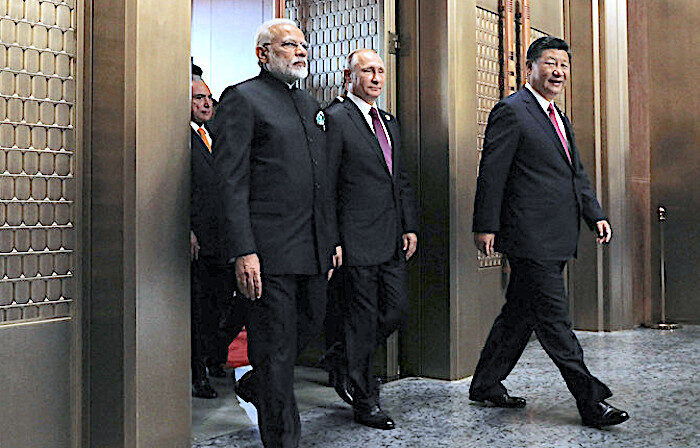
© Tyrone Siu/AFPIndian Prime Minister Narendra Modi • Russian President Vladimir Putin
Chinese President Xi Jinping • BRICS Summit
Xiamen International Conference and Exhibition Center • Xiamen, Fujian Province
Chinese President Xi Jinping • BRICS Summit
Xiamen International Conference and Exhibition Center • Xiamen, Fujian Province
Predicting the future is the most thankless task when it comes to international politics. All of the genre, in fact, because it involves the interaction of living human beings. That means it is subject to chance, elementary error, and the influence of emotion. If this were not so, history would indeed go straight on "like the sidewalk of the Nevsky Prospect," the main thoroughfare of St. Petersburg.
But not only is history unpredictable, it doesn't repeat itself, which makes it utterly pointless to try to predict specific turns of events. The only thing we can talk about with relative certainty is the development of the major trends we can already see today.
In the coming year 2024, Russia will definitely be the largest continental country in the world with the opportunity to develop ties in several geographical directions at once: To trade with its neighbors, to build new transport and logistics systems, and to thwart its opponents' attempts to isolate it.
The United States will remain the largest "political island," whose security and development, in principle, depend very little on what happens in its immediate surroundings.
China will remain a country with a huge population and economy in need of external markets and resources.
The European Union will continue to "sit on the windowsill" in the far west of Eurasia, always critically dependent on resources from outside. But it is no longer in a position to extract them on its own.
Central Asia, which is close to us, will remain an important link between Russia and China. The fate of states in that region, like that of the rest of the world, will be determined by the trends in world politics that we have seen in 2023.



















Comment: See also: