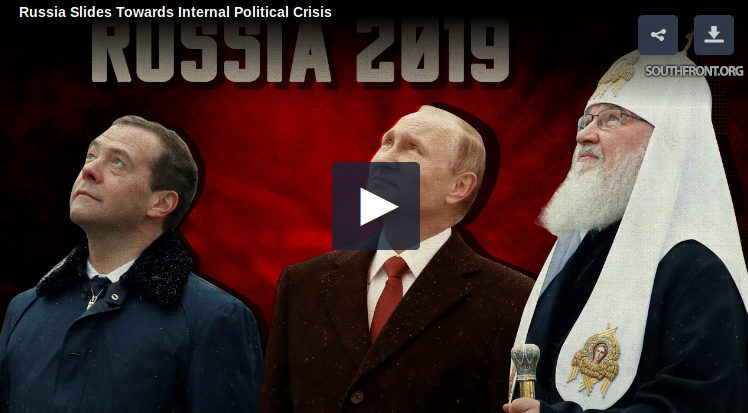
Screenshot of video posted below
The Russia of 2019 is in a complicated economic and even political situation.
Smoldering conflicts near its borders amid continued pressure from the US and NATO affect the situation in the country negatively. This is manifested in society and in national politics. The approval rating of the Russian government and personally of President Vladimir Putin has been decreasing.
According to VCIOM, a state pollster,
in January 2019, Putin's confidence rating was only 32.8%. This is 24% less than in January 2018 when it was 57.2%. At the same time, the confidence rating of Prime Minister Dmitry Medvedev was 7.8%. The approval rating of his cabinet is 37.7% while the disapproval rating is 38.7%. Opposition sources show data, which is far worse for the current Russian leadership.
This tendency is not linked to the foreign policy course of the Kremlin. Rather,
it's the result of the recent series of liberal-minded economic reforms, which look similar to the approaches exercised by the Russian government in the mid-1990s.
The decision to increase Value Added Tax amid the slowing Russian economy, especially in the industrial sector,
and a very unpopular pension reform increasing the retirement age were both factors contributing to the further growth of discontent in the population.











Comment: Ukraine is an utter mess - too corrupt and disorganized to even get its act together enough to be the proxy force against Russia that the US would have them be! See also: