Puppet MastersS


Putin

Putin slams idea that Hitler & Stalin share equal responsibility for WW2 as 'garbage' promoted by 'ignorant people' in EU Parliament

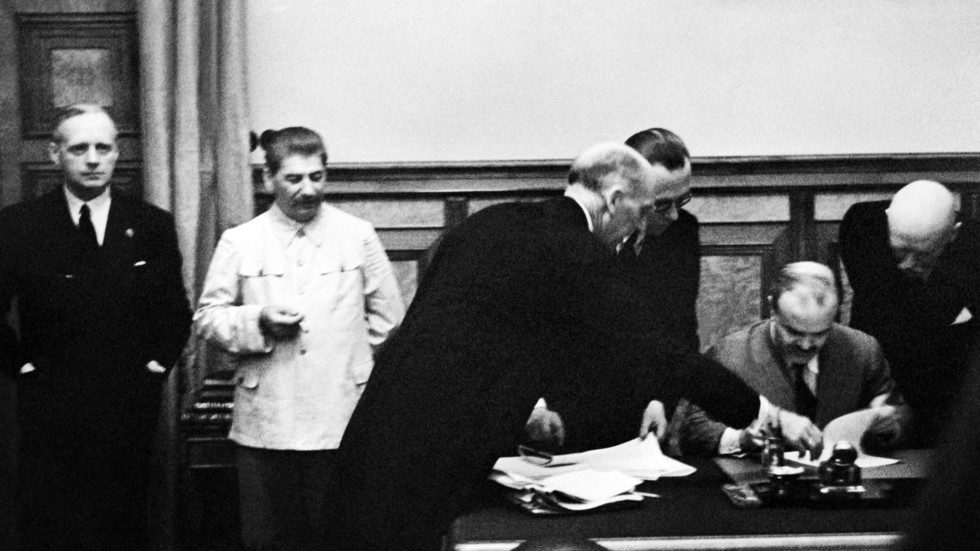
Joachim Von Ribbentrop Stalin Molotov
© Agence France-PresseGerman Foreign Minister Joachim Von Ribbentrop (L), Joseph Stalin (2nd L) and the Soviet Foreign Minister Vyacheslav Molotov (R)
Vladimir Putin has lashed out at the European Union, which now holds Nazi Germany and the USSR equally responsible for starting World War Two. The Russian President is concerned at ongoing historical revisionism.

Putin also pointed out that, unlike the European Union, Russia has condemned the secret articles in the controversial Molotov-Ribbentrop Pact, signed in 1939 by Moscow and Berlin.

He recalled the tumultuous end of the 1930s in the latest episode of TASS news agency's 20 Questions to Vladimir Putin, which focused entirely on the wartime period.

Comment:


Snakes in Suits

Joe Biden calls factory worker 'full of s**t', shushes female staffer

biden
© Reuters / Brendan McDermid
Joe Biden ended up in a shouting match with a Michigan factory worker who accused him of trying to take Americans' guns away, resulting in the former VP calling the voter a "horse's ass" and saying he is "full of s**t."

The man accused Biden of "actively trying to end our Second Amendment rights" at a campaign stop on Tuesday as voters headed to the polls for the crucial Michigan primary.

"You're full of s**t," an incensed Biden shot back.

Sensing disaster, a female staffer attempted to rescue Biden and usher him on, but he quickly brushed her off, telling her: "No. Shush. Shush."


Biden then told the gathered voters that he supports the second amendment and he is "not taking your guns away at all."

Comment: Nice to know Biden can keep his cool while dealing with low levels of criticism and minor pressure. Another angle:


See also:


Question

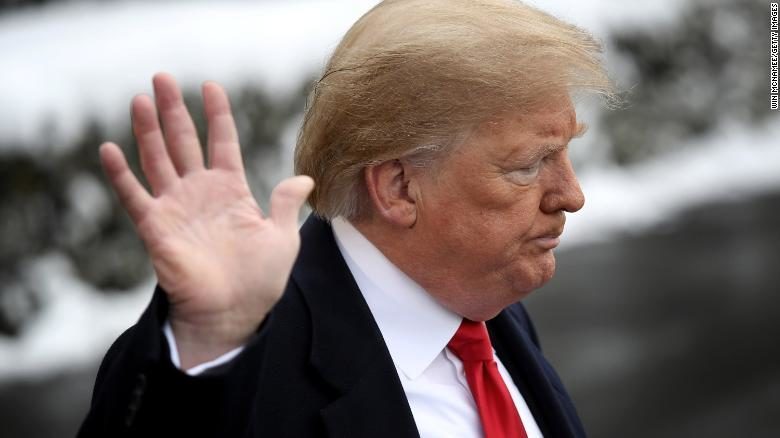
75 years after Russia & America worked as allies to defeat Hitler, Trump refuses Putin's Moscow celebrations invite

trump
© Wim MacNamee/Getty
While the 'Russiagate' hoax kept millions entertained in the fantasy world of US cable news, it also had plenty of real-world consequences. Now another can be added to the list: the White House's absence from Moscow on May 9.

US President Donald Trump has rejected Vladimir Putin's invitation to the Russian capital to mark the 75th anniversary of the World War II victory over Nazi Germany, according to Kremlin Spokesman Dmitry Peskov.

Trump's non-attendance, which could be seen by many in Russia as an extraordinary affront to Soviet Russia's disproportionate sacrifice in annihilating fascism, marks an incredible U-turn after he previously showed a willingness to come to the May 9th parade. It can only be presumed that fear of being seen in Moscow during an election year forced the president's hand, given he has endured years of bizarre smears about his supposed connections to Russia.

Comment: Trump is known to have benign, if not warm feelings for Russia, and a personal liking for Putin. It would be a shame that the optics of a visit on such an important occasion would dictate his attendance.


Control Panel

Russian parliament tables proposal to allow Putin run again in 2024 Presidential elections

Russian Parliament
© Reuters / Evgenia Novozhenina
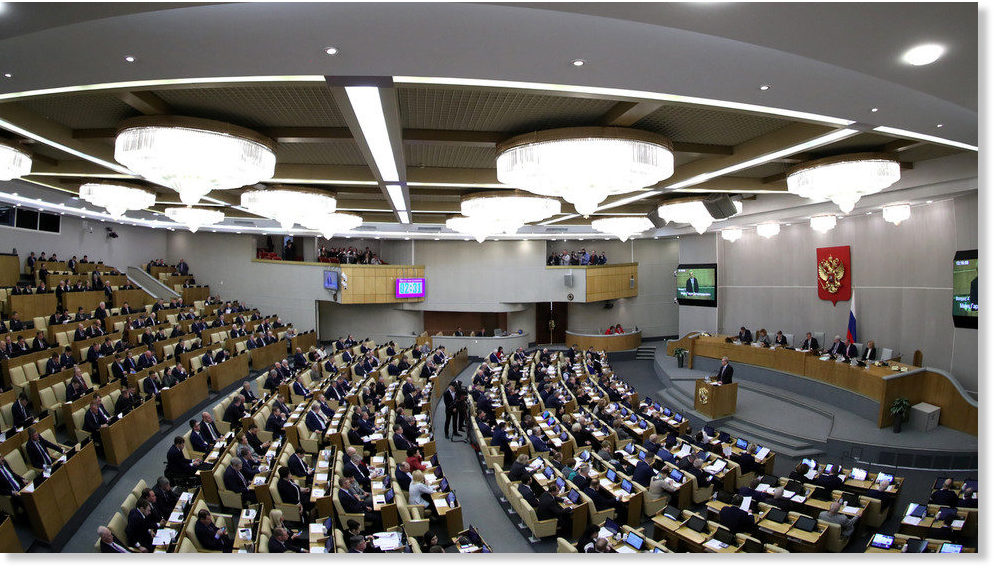
Proceedings in Russia's State Duma have been temporarily suspended and President Vladimir Putin is set to make an address this afternoon. It comes after a suggestion that Presidential term limits could be re-set.

The idea was floated by Valentina Tereshkova, an MP from the ruling 'United Russia' party, who is also famous for being the first woman in space. She wants to give the incumbent head of state a chance to compete in the 2024 Presidential election.

Under existing rules, Putin must stand aside after the current mandate, his fourth, ends. However, putative constitutional changes currently being discussed would limit future Presidents to only two terms. Tereshkova wants to start the clock again, making Putin eligible for two more runs before he would be bound by the new restrictions.

In her speech, she said in the situation Russia now faces [economically and politically] there are "unpredictable risks" meaning "reliable insurance" is needed.

"This insurance, I am 100% sure, is from strong Presidential power and the moral authority of the person who holds the post," Tereshkova explained. "The question is not really about him [Putin], it is about us, the citizens of Russia, and its future... why make any artificial structures? Everything must be honest and transparent."

Her speech was met with applause. The head of the United Russia parliamentary party, Sergei Neverov, said it would support such an amendment. Meanwhile, Vyacheslav Volodin, the house speaker, said the initiative required consultation with the president himself and leaders of all Duma parties.

Comment: As for the other issues Putin had proposed, Russia's Parliament had responded favorably:
Russian MPs have voted in favor of a bill to amend the country's Constitution. The changes include broadening the powers of parliament as well as limiting the number of lifetime presidential terms for one person.

The bill was supported by 382 deputies during the second and main reading on Tuesday. 44 MPs abstained from the vote, mostly members of the opposition Communist party.

Russians will head to the polls to vote on the proposed constitutional changes on April 22. Amendments to the country's' principal law, among other things, include redistributing some powers away from the president to the Duma, restricting the president to two overall terms, banning officials from having foreign citizenship and setting the minimum wage above the basic cost of living.

During his speech in the parliament's lower house (Duma), Putin pointed out that this was "long overdue."

The changes are aimed at strengthening the country's sovereignty and traditions, while creating the conditions for "for steady, positive, evolutionary development of Russia in the long-term historical perspective."
President Putin also rejected an initiative for early elections which was a point of contention among some MPs:
Vladimir Putin said he saw no need to hold snap parliamentary elections after the adoption of proposed amendments to Russia's Constitution. The idea had been floated on Tuesday in the lower house of the Russian parliament.

If there's a lack of consensus on the issue among MPs and "there's no such unity as the chairman [of the Parliament Vyacheslav Volodin] told me than I don't see any need for an early election to the State Duma," Putin said in an address parliament on Tuesday.

The proposed amendments to the Constitution will transfer some of the presidential powers to the parliament, thus raising the question: "Does this State Duma in its current composition have the right to take on those new responsibilities?" he said.

But if the people, who go to the polls on April 22, back those amendments then they'll confirm the Duma's new authority.
The people are the only source of power and if they say so the issue will be off the table.
MP Alexander Karelin, from the ruling United Russia party, who came up with the idea of a snap election, removed his motion from consideration by the Duma after Putin's address.

Earlier on Tuesday, the three-time Olympic wrestling champion argued that "it would be only fair" to hold a new vote as the president is looking to increase the role of the parties in ruling the country.

State Duma veteran Vladimir Zhirinovky of the Liberal Democratic Party, who was initially supportive of Karelin's proposal, joked that Putin's words became a huge relief for some of his colleagues who were "close to a heart attack" due to the possibility of an early election.

[...]


Target

Extortion? Erdogan demands NATO give 'assistance' on Syria and migrant release, as his plans derail

Migrants
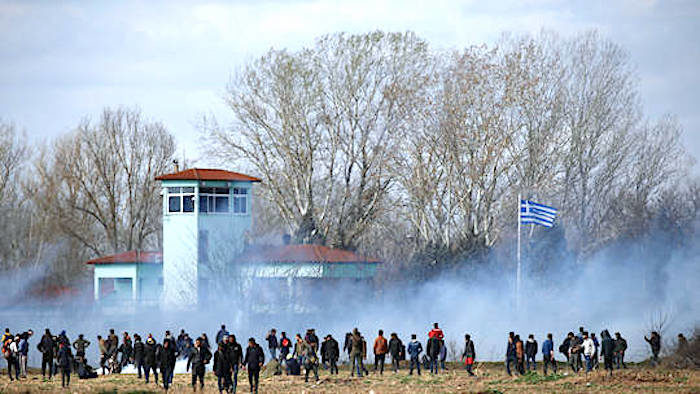
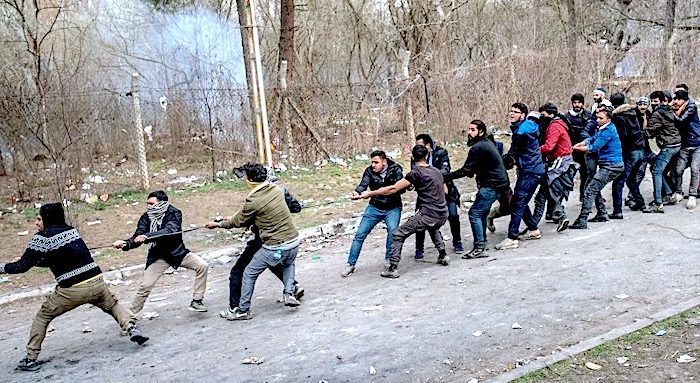
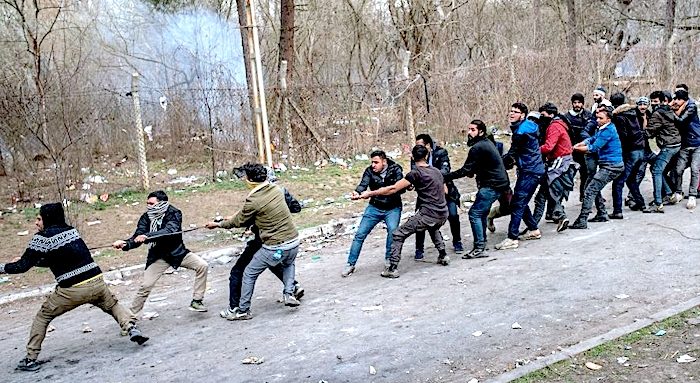
© Reuters/Huseyin AldemirMigrants gather on the Turkish side of the border at Pazarkule crossing in Edirne, trying to break through into Kastanies, Greece, March 7, 2020.
Turkish President Recep Tayyip Erdogan is in Brussels, demanding help from NATO with both the conflict on his southern border and the migrants he tried to unleash on the West, now that neither situation is going according to plan.

After meeting with NATO Secretary General Jens Stoltenberg on Monday, the Turkish leader said he requested "additional assistance" from the alliance, for the "defense" of the Turkish border with Syria and "in connection with the migration challenge."

"We expect concrete support from all our allies to this struggle," Erdogan added, urging the allies to support Turkey "without discrimination and with no political preconditions."

Comment: See also:


Footprints

US troop withdrawal from Afghanistan has begun

Chopper Afghanistan
© Thomas Watkins/AFP
A U.S. official says U.S. forces have begun leaving Afghanistan under the first phase of an initial troop withdrawal required under the newly signed U.S.-Taliban peace agreement. The official, who spoke on condition of anonymity, told the Associated Press on March 9 that hundreds of U.S. soldiers are now heading out of Afghanistan.

He said the soldiers originally were meant to leave under a rotation plan created before the peace deal was signed in Doha on February 29. With the peace deal, however, the official said the departing U.S. soldiers will not be replaced.

That means the United States is now effectively moving ahead with an initial reduction of U.S. troops in Afghanistan from about 13,000 to 8,600 soldiers. The long-term plan is for the United States to withdraw all troops from Afghanistan within 14 months if security conditions are met.

But a political dispute over the official results of Afghanistan's September 2019 presidential election threatens to complicate Washington's attempts to move forward on the U.S.-Taliban agreement and end Afghanistan's 18-year war. Afghanistan's rival leaders -- President Ashraf Ghani and former Chief Executive Officer Abdullah Abdullah -- were each sworn in as president in separate, parallel ceremonies on March 9.

Comment: See also:


Rocket

Afghanistan: Ghani's presidential inauguration ceremony interrupted by nearby ISIS rocket attack

Ghani
© AFP/Getty Images/Wakil KohsarAfghan President Ashraf Ghani at the swearing-in ceremony interrupted by rocket blasts.
Afghan President Ashraf Ghani's inauguration ceremony was interrupted by the sound of explosions Monday after a suspected rocket attack claimed by the Islamic State militant group (ISIS).

Ghani was delivering a speech at the podium outside the presidential palace in the capital Kabul when the explosions were heard, causing the recently re-elected leader to pause and stirring a brief panic among attendees. The president returned to the mic and stated he would not be intimidated by a suspected attack.

The Afghan president then opened his suit to reveal he was not wearing a bulletproof vest and announced that he would sacrifice himself for his country and its people. The source of the explosions and the number of injuries was not clear.

Hours later, ISIS' official news agency Amaq published a statement claiming that
"soldiers of the caliphate targeted the inauguration of the tyrant (Ashraf Ghani) near the presidential residence in the (fourth) district of the city of Kabul with ten rockets, and the injury was delivered, praise be to God."
The blasts came as the country is struggling to overcome ongoing unrest in the wake of a historic peace deal signed by the United States and the Taliban.

Comment: Twitter captured the explosions as President Ghani was speaking:
See also:


No Entry

Europe must not fall victim to Erdoğan's migrant blackmail

Migrants pull fence
© Bulent Kilic/AFP/Getty ImagesMigrants at the Turkey-Greece border try to pull down the Greek border fence and enter Greece, near Edirne, Turkey, on March 4, 2020.
Turkey's Islamist strongman, President Recep Tayyip Erdoğan, has threatened Europe several times with "sending millions of refugees your way." Turkey would apparently like to see more progress in the talks to grant it admission as a full member of the European Union. At the moment, these membership negotiations have stalled. He may also wish for Western support -- from the EU, the United States and all of NATO -- for his ideal architecture to install Turkey in northwest Syria.

As Turkish servicemen were recently killed in Syria, with direct Russian military involvement, it is probably safe to assume that the support Erdoğan is seeking, both directly and indirectly, is "support for a NATO ally against Russian aggression". In addition, Erdoğan would also most certainly like the West overlook his massive democratic deficit, and to help Turkey secure even more dominance over the Greek islands off its coast, as well as its claims on the gas fields beneath the eastern Mediterranean.

On February 27, the Turkish government finally pressed the button to execute the threat: Millions of (mostly Syrian) migrants on Turkish soil were now free to travel to Europe; Turkish border gates were now open.

Why did Erdoğan decide now to resort to the "nuclear option" in his country's deeply problematic relations with the European Union? It seems, bizarrely, that Erdoğan decided to punish the EU because he was angry with... Russia.

Comment: See also:


Calendar

60 days notice: Republika Srpska threatens secession from Bosnia

Milorad Dodik
© AP/Darko VojinovicMilorad Dodik, the Serb member of Bosnia’s multiethnic presidency
Lawmakers in Republika Srpska (RS), Bosnia's Serb entity, have given a 60-day deadline for the reform of Bosnia's Constitutional Court, threatening secession following the court's rejection of a move by Bosnian Serbs to claim federal agricultural land.

During an extraordinary session on February 17, Bosnian Serb lawmakers voted 72-2 to suspend the work of all RS representatives in Bosnia's institutions until the federal parliament terminates the mandates of the three international members of the Constitutional Court.

Addressing Republika Srpska's legislature in Banja Luka on February 17, Milorad Dodik, the Serb member of Bosnia's multiethnic presidency, said: "Goodbye [Bosnia], welcome [Republika Srpska's] exit. We will see each other in 60 days."

Following the 1995 Dayton peace accords that ended the Bosnian war, three foreign judges serve on the court along with two Croats, two Muslims, and two Serbs.

Tensions have flared in Bosnia since the Constitutional Court earlier this month ruled that unclaimed agricultural land automatically became the property of the central Bosnian state rather than Republika Srpska -- contradicting Bosnian Serb law.

Comment: See also:


Bad Guys

US-led coalition forces withdraw from base in western Iraq

US troops in Iraq
The US-led coalition has fully pulled out its forces from a base in the al-Anbar Province in western Iraq, security sources said on Monday amid increasing efforts by Baghdad to expel the United States military from the country.
"All forces and equipment of the US-led coalition have withdrawn from a base in the Southern parts of al-Qaem," the security source told the Arabic-language al-Soumeriyeh news website.
He added that the US-led coalition forces were pulled out from a base near the al-Fousfat railway station in the southern parts of al-Qaem, 310km away from western Ramadi in al-Anbar near the borders with Syria. The source said the military equipment deployed at the base has been transferred to Ein al-Assad base in the al-Baghdadi district.

Comment: But will this relatively small withdrawal (or relocation) count for much? Quite probably not: