Science & TechnologyS


Question

'Alien megastar' darkens again

Tabby's Star
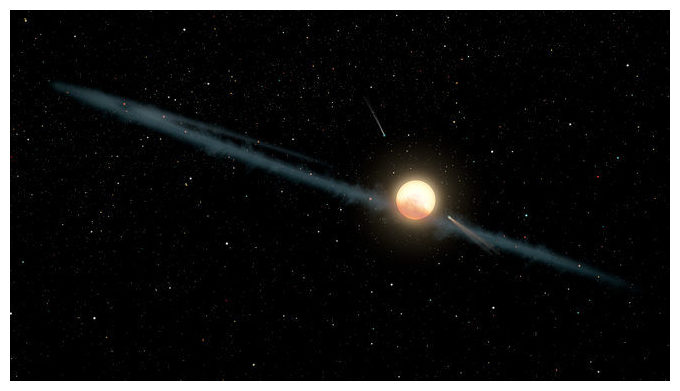
© NASA/JPL-CaltechAn artist's illustration depicting a hypothetical dust ring orbiting Tabby's star, more formally known as KIC 846.
A faraway megastar that once raised questions about aliens because of its weird pattern of dimming has darkened once again.

By now, though, researchers have figured out that it's not an alien megastructure that is causing the dimming; it's just dust. Still, astronomer Tabetha Boyajian of Louisiana State University and colleagues are keeping a close eye on the far-off star, trying to figure out what the dust is and where it came from. On March 16, the brightness of the star started dipping, Boyajian and her colleagues reported on their blog. The dip in brightness was the largest observed dip in the star since 2013, Boyajian wrote.

As of March 22, the star's brightness was increasing rapidly and was almost back to normal.

Satellite

'Out-of-control' Chinese space station Tiangong-1 will crash back down to Earth next weekend

People's Republic of China (PRC) manned spacecraft (Shenzhou)
© GettyPeople's Republic of China (PRC) manned spacecraft (Shenzhou) docking with space station (Tiangong) in Earth orbit
The European Space Agency has revised its prediction for when free-falling Tiangong-1 will crash into Earth.

The out-of-control Chinese space station will crash down back to Earth over Easter weekend, experts have said.

According to the European Space Agency's Space Debris Office in Darmstadt, Germany, debris from Tiangong-1 will splash down between March 30 and April 2 across the northern hemisphere.

The space agency said these dates were "highly variable" and that it would be offering revised forecasts every couple of days.

"At no time will a precise time/location prediction from ESA be possible," it explained in a statement .

"This forecast was updated approximately weekly through to mid-March, and is now being updated every 1~2 days."

Brain

LSD experiment: Scientists tentatively identify the brain receptor responsible for sense of self

psychedelic brains
© Sangoiri/Shutterstock
Scientists in Switzerland dosed test subjects with LSD to investigate how patients with severe mental disorders lose track of where they end and other people begin.

Both LSD and certain mental disorders, most notably schizophrenia, can make it difficult for people to distinguish between themselves and others. And that can impair everyday mental tasks and social interactions, said Katrin Preller, one of the lead authors of the study and a psychologist at the University Hospital of Psychiatry in Zurich. By studying how LSD breaks down people's senses of self, the researchers aimed to find targets for future experimental drugs to treat schizophrenia.

"Healthy people take having this coherent 'self' experience for granted," Preller told Live Science, "which makes it difficult to explain why it's so important."

Scientists in Switzerland dosed test subjects with LSD to investigate how patients with severe mental disorders lose track of where they end and other people begin.

Bizarro Earth

Mount Etna: Europe's biggest volcano 'sliding towards the sea'

Mount Etna
© GettyMount Etna is in an almost constant state of activity, with eruptions occurring particularly regularly in recent decades
Scientists say they will 'need to keep an eye on' gradual movement as it could lead to future landslides and affect eruption forecasting

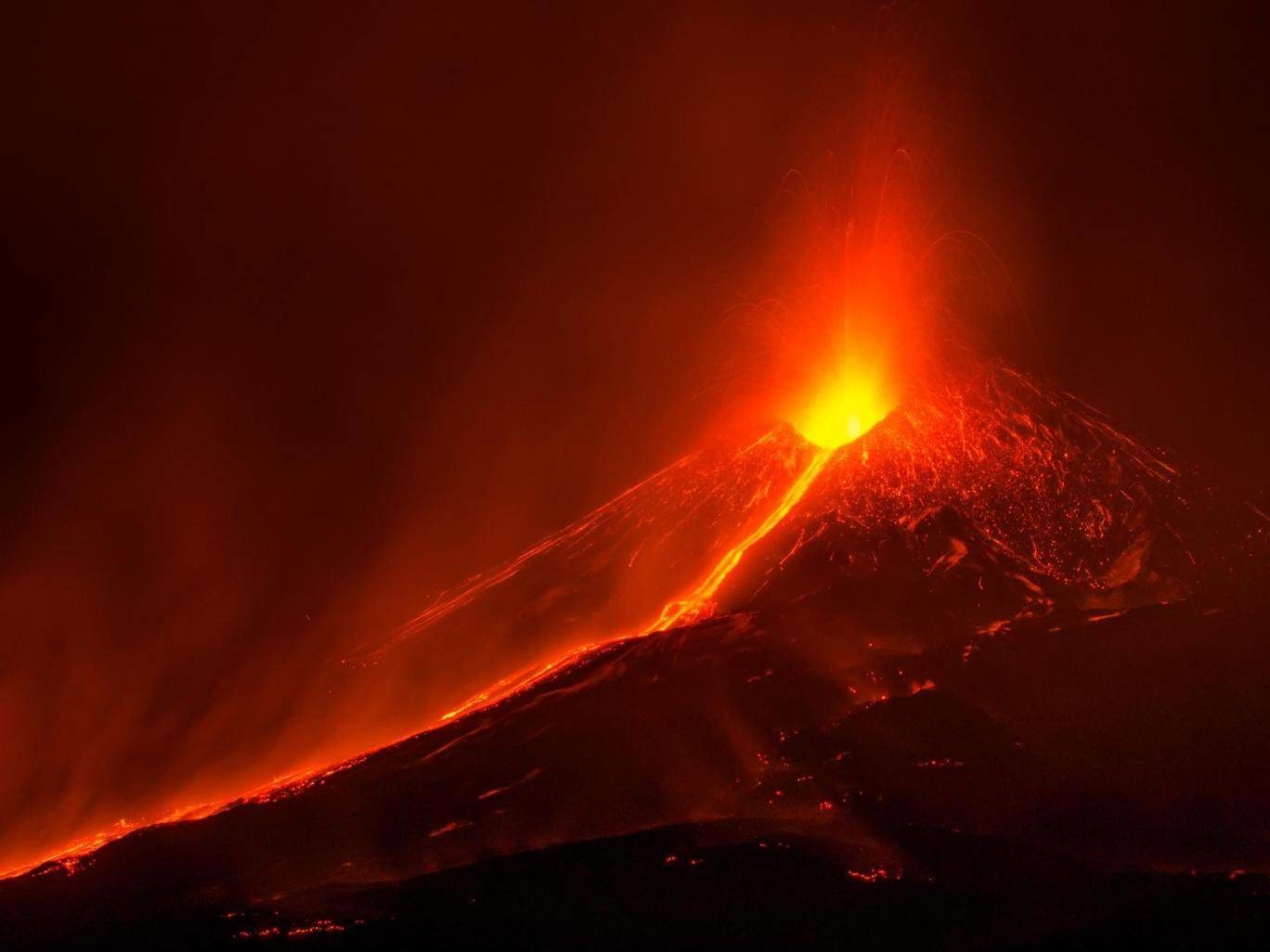
The most active volcano in Europe is slowly sliding into the sea, according to new research.

Mount Etna - located on the Italian island of Sicily - is edging towards the Mediterranean at a rate of around 14mm per year.

While its movement may seem too slow to cause any concern, scientists studying the geology of the volcano have said the situation will require careful monitoring.

"I would say there is currently no cause for alarm, but it is something we need to keep an eye on, especially to see if there is an acceleration in this motion," lead author Dr John Murray told the BBC .

This is the first time downward "basement sliding" of an entire active volcano has been directly observed.

However, studies of extinct volcanoes suggest this phenomenon can lead to "devastating" collapse of their downslope sides, resulting in landslides.

Comment: Radon, slosh dynamics and Mount Etna's unrest


Mars

New study: Comets and asteroids strike Mars with organics

Comets and asteroids shower Mars with organics
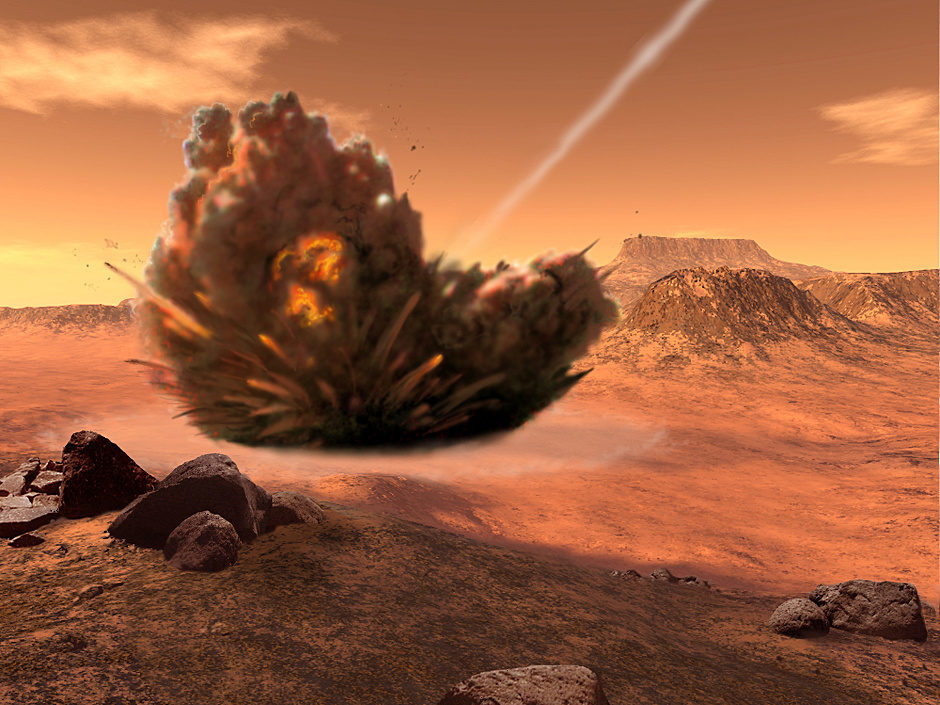
© Arizona State University/Ron MillerA new study suggests that impacts by comets and asteroids, which both contain organic compounds, are responsible for roughly 30 percent of the organic material found on the martian surface. This artist’s concept (from a proposed but not flown Mars Scout mission) shows the impact of a high-velocity probe similar to a large meteorite
For decades, astronomers suspected that Mars might be teeming with organics, which are carbon-based molecules like proteins, carbohydrates, and nucleic acids. However, it wasn't until 2015 that the Mars Curiosity rover uncovered the first evidence showing these life-supporting compounds were not only present, but also likely scattered all over the Red Planet.

At the time, astronomers suspected that organics were hitchhiking to Mars almost exclusively aboard tiny, interplanetary dust particles (which are incredibly common and cause most meteors here on Earth). But now, just three short years later, new research suggests otherwise.

In a new study set for publication on July 15 in the journal Icarus, an international team of researchers found that about one-third of the organic material on Mars was delivered there by asteroid and comet strikes. To determine this, the researchers created a computer model of the solar system that included hundreds of thousands of asteroids and comets. Then they used Peregrine - a supercomputer at the University of Groningen in the Netherlands - to run multiple simulations.

Cassiopaea

Possible nova in constellation Carina

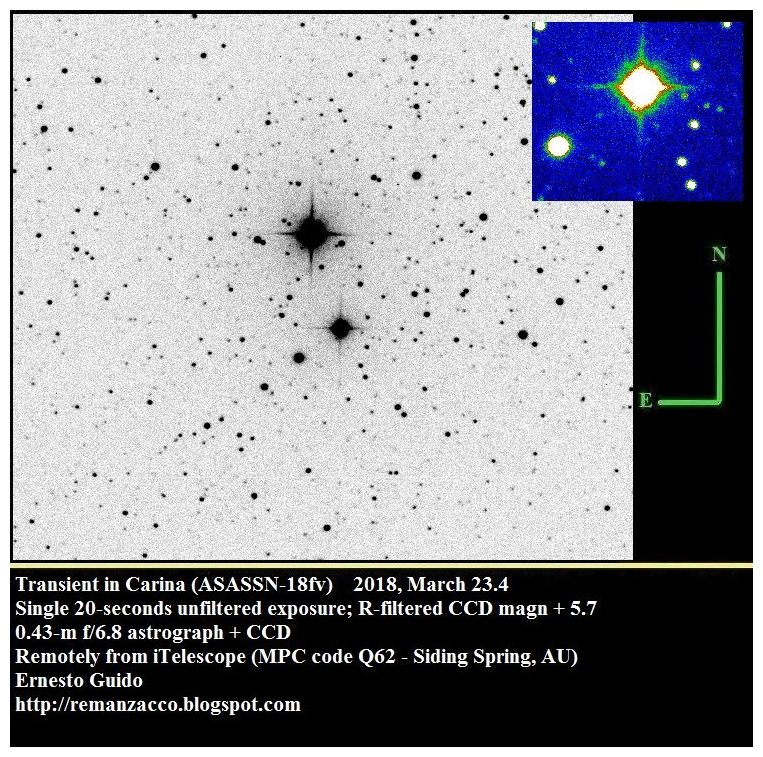
Following the posting on the ATel #11454 about the discovery by All Sky Automated Survey for SuperNovae survey (ASAS-SN) of a new transient source, possibly a classical nova, near the Galactic plane in Carina (ASAS-SN Designation: ASASSN-18fv) I performed some follow-up of this object through a 0.43-m f/6.8 astrograph + CCD from MPC Code Q62 (iTelescope Observatory, Siding Spring).

On images taken on March 23.4, 2018 I can confirm the presence of an optical counterpart with R-filtered CCD magnitude +5.7 at coordinates:
R.A. = 10 36 15.42, Decl.= -59 35 53.7

(equinox 2000.0; UCAC-4 catalogue reference stars).

Below you can see my confirmation image (single 20-sec exposure through a 0.43-m f/6.8 astrograph + CCD), click on it for a bigger version:

Nova in Carina
© Remanzacco Blogspot

Fire

Radon, slosh dynamics and Mount Etna's unrest

Radon Tells Unexpected Tales of Mount Etna’s Unrest
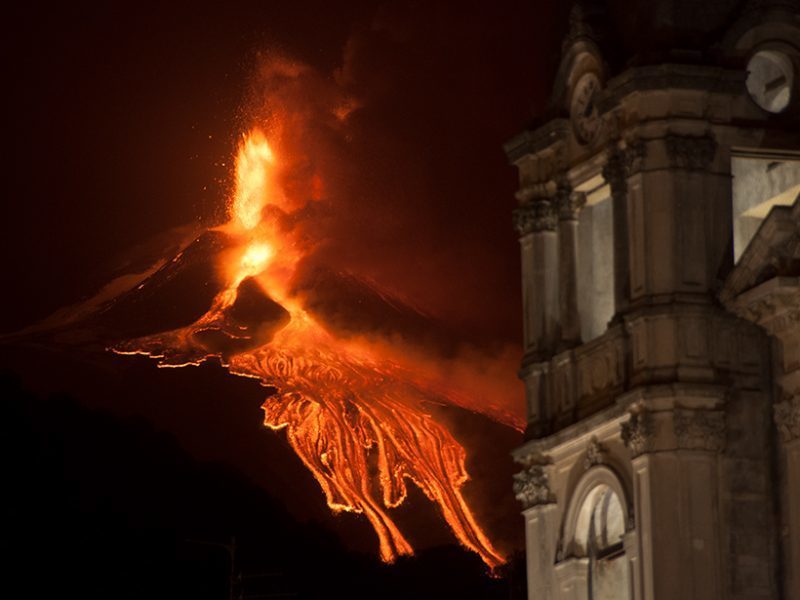
© Marco NeriMount Etna in Sicily, Italy, spews lava from a Strombolian and effusive eruption on 24 April 2012. The church Santa Maria della Provvidenza stands in the foreground in the town of Zafferana Etnea on the mountain's eastern flank. New research from a team studying the volcano finds that variations in its radon emissions provide insights into volcanic and tectonic influences inside the mountain and, for some seismic activity, up to tens of kilometers away.
Readings from a sensor for the radioactive gas near summit craters of the Italian volcano reveal signatures of such processes as seismic rock fracturing and sloshing of groundwater and other fluids.

Some researchers view radon emissions as a precursor to earthquakes, especially those of high magnitude [e.g., Wang et al., 2014; Lombardi and Voltattorni, 2010], but the debate in the scientific community about the applicability of the gas to surveillance systems remains open. Yet radon "works" at Italy's Mount Etna, one of the world's most active volcanoes, although not specifically as a precursor to earthquakes. In a broader sense, this naturally radioactive gas from the decay of uranium in the soil, which has been analyzed at Etna in the past few years, acts as a tracer of eruptive activity and also, in some cases, of seismic-tectonic phenomena.

To deepen the understanding of tectonic and eruptive phenomena at Etna, scientists analyzed radon escaping from the ground and compared those data with measurements gathered continuously by instrumental networks on the volcano (Figure 1). Here Etna is a boon to scientists-it's traced by roads, making it easy to access for scientific observation.

Comment: See Also:


Fire

Magma plume stretching all the way from Mexico found beneath Yellowstone supervolcano

yellowstone
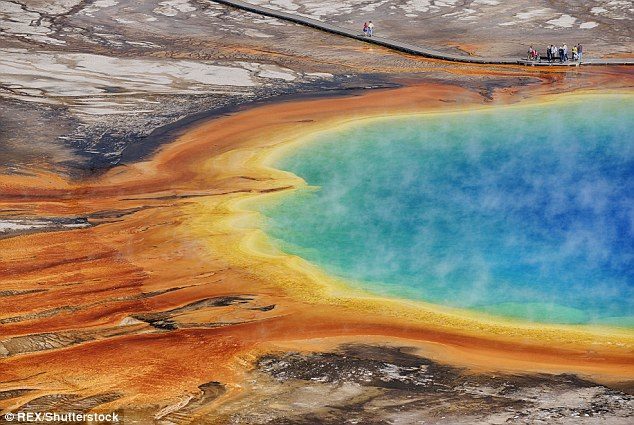
An underwater 'fountain' of magma has been found beneath Yellowstone National Park. Experts suggest the 'magma plume' could be the source of the heat that drives so much of the park's surface activity, such as its world-famous bubbling springs (stock image)

An underwater 'fountain' of magma has been found beneath Yellowstone supervolcano, heightening fears that a major eruption is on the way.

Researchers found a column of hot volcanic ash known as a magma 'plume' beneath the volcano, and they believe it stretches all the way from Mexico.

Experts suggest the plume could be the source of the heat that drives so much of the volcano's surface activity, such as its world-famous bubbling springs.

The news follows a spate of four mini-tremors in the area last week that raised fears Yellowstone's supervolcano is about to blow.


Comment: Thousands of termors over the past year, a recent tremor swarm, the deformed ground surrounding Yellowstone due to increased pressure and recently rare activity was recorded from one of Yellowstone's Geyser Steamboat - an uptick in activity is evident.


Comment: Due to a slow down in the Earth's rotation, scientists have been predicting an upsurge in earthquakes and volcanoes, and we're seeing other incredible events that are most likely related - but it's not just the Earth that's shifting, weather worldwide is increasingly chaotic:


War Whore

US military is making a laser that can create human sounds out of thin air

laser weapon
© NON-LETHAL WEAPONS PROGRAM/U.S. DEPARTMENT OF DEFENSE
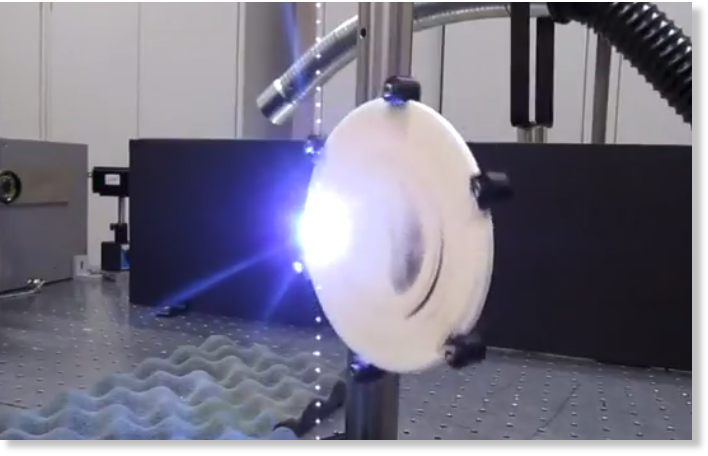
Within three years, the Pentagon's non-lethal weapons lab hopes to have a direct energy weapon that can produce an effect like a haunted walkie-talkie or the biblical burning bush.

Watch the video above and listen carefully for what sounds like a human voice during the second spin. That's not an audio recording or a broadcast transmitted over radio...it's not human at all. It's an auditory effect that's created by military scientists who manipulated the air with lasers - and it's the Pentagon's most interesting idea for stopping people charging checkpoints, or just scaring the crap out of them.

The U.S. military's Joint Non-Lethal Weapons Program, or JNLWD, is inching closer to a weapon that alters atoms to literally create words from thin air. It's called the Laser-Induced Plasma Effect and, fingers crossed, they hope to be able to say intelligible words within the next three years.

Grey Alien

Scientists study baffling 5-inch skeleton of '6-year-old girl' found in Atacama Desert

Skeleton
© Dr. Emery Smith / AFP
Back in 2003 conspiracy theorists were in a tizzy following the discovery of an alien-like skeleton in a remote Chilean town. Theories spread about the origin of the tiny mummified body but now the mystery has been solved.

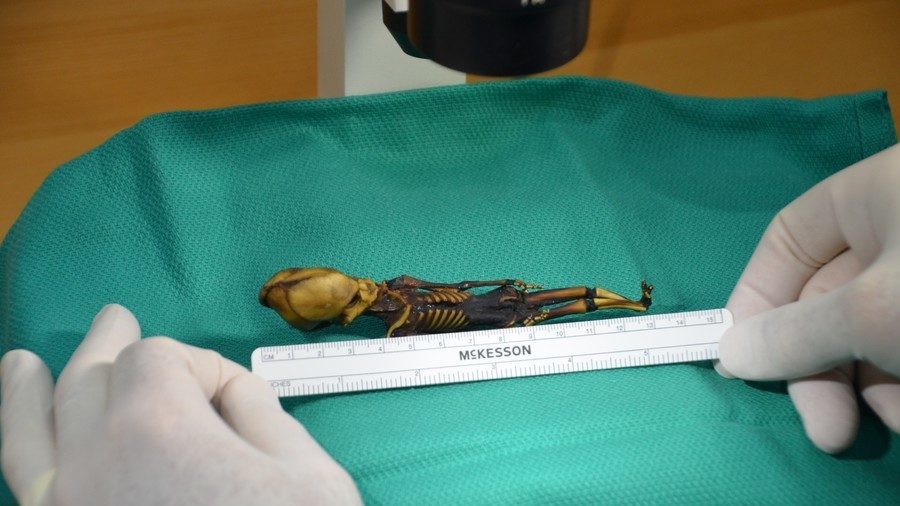
'Ata,' as it was named, was discovered tucked inside a pouch behind a church in a ghost town in Chile's Atacama desert. Unlike anything ever found before, it had an elongated skull, strange sunken eyes and ten pairs of ribs, humans typically have 12 pairs.

Perhaps the most bizarre feature of Ata was its size. Despite appearing fully formed, it's roughly 6 inches (13cm) long, no bigger than a dollar bill. Until now its gender, age, how long it had been buried in the Atacama desert, cause of death - and even home planet - remained a mystery.

These questions have now been answered thanks to a comprehensive genome analysis by scientists from Stanford University and the University of California-San Francisco. "I had heard about this specimen through a friend of mine, and I managed to get a picture of it," senior study author Garry Nolan said in a university press release.

Comment: It doesn't bring us any closer, really. Another such discovery was made in Crimea, Russia, last year:


See also: Mystery of alien-like skulls from medieval Europe revealed after 50 years