Science & TechnologyS


Brain

New study: Brain scans can read human emotions with 90% accuracy

How neuroscientists are learning to predict emotions with increasing accuracy.
Cryiing Man
Brain scans can read human emotions with 90% accuracy, a new study finds.

Researchers have been able to predict the intensity of negative emotions to evocative images.

They found that negative emotions have a 'neural signature' which a computer could learn.

Comment: Can this technology be used for identifying the developmental trauma and give feedback to rewire the brain for optimal performance? Check it out Neurofeedback technologies.


Info

Math proves there is a something hiding beyond Pluto at the edge of our Solar System say astronomers

Planet Nine
© YouTube
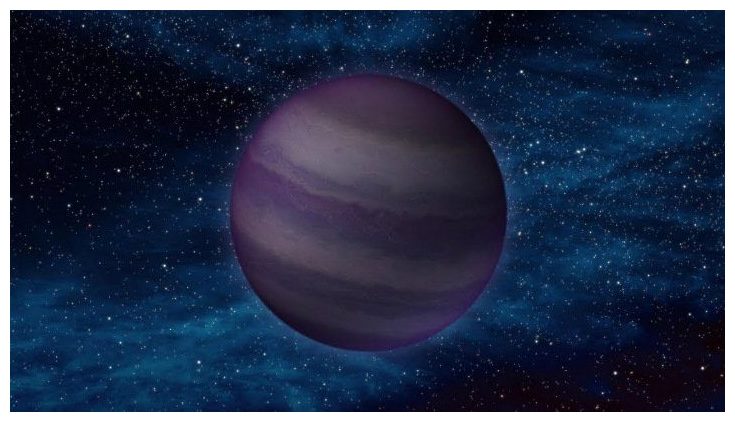
No, it's not Pluto. Unfortunately for die-hard astronomy fans, Pluto is still languishing in its dwarf planet classification, and now it may become replaced by an even more distant planet, hidden somewhere in the mysterious Kuiper Belt. The supposed planet, creatively nicknamed Planet Nine, has not been proven to exist yet, but astronomers have a wealth of data that points to something about 10 times the size of Earth lurking at the edge of the solar system.

The search for Planet Nine started relatively innocuously with some research in 2014: astronomers Scott Shephard and Chad Trujillo published a paper studying a strange object called Sedna, a 1,000-kilometer-wide trans-Neptunian object (TNO). TNOs are minor planets, asteroids, and other bodies who orbits taken them farther out than Neptune, and include Pluto and 10-30 other objects.

The strange thing about Sedna was that it's incredibly long and eccentric orbit seemed to tie it to an unknown planet somewhere outside the solar system, leading Shephard and Trujillo to hypothesize there may be a ninth planet beyond Pluto.

Jet4

Russian Deputy DM: Blackjack strategic bomber to get 1000km range-boost and 'special coatings'

A Tupolev Tu-160 Blackjack strategic bomber
© / ReutersA Tupolev Tu-160 Blackjack strategic bomber
All Russian Tu-160 strategic bombers are scheduled to undergo "deep modernization," the Russian Defense Ministry says. The upgrade will involve installation of new engines that will significantly boost their flight range.

The new engines are expected to be 10 percent more energy efficient. This would ultimately allow the bombers to fly 1,000 kilometers further, Russian Deputy Defense Minister Yury Borisov told journalists while visiting the engine manufacturing company located in Samara, Russian.

Nowadays, the long-range aircraft can already cover a distance of more than 12,000 kilometers without refueling. Its record distance without refueling has reached 18,000 kilometers.

Comment: See also: Russian Tu-160 strategic bomber upgraded and ready for debut flight 2018


Info

Scholz's star disturbed prehistory solar system comets

Scholz's Star
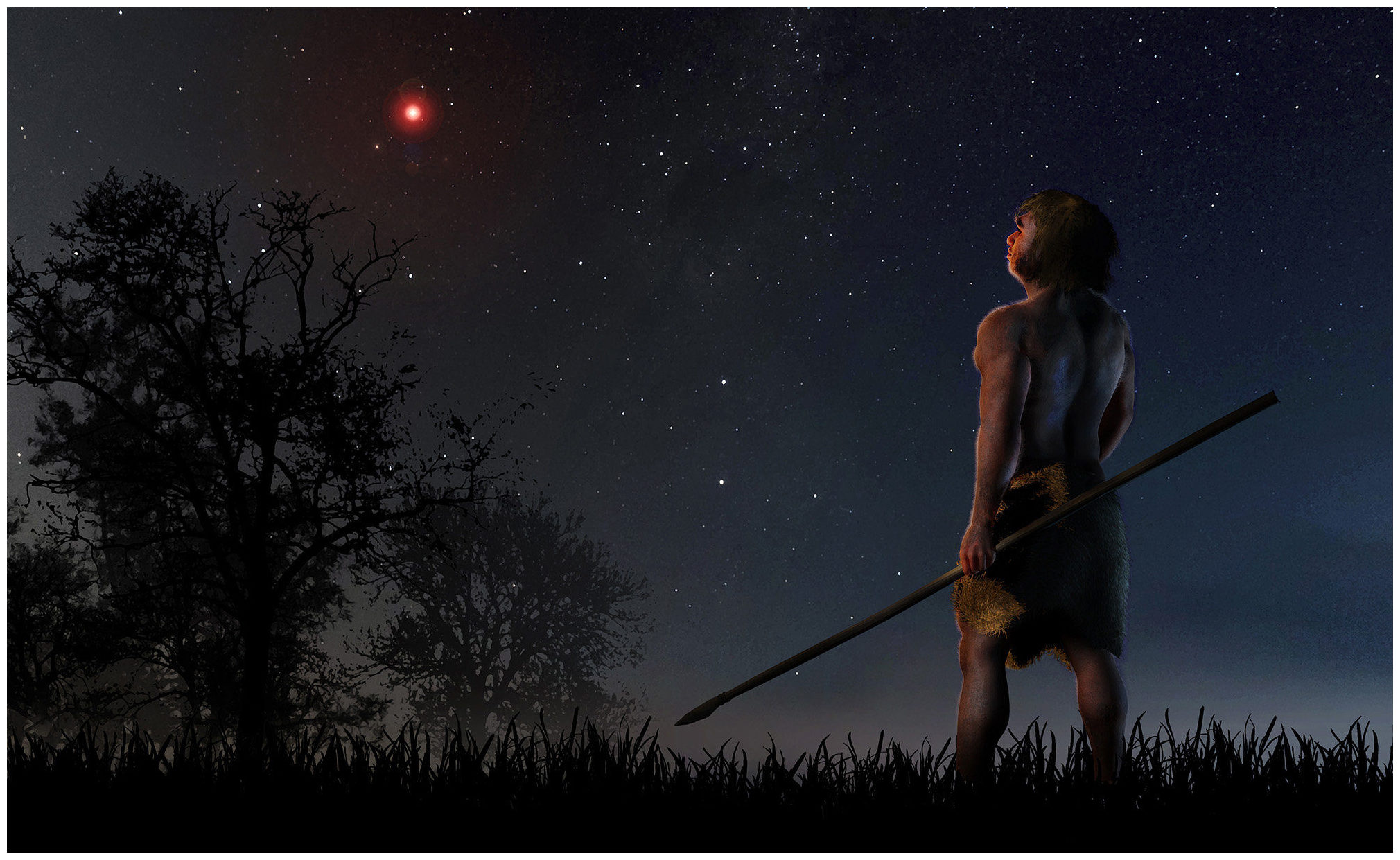
© José A. Peñas/SINCAt a time when modern humans were beginning to leave Africa and the Neanderthals were living on our planet, Scholz's star approached less than a light-year.
About 70,000 years ago, during human occupation of the planet, a small, reddish star approached our solar system and gravitationally disturbed comets and asteroids. Astronomers from the Complutense University of Madrid and the University of Cambridge have verified that the movement of some of these objects is still marked by that stellar encounter.

At a time when modern humans were beginning to leave Africa and the Neanderthals still thrived, Scholz's star-named after the German astronomer who discovered it-approached less than a light-year from the sun. Today, it is almost 20 light-years away, but 70,000 years ago, it entered the Oort cloud, a reservoir of trans-Neptunian objects located at the confines of the solar system.

This discovery was made public in 2015 by a team of astronomers led by Professor Eric Mamajek of the University of Rochester (USA). The details of that stellar flyby, the closest documented so far, were presented in The Astrophysical Journal Letters.

Now, two astronomers from the Complutense University of Madrid, the brothers Carlos and Raúl de la Fuente Marcos, together with the researcher Sverre J. Aarseth of the University of Cambridge (United Kingdom), have analyzed for the first time nearly 340 solar system objects with hyperbolic orbits (very open V-shaped, rather than elliptical) They have concluded that the trajectories of some of these were influenced by the passage of Scholz's star.

Robot

AI reads emotions better than humans

AI Reading Emotions
© Pixabay
A new artificial intelligence has been constructed that is better than humans at reading emotions. This isn't based on the facial expression a person might be making, but instead, on how red their face is.

Yes, that's right-robots can tell when you're blushing.

What's particularly interesting is that this AI was created as a side project for different research-it wasn't even the primary goal of the experiment.

A team at Ohio State University has been researching human displays of emotions. Their studies have been based on the belief that humans display subtle but noticeable changes in skin color, caused by blood flow within the face, in order to communicate how we're feeling. If parts of a person's face get redder, they might be experiencing surprise or happiness, while if other parts change color, it could be an indicator of sadness or disappointment.

Apparently, it is possible to detect if someone is telling you a bald-faced lie, all by looking at how much blood is coursing through their face.

In order to test this theory, the scientists created an AI that could measure the color of certain parts of a person's face in order to guess at their emotions. The robot was given pictures of a person experiencing different emotions, and, without having any training on understanding expressions, the AI was forced to make assumptions based completely on color. As the photos showed people with blank expressions, it wasn't possible for humans to determine their emotions based on whether or not they were smiling, and so everyone involved had to use facial hue alone.

Eye 1

Possible cure for blindness found as stem cell trial restores sight in two patients

surgeons
© Nguyen Huy Kham / Reuters
Treatment for one of the leading causes of blindness could be available within five years. That's according to scientists who used a revolutionary stem cell therapy to restore vision in two patients.

The patients - a woman in her 60s and a man in his 80s - suffered from severe visual impairment caused by age-related macular degeneration (AMD). The disease causes the gradual loss of sight due to blurring or loss of central vision.

AMD is the most common cause of blindness in people over the age of 50, causing the gradual loss of sight due to blurring or loss of central vision. It takes two forms: wet and dry. The patients treated in the trial had the rapidly developing wet AMD and could not read at all, even with spectacles.

Scientists from the London Project to Cure Blindness examined whether the diseased cells at the back the patients' affected eye could be replenished using a stem cell-based patch. A specially engineered surgical tool was used to insert the patch under the retina in an operation lasting up to two hours.

Comment: Stem cell therapy: The innovations and potential to help repair and regenerate your body


Archaeology

Fossilized brains of ancient 'sea monster' discovered in Greenland

Kerygmachela kierkegaardi fossilized brains
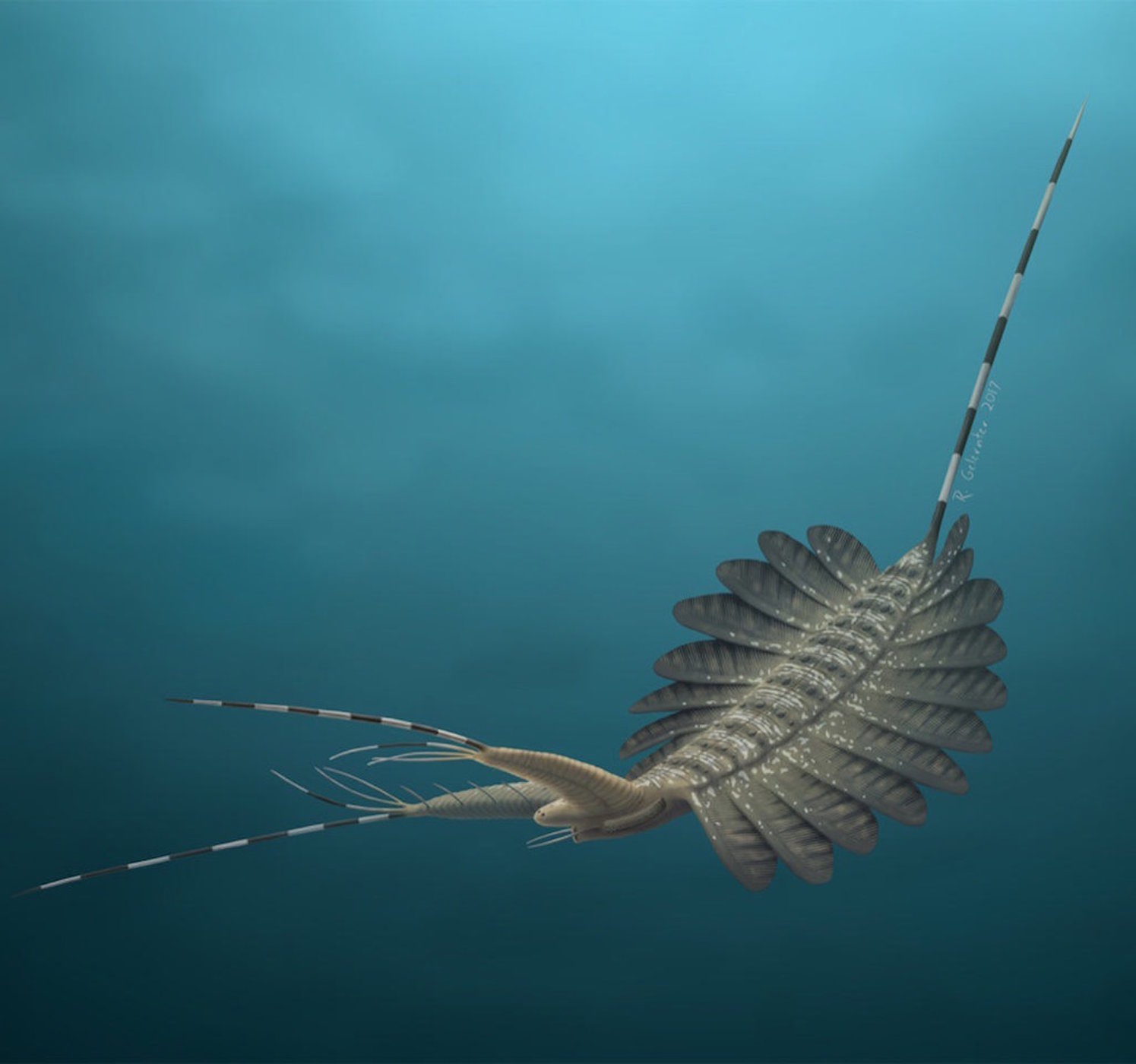
© Rebecca GelernterAn artist's interpretation of Kerygmachela kierkegaardi, the weird critter that once possessed the 520-million-year-old brains
The discovery of not just one, but 15 fossilized brains from a 520-million-year-old marine predator is helping scientists understand how ancient brains evolved into the complex command centers they are today.

The creature in question, Kerygmachela kierkegaardi - a bizarre, oval-shaped water beast that had two long appendages on its head, 11 swimming flaps on each side and a skinny tail - isn't new to science, but its brain is, said study co-lead researcher Jakob Vinther, a United Kingdom-based paleontologist.

The animal would have been up to 10 inches (25 centimeters) long, based on the findings. And unlike the human brain, which is divided into three segments, the fossilized brain of this predator was simple, with just a single segment. This means that the brain was less complex than the three-segmented brains seen in the creature's distant, arthropod relatives, such as spiders, lobsters and butterflies, Vinther said.

Frog

Darwin, we've got a problem: Reverse speciation and environmentalists playing god

dogs breeds or species
Biology has a 'new' problem: Speciation Reversal. One recent paper on the topic declares:
"We argue that extinction by speciation reversal may be more widespread than currently appreciated. Preventing such extinctions will require that conservation efforts not only target existing species but identify and protect the ecological and evolutionary processes that generate and maintain species".
Another paper worries that climate change is hastening the loss of landscape heterogeneity thus encouraging "Interspecific hybridization [which] is .... an evolutionary process that is (i) highly susceptible to human influences, and (ii) very fast" and that "The most probable proximate outcome of such hybridization will be a collapse of hybridizing species and subsequent loss of biodiversity."

A third paper laments the speciation reversal seen in two previously separately identified raven species in California, the non-sister lineages of 'California' and 'Holarctic' ravens, which underwent a fusion and formed the Common Raven. This "represents a case of ancient speciation reversal that occurred without anthropogenic causes." This same paper holds that "Under certain circumstances, hybridisation can cause distinct lineages to collapse into a single lineage with an admixed mosaic genome. Most known cases of such 'speciation reversal' or 'lineage fusion' involve recently diverged lineages and anthropogenic perturbation."

Comment: See Also:


Beaker

Understanding of liquid-to-glass transition process improves creation of metallic glass

glass shards
For millennia, people have used molten sand and other ingredients to create glass and fashion beads, vessels, lenses and windows.

These days, metallic glasses - made entirely of metal atoms - are being developed for biomedical applications such as extra-sharp surgical needles, stents, and artificial joints or implants because the alloys can be ultra-hard, extra strong, very smooth and resistant to corrosion.

While a combination of trial and error and scientific research helped refine glassmaking processes over time, controlling the creation of metallic glasses at the atomic level remains an inexact endeavor informed largely by long experience and intuition.

"Our job," says Paul Voyles, "is to build fundamental understanding by adding more data."

Comet 2

New Comet: C/2018 E1 (ATLAS)

CBET nr. 4494, issued on 2018, March 16, announces the discovery of an apparently asteroidal object (magnitude ~17) in the course of the "Asteroid Terrestrial-impact Last Alert System" (ATLAS) search program on CCD images obtained with a 0.5-m f/2 Schmidt reflector at Haleakala, Hawaii. Posted on the Minor Planet Center's PCCP webpage, it has been reported as showing cometary activity by CCD astrometrists elsewhere. The new comet has been designated C/2018 E1 (ATLAS).

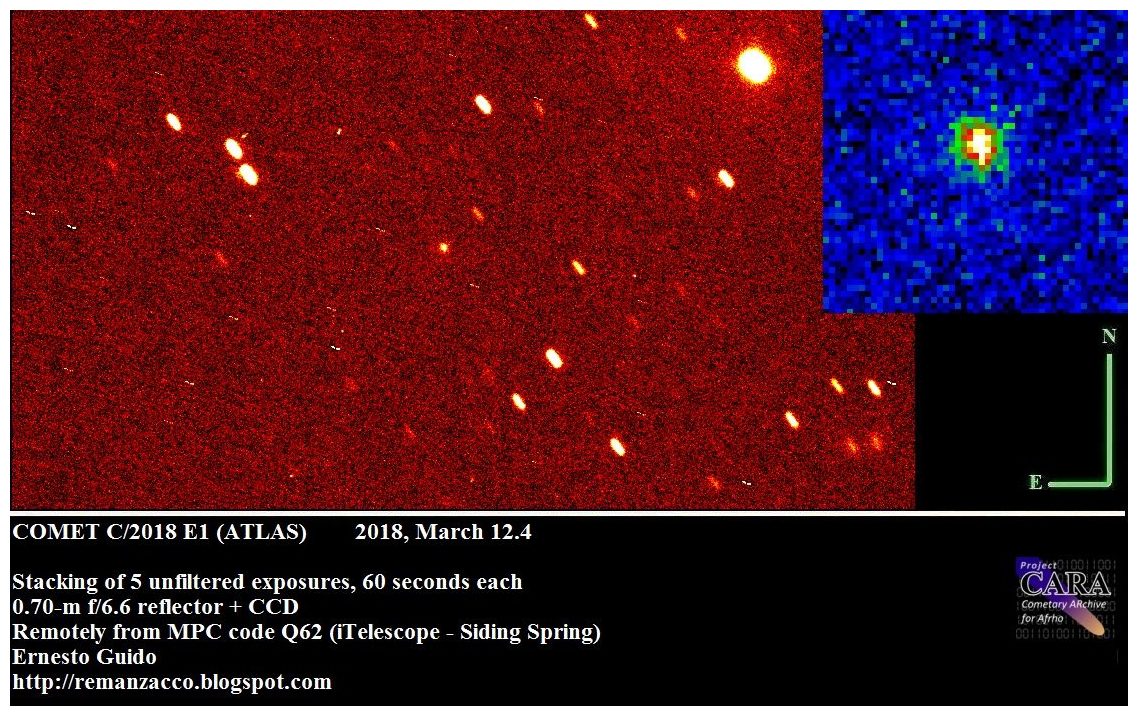
I performed follow-up measurements of this object, while it was still on the PCCP webpage. Stacking of 5 unfiltered exposures, 60 seconds each, obtained remotely on 2018, March 12.4 from Q62 (iTelescope network) through a 0.70-m f/6.6 reflector + CCD, shows that this object is a comet with a diffuse coma about 5 arcsec in diameter. The FWHM of this object was measured about 20% wider than that of nearby field stars of similar brightness.

My confirmation image (click on it for a bigger version)
Comet C/2018 E1 Atlas
© Remanzacco Blogspot
"Pre-discovery" Panstarrs observations (2015 & 2016) were identified by R. Weryk. M.P.E.C. 2018-F10 assigns the following elliptical orbital elements to comet C/2018 E1: T 2018 Apr. 17.3; e= 0.95; Peri. = 299.47; q = 2.70; Incl.= 72.48