Science & TechnologyS


Pi

Pi is wrong! We should all be celebrating Tau Day

Pi blackboard
© domin_domin/iStockphotoNOT PIOUS Pi, the ratio of a circle’s circumference to its diameter, is revered as an all-important number in mathematics. But some are starting to question that devotion.
As a physics reporter and lover of mathematics, I won't be celebrating Pi Day this year. That's because pi is wrong.

I don't mean that the value is incorrect. Pi, known by the symbol π, is the number you get when you divide a circle's circumference by its diameter: 3.14159... and so on without end. But, as some mathematicians have argued, the mathematical constant was poorly chosen, and students worldwide continue to suffer as a result.

A longtime fixture of high school math classes, pi has inspired books, art (SN Online: 5/4/06) and enthusiasts who memorize it to tens of thousands of decimal places (SN: 4/7/12, p. 12). But some contend that replacing pi with a different mathematical constant could make trigonometry and other math subjects easier to learn. These critics - including myself - advocate for an arguably more elegant number equal to 2π: 6.28318.... Sometimes known as tau, or the symbol τ, the quantity is equal to a circle's circumference divided by its radius, not its diameter.

2 + 2 = 4

The Black Hole in the JANUS Cosmological Model

Jean-Pierre Petit
Jean-Pierre Petit explaining the Janus model
The unmanageable runaway effect prevents the introduction of negative mass in astrophysics and cosmology. It becomes possible to cancel that phenomenon in the Janus cosmological bimetric model, with great benefit. Negative mass content explains many observed phenomena and makes the dark matter and dark energy no longer necessary.


Further reading:

Dig

Evolve or die: Ancient humans learned to be social more than 320,000 years ago

Rick Potts
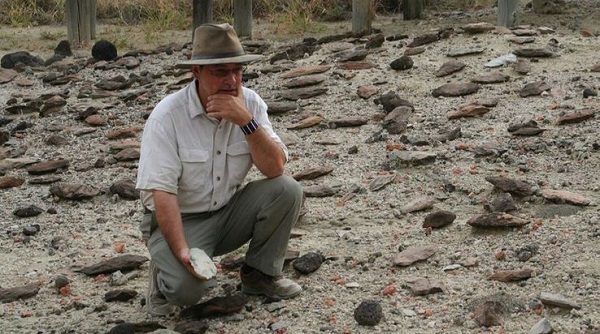
© Human Origins Program, SmithsonianRick Potts, director of the National Museum of Natural History’s Human Origins Program at the Smithsonian, surveys an assortment of Early Stone Age hand axes discovered in Kenya's Olorgesailie Basin.
New discoveries in eastern Africa suggest that human behaviors like symbolic thought and the creation of extended social networks were established at least 320,000 years ago - tens of thousands of years earlier than previously thought.

The work, published as a trio of papers Thursday in Science, sheds new light on the often murky story of when our ancestors first started acting like humans, and why, experts said.

"What we are seeing is a complex set of developments that may represent new ways of surviving in an unpredictable environment," said Rick Potts, a paleoanthropologist and director of the Smithsonian's Human Origins program. "It is a package we didn't know occurred so early, and right at the root of our species."

For more than 30 years, Potts has led excavations in southern Kenya at a site known as the Olorgesailie Basin, which was occupied by hominids for more than 1 million years.

Vinyl

Volcanic thunder recorded for the first time

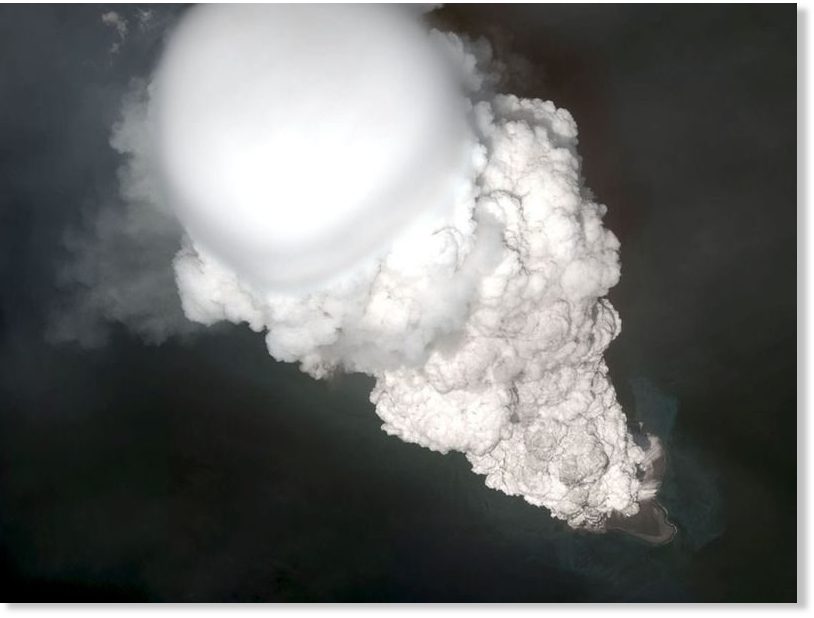
This satellite image shows Bogoslof volcano erupting on May 28, 2017.
© Dave Schneider/Alaska Volcano Observatory & U.S. Geological SurveyThis satellite image shows Bogoslof volcano erupting on May 28, 2017.
It's an explosion that starts within the earth, a release of pressurized gases and bits of rock; either as sharp shards or molten fragments or both. A volcanic eruption is one of the most powerful demonstrations of the dynamism of the planet that we usually think of as solid and unyielding.

It's also loud. Really, really loud. Underwater eruptions can sound like gunshots or bombs reverberating through the water. Looking for a single, ephemeral sound within all that noise of tons of lava and gas and ash and rock all getting slammed out of the Earth's crust is like listening for a whisper in a thunderstorm.

Or like, you know, listening for thunder in the middle of a volcanic eruption. That's exactly what some researchers managed to record during eruptions of Alaska's Bogoslof volcano last year.

They noticed that cracks and pops in the recordings lined up with the timing of volcanic lightning in the same area. Volcanic lightning occurs when eruptions that send a lot of ash into the atmosphere. During their speed run into the air, the ash particles rub against each other, creating an electric charge a lot like when you rub a balloon against your hair. As the particles spread out, that electric charge discharges into lightning....and apparently, thunder.

Galaxy

Citizen scientists help NASA find out more about an aurora named Steve

Aurora lights
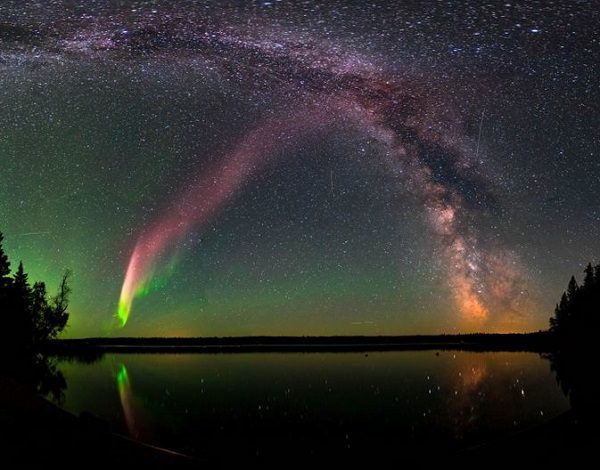
© Krista TrindeSTEVE and the Milky Way at Childs Lake, Manitoba, Canada. The picture is a composite of 11 images stitched together.
Notanee Bourassa knew that what he was seeing in the night sky was not normal. Bourassa, an IT technician in Regina, Canada, trekked outside of his home on July 25, 2016, around midnight with his two younger children to show them a beautiful moving light display in the sky - an aurora borealis. He often sky gazes until the early hours of the morning to photograph the aurora with his Nikon camera, but this was his first expedition with his children. When a thin purple ribbon of light appeared and starting glowing, Bourassa immediately snapped pictures until the light particles disappeared 20 minutes later. Having watched the northern lights for almost 30 years since he was a teenager, he knew this wasn't an aurora. It was something else.

From 2015 to 2016, citizen scientists - people like Bourassa who are excited about a science field but don't necessarily have a formal educational background - shared 30 reports of these mysterious lights in online forums and with a team of scientists that run a project called Aurorasaurus. The citizen science project, funded by NASA and the National Science Foundation, tracks the aurora borealis through user-submitted reports and tweets.

Coffee

Coffee affects cannabis and steroid metabolism

Coffee
© NorthWestern Now
Chicago - It's well known that a morning cup of joe jolts you awake. But scientists have discovered coffee affects your metabolism in dozens of other ways, including your metabolism of steroids and the neurotransmitters typically linked to cannabis, reports a new study from Northwestern Medicine.

In a study of coffee consumption, Northwestern scientists were surprised to discover coffee changed many more metabolites in the blood than previously known. Metabolites are chemicals in the blood that change after we eat and drink or for a variety of other reasons.

The neurotransmitters related to the endocannabinoid system - the same ones affected by cannabis - decreased after drinking four to eight cups of coffee in a day. That's the opposite of what occurs after someone uses cannabis. Neurotransmitters are the chemicals that deliver messages between nerve cells.

Cannabinoids are the chemicals that give the cannabis plant its medical and recreational properties. The body also naturally produces endocannabinoids, which mimic cannabinoid activity.

Info

Babies can logically reason even before they can talk says new study

Baby
© The Verge
One-year-old babies may not be able to speak, but they are able to think logically, according to new research that shows the earliest known foundation of our ability to reason.

Legendary psychologist Jean Piaget believed that we didn't have logical reasoning abilities until we were seven, but scientists scanned the eyes of 48 babies and found that they're able to reason through the process of elimination. The research was published today in the journal Science.

The type of reasoning in question, process of elimination, is formally called "disjunctive syllogism." It goes like this: if only A or B can be true, and A is false, then B must be true. So, if the cup is either red or blue, and it is not red, then it is blue. Process of elimination isn't necessarily the easiest form of reasoning, says Justin Halberda, a psychologist and child development expert at Johns Hopkins University who was not involved in today's study, but it's a crucial one for higher thinking. "One of the central pieces that separates human reasoning from all other forms is to negate a premise - you see that if it's not A, it's something else," he says. "That's quite fancy stuff."

Telescope

Scientists in Russia testing lasers to blow up deadly asteroids

Asteroids
© Pixabay
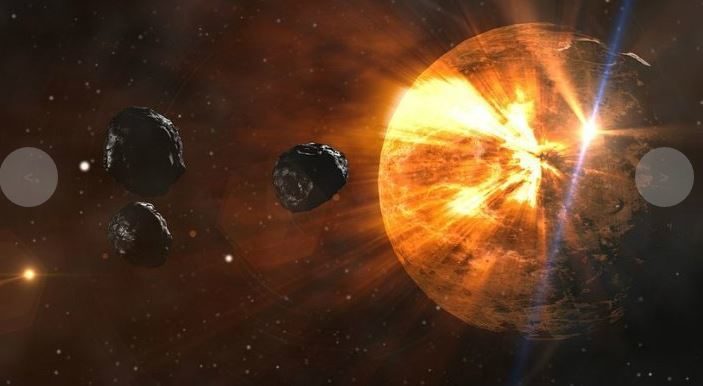
Remember last week, when we learned that NASA has official plans to blow up deadly asteroids with nuclear bombs? Well, we've got more good news: Russian scientists from ROSATOM (aka, the Rosatom State Nuclear Energy Corporation) and MIPT (the Moscow Institute of Physics and Technology) have been building tiny, scale-model asteroids and blowing them up with lasers in order to figure out how to destroy real-life asteroids. They've even figured out how much energy we'd need to demolish a 200-meter wide, non-metallic asteroid: the equivalent of about 3 megatons of TNT.

The experiments are based on miniature asteroids about 8 to 10 millimeters wide that have been carefully manufactured to reflect the density, rigidity and shape of real asteroids-even the chemical compositions and porosity are realistic. To reflect the diversity of asteroid shapes, spherical, ellipsoidal, and cubical models were created, too. From there, the scientists shot them with a laser and measured the effects, including how much energy per gram of mass was needed to destroy the model. One of the more interesting discoveries they made was that asteroids have weak points-targeting a cavity on a model asteroid required less energy for the whole thing to blow up, meaning that if we ever want to blow an asteroid out of the sky, we'd probably target the cavities.

Mars

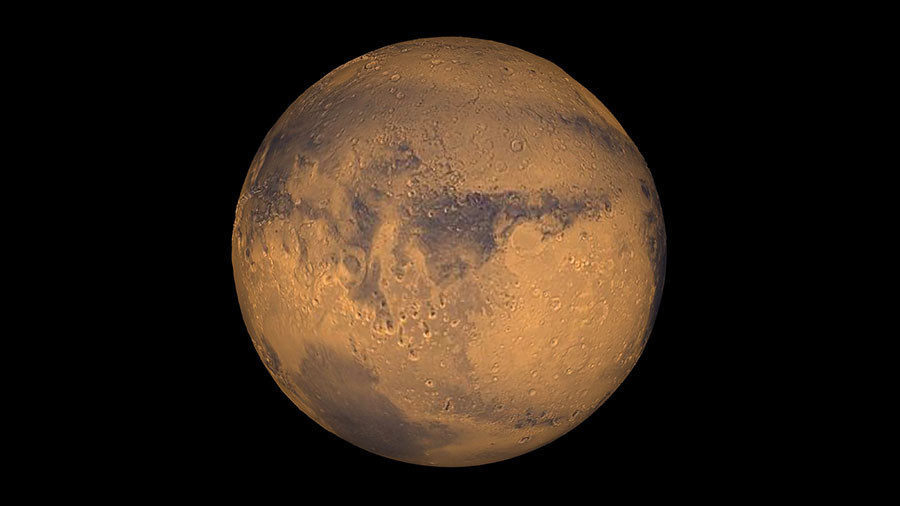
Russia responds to Western warmongering... by announcing plans for manned Mars mission and lunar base

Mars
© NASA / Greg Shirah / Reuters
Russia is launching an ambitious series of missions to the Red Planet, starting with an unmanned Mars mission in 2019, President Vladimir Putin said in an interview.

"We are planning unmanned and later manned launches - into deep space, as part of a lunar program and for Mars exploration. The closest mission is very soon, we are planning to launch a mission to Mars in 2019," the president said in an interview shown in a new documentary by Andrey Kondrashov.

He added that the lunar exploration program would target the polar regions of the moon.

Jupiter

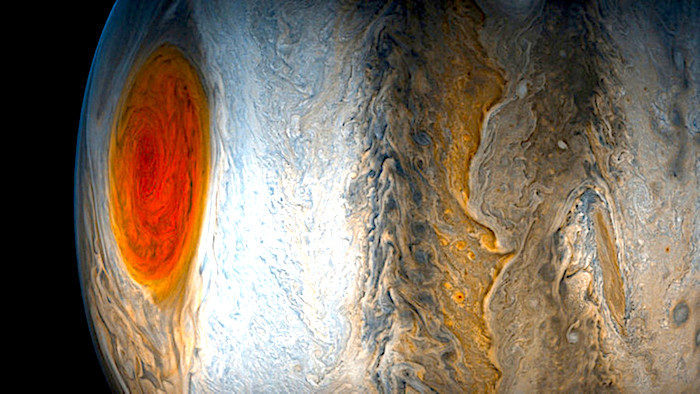
Red alert: Jupiter's 'spot' turning orange and changing shape

Jupiter orange spot
© JPL-Caltech/SwRI/MSSS/Gerald Eichstadt/Sean Doran / NASA
Jupiter's Great Red Spot has been shrinking for 150 years but scientists studying the enormous swirling storm have discovered that the iconic spot is changing color. It's also growing longer.

The storm, which has been monitored since 1830, was once big enough to swallow three Earths, however it could now only fit one. This drastic reduction has left scientists unsure about its fate.

To try to figure out how it may change in the future, a team of researchers have traced the evolution of the cyclone by examining archived observations of the Great Red Spot. "Storms are dynamic, and that's what we see with the Great Red Spot. It's constantly changing in size and shape, and its winds shift, as well," explained Amy Simon, lead author of new research on Jupiter published in the Astronomical Journal.

The team mined data from observations dating back as far as 1979, from the two Voyager missions, as well as information obtained from NASA's Hubble Space Telescope and the Outer Planets Atmospheres Legacy (OPAL) project. The new findings indicate that the Great Red Spot recently started to drift westwards faster than before and, as it has contracted in size, it has also stretched up. "It's almost like clay being shaped on a potter's wheel," NASA's Elizabeth Zubritsky explained.