Science & TechnologyS


Jet3

Internal report reveals USAF may be forced into massive reduction of planned F-35 fleet

An F-35B Lightning II undergoes ice evaluation testing
© Michael D. Jackson/F-35 Integrated Test Force/Handout / ReutersAn F-35B Lightning II undergoes ice evaluation testing at the 96th Test Wing's McKinley Climatic Laboratory at Eglin Air Force Base, Florida
The US Air Force may be forced to dramatically cut its fleet of F-35 multirole stealth fighters if it doesn't dramatically reduce operations and maintenance costs for the flagship fighter, according to an internal report.

At present, costs over the next decade are running at almost 38 percent over budget, according to analysis by the USAF seen by Bloomberg. The USAF previously ordered a total of 1,763 jets but may be forced to cut up to 590 of the fighters due to prohibitively expensive running costs.

The Defense Department estimates the cost of developing and producing a fleet of 2,456 F-35s for the Air Force, Navy and Marine Corps at $406 billion. However, according to the internal analysis and subsequent cost estimates, it may cost upwards of $1.1 trillion to maintain the military fleet of next-generation stealth fighters through 2070.

Attention

Vets warn raw chicken can lead to rare but potentially fatal paralysis in dogs

raw chicken linked paralysis dogs
© iStockVets are warning raw chicken could be dangerous and owners should stick with regular dog food.
As pet ownership increases across the world, our furry (as well as feathered and scaly) friends have become firmly established members of the family.

Wanting the best for our pets, we often offer special treats, and chicken necks are a favourite in many families - often considered a 'healthy' option.

But vets are warning raw chicken, particularly chicken necks, can lead to a debilitating and potentially fatal form of paralysis in dogs.

A new study, led by the University of Melbourne's U-Vet Werribee Animal Hospital, found the consumption of raw chicken meat increases the risk of dogs developing a paralysing condition called acute polyradiculoneuritis (APN) by more than 70 times.

Archaeology

"Cosmic signatures" of the Younger Dryas impact found in Antarctica

Black mat

An example of the black mat: The Kloosterman layer
Detailed microscopic investigations of horizons in a surface paleosol, part of a pedostratigraphic stack of tills at New Mountain, Antarctica, dated to the middle Miocene climatic optimum event (ca. 15 Ma), suggest not only that the paleoclimate history of the continent can be read from stratigraphic layers within paleosols but also that records of cosmic events may lie embedded in coatings on sand clasts resident in paleosols.

Recent microscopic and chemical data from sands in the upper horizons of a surface paleosol (Ant-828), adjacent to the Taylor Glacier, contain Fe and Na coatings surfaced with cosmic signatures including welded and shock-melted grains, opaque carbon coatings, microfeature stack of cards, Fe spherules, solubilized grain surfaces with streams of melted skin, a grain carrying an Ir signature, rare earth elements elevated above crustal averages, and slightly elevated Pt/Pd ratios.

Comment: For an excellent article on the events surrounding the Younger Dryas Event, see: Of Flash Frozen Mammoths and Cosmic Catastrophes

Also See:


Info

High resolution CT scans shed new light on the extinct Tasmanian Tiger

Tasmanian Tiger
© University of MelbourneA scan reveals the internal structure of Tasmanian Tiger joeys.
When all that remains of an extinct species is a few precious specimens, dissecting them, even in the name of science, isn't really an option.

But by using CT scanning, a technique similar to medical CAT scans but with much higher resolution, researchers from the University of Melbourne and Museums Victoria have been able to take a 'virtual' look inside the Tasmanian tiger to study the biology of this iconic species.

Called non-invasive X-ray micro-CT scanning, this technique has also been used to examine Egyptian Mummys, another example of rare and delicate specimens.

Dr Christy Hipsley, Research Associate at Museums Victoria and the University of Melbourne says that before they were hunted to extinction in 1936, it was very popular for museums to collect samples of the Tasmanian tiger, also known as thylacine or Thylacinus cynocephalus.

Question

Are blue-eyed redheads going extinct?

Redhead
© iStockMany more people carry the traits for red hair and blue eyes than are actually expressed.
For every 100 people in the world, only one or two will have red hair.

And when you meet a red head with blue eyes, you are looking at the rarest colour combination of all for human beings.

Around 17 per cent of people have blue eyes, and when combined with 1-2 per cent having red hair, the odds of having both traits are around 0.17 per cent. That's 13 million people, out of the 7.6 billion on Earth.

So with numbers this low, could redheads with blue eyes actually go extinct?

The reason these looks are so unusual is because they are the result of two different sets of DNA instructions, or mutations, happening in the same person, explains Professor Mark Elgar, an evolutionary biologist from the University of Melbourne.

"The mutations occurred tens of thousands of years ago, and have now become established as different versions or variants of the genes that help determine our skin and eye colour.

Laptop

First biocomputer made from living human cells created by scientist

BioComputer
© YouTube
As fears over artificial intelligence continue to grow, we can at least take solace in knowing our bodies will never rise up and join the machines-we're still made of meat, which makes us difficult to hack. However, thanks to researchers from ETH Zurich, we've recently made a huge step forward in the development of biocomputers, collections of cells that are organized and manipulated to act like a very simple computer. Soon, the line between computer and human may become blurrier than ever.

The key behind the new biocomputer is nine modular cell cultures, which are arranged into 3-D lattices. Each of these little modules, which are made of human cells, is "programmed" to react to different chemical inputs, the way a normal computer reacts to electrical inputs.

The team from Zurich has even managed to structure the cells so that the biocomputer can create logic gates, which take two inputs and process them to create one output. This has allowed the team to accomplish "full-adder computations," where different cells do small parts of a calculation and then add the results together to get a complete answer.

Binoculars

Flat-earth rocket scientist blasts off into California sky, lands in Mojave Desert

mike hughs flat earth
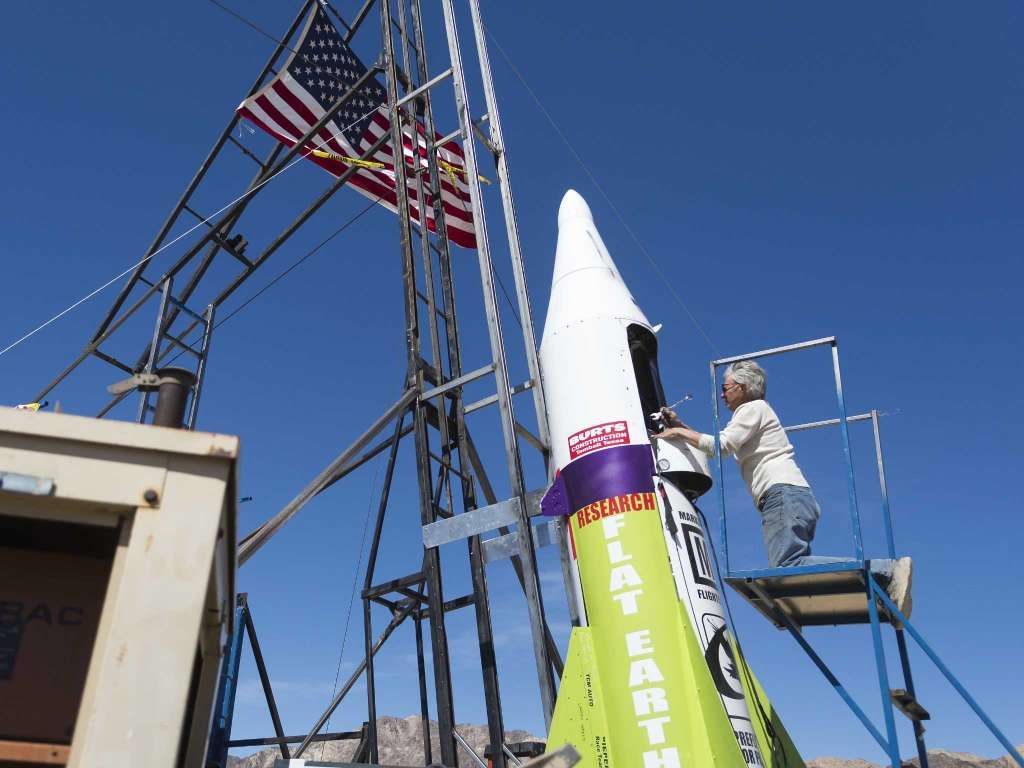
© James Quigg/Daily Press / AP"Mad" Mike Hughes begins work on repairing a steam leak after he scrubbed his launch attempt of his steam-powered rocket near Amboy, Calif. The self-taught rocket scientist who believes the Earth is flat propelled himself about 1,000 feet into the air before a hard-landing in the Mojave Desert that left him injured Saturday, March 24, 2018. Hughes tells The Associated Press that he injured his back but is otherwise fine after Saturday's launch near Amboy, Calif.
He finally went up - just like the self-taught rocket scientist always pledged he would.

He came back down in one piece, too - a little dinged up and his steam-powered vessel a little cracked up.

Still, mission accomplished for a guy more daredevil than engineer, who drew more comparisons to the cartoon character Wile E. Coyote from his critics than he did to iconic stunt man Evel Knievel.

"Mad" Mike Hughes, the rocket man who believes the Earth is flat, propelled himself about 1,875 feet into the air Saturday before a hard landing in the Mojave Desert. He told The Associated Press that outside of an aching back he's fine after the launch near Amboy, California.

"Relieved," he said after being checked out by paramedics. "I'm tired of people saying I chickened out and didn't build a rocket. I'm tired of that stuff. I manned up and did it."

Comment: See also:


Newspaper

Russian camo goes invisible in infrared remission

Soldier at Russian Army Festival
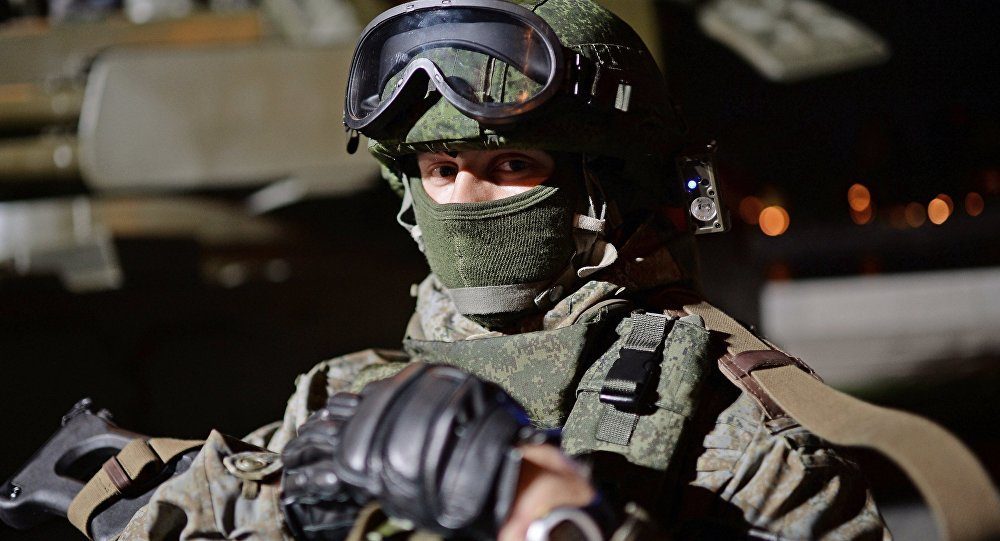
© Sputnik/ Ramil SitdikovSoldier at Russian Army Festival
Step aside, Schwarzenegger, you don't need mud anymore: this new Russian camo can defeat the Predator's infrared vision no-problem.

The Russian military has new camouflage that can conceal a fighter's visibility in the infrared spectrum, says Oleg Faustov, a senior engineer with the Russian industrial design bureau TsNIITochMash who works on personnel life support systems.

Info

Young gorillas have learnt to dismantle poachers' snares in the wild

Young gorillas
© Dian Fossey Gorilla Fund
Days after a poacher's trap killed a young mountain gorilla in Rwanda's Volcanoes National Park in 2012, researchers spotted something remarkable: two four-year old gorillas working together to dismantle similar snares in the area.

"This is absolutely the first time that we've seen juveniles doing that ... I don't know of any other reports in the world of juveniles destroying snares," Veronica Vecellio from the Dian Fossey Gorilla Fund's Karisoke Research Centre in Rwanda told National Geographic at the time.

"We are the largest database and observer of wild gorillas ... so I would be very surprised if somebody else has seen that."

Thousands of these snares are set up by local bush meat hunters to catch antelopes and other animals for eating, and while they reportedly have no interest in primates, young gorillas are sometimes unintentionally caught up and left to die.

Comment:


See also:
Orangutans know herbal medicine
Rooted in our biology: Revealing insights on behavioral sex differences from our primate cousins
Bonobos observed making wooden spears, daggers and stone shovels like our human ancestors


Cassiopaea

Scientists observed one of the fastest, brightest supernovas on record

Supernova
© GettyA speedy supernova hit maximum brightness in just a few days.
The quickest supernova we've ever seen went from invisible to extraordinarily bright in only 2.2 days. It is the first of these speedy stellar explosions that's been observed thoroughly enough to help us figure out exactly how they work.

Supernovae are massive explosions that happen when a star burns out. They usually take weeks or months after the death of the star to reach maximum brightness, and even longer to fade away. But Armin Rest at the Space Telescope Science Institute in Baltimore, Maryland and his colleagues found one in data from the Kepler Space Telescope that rose to peak brightness in less than 53 hours and faded back to half that brightness in 6.8 days.

Often, quick supernovae are dimmer than their longer-lasting counterparts, so they can be explained simply by invoking a weaker mechanism like a star that only partially exploded. But this one, called KSN 2015K, was just about as bright as a regular supernova, so it needed a different explanation.

Rest and his colleagues were able to take images of the supernova once every 30 minutes, making it the most thoroughly observed of the fast supernovae. "Usually you might have 1 or 2, maybe 3 measurements in 2.2 days, but we have a whole series of really strong measurements that allow us to test different models," says Rest.