
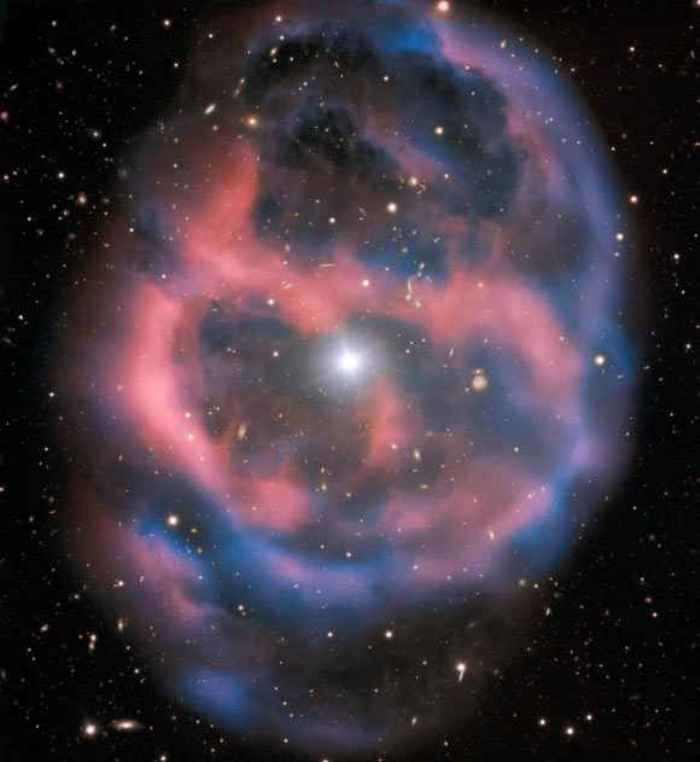
© ESOESO 577-24 was imaged by the FOcal Reducer/low dispersion Spectrograph 2 (FORS2) on ESO’s Very Large Telescope. The FORS2 instrument captured the bright, central star, Abell 36, as well as the surrounding planetary nebula. The red and blue portions of this image correspond to optical emission at red and blue wavelengths, respectively. An object much closer to home is also visible in this image — an asteroid wandering across the field of view has left a faint track below and to the left of the central star. And in the far distance behind the nebula a glittering host of background galaxies can be seen.
ESO 577-24, also known as IRAS F13378-1937 or 2MASS J13404134-1952553, resides approximately 1,400 light-years away from Earth.
It was discovered as part of the National Geographic Society-Palomar Observatory Sky Survey in the 1950s, and was recorded in the Abell Catalogue of Planetary Nebulae in 1966.
The dazzling nebula is the remains of a dead giant star that has thrown off its outer layers, leaving behind a small, intensely hot dwarf star.
This diminished remnant will gradually cool and fade, living out its days as the mere ghost of a once-vast red giant star.











Comment: Considering the many similarities between Neanderthal and Homo sapien, it probably shouldn't be so surprising that, like humans (up until very recently anyway), meat constituted the primary source of nutrition in their diet: