
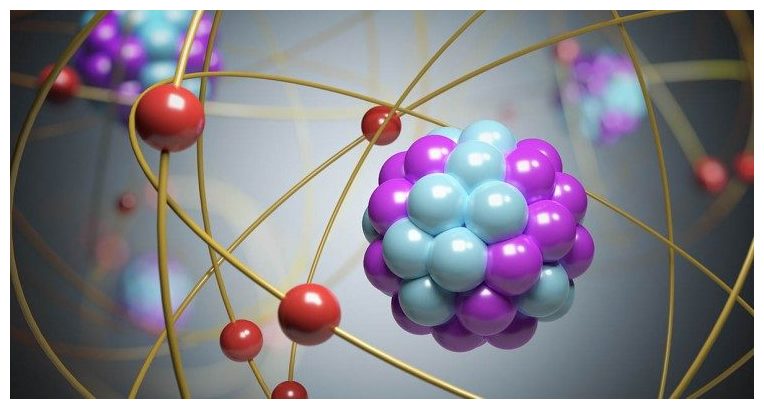
© DepositPhotos
Physicists really didn't like this, because neutrons are neutrons whether they're inside an atom or not. And protons are protons. Both protons and neutrons (which together make up the class of particles called "nucleons") are made up of three smaller particles, called quarks, bound together by the strong force.
"When you put quarks into a nucleus, they start to move slower, and that is very weird," said study co-author Or Hen, a physicist at the Massachusetts Institute of Technology. That's strange because the powerful interactions between quarks mainly determine their speed, whereas forces that bind the nucleus (and also act on quarks inside the nucleus) are supposed to be very weak, Hen added.
And there's no other known force that should be modifying the behavior of quarks in a nucleus so intensely. Yet, the effect remains: Particle physicists call it the EMC effect, named for the European Muon Collaboration, the group that discovered it. And until recently, scientists weren't sure what caused it.
Two particles in a nucleus are typically pulled together by a force of around 8 million electron volts (8 MeV), a measure of energy in particles. Quarks in a proton or neutron are bound together by about 1,000 MeV. So it doesn't make sense that the comparatively mild interactions of the nucleus are dramatically impacting the powerful interactions inside quarks, Hen told Live Science.
"What is eight next to 1,000?" he said.
But the EMC effect doesn't look like a mild nudge from an outside force. Though it varies from one sort of nucleus to the next, "It's not like half a percent. The effect pops out of the data once you are creative enough to design an experiment to look for it," Hen said.
















Comment: Maybe we should call it intellectual fraud. Perhaps the main reason Darwinists are so intent to deny the obvious is because accepting the obvious would lead to the obvious conclusion: that there is purpose in nature. Purpose implies agency and that hits a little too close to the bone for the ideological materialists. It implies that materialism is false, that consciousness is more important than they're willing to entertain, and that maybe, just maybe, there is an intelligence (or intelligences) higher than our own.