
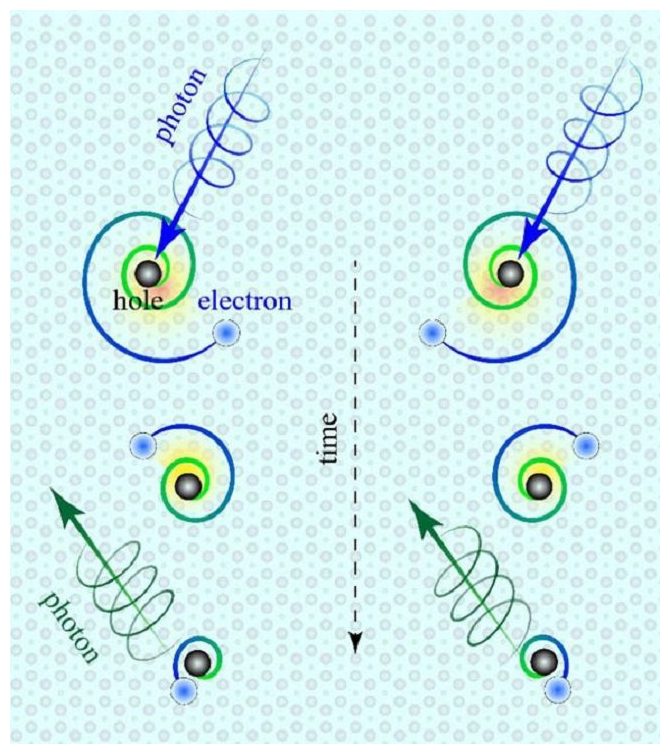
© Hsiang-Hsi (Sean) Kung / Rutgers University-New BrunswickThe two types of chiral surface excitons are on the right and left side of the image. They are generated by right- and left-handed light (photons in blue). The excitons consist of an electron (light blue) orbiting a ‘hole’ (black) in the same orientation as the light. The electron and hole are annihilated in less than a trillionth of a second, emitting light (photons in green) that could be harnessed for lighting, solar cells, lasers and electronic displays.
"Chiral refers to entities, like your right and left hands, that match but are asymmetrical and can't be superimposed on their mirror image," said team member Hsiang-Hsi (Sean) Kung, a graduate student at Rutgers University.
"Excitons form when intense light shines on solids, kicking negatively charged electrons out of their spots and leaving behind positively charged 'holes'."
The electrons and holes resemble rapidly spinning tops.
The electrons eventually spiral towards the holes, annihilating each other in less than a trillionth of a second while emitting a kind of light called photoluminescence.
This finding has applications for devices such as solar cells, lasers and TV and other displays.
Kung, Professor Blumberg and co-authors discovered chiral excitons on the surface of bismuth selenide (Bi2Se3), which could be mass-produced and used in coatings and other materials in electronics at room temperature.
"Bismuth selenide is a fascinating compound that belongs to a family of quantum materials called 'topological insulators'," Professor Blumberg said.
"They have several channels on the surface that are highly efficient in conducting electricity."
The dynamics of chiral excitons are not yet clear and the physicists want to use ultra-fast imaging to further study them.
The team's results will be published in the Proceedings of the National Academy of Sciences.



Reader Comments