Science & TechnologyS


Fish

Robots used to aid communication between bees and fish

bees and fish
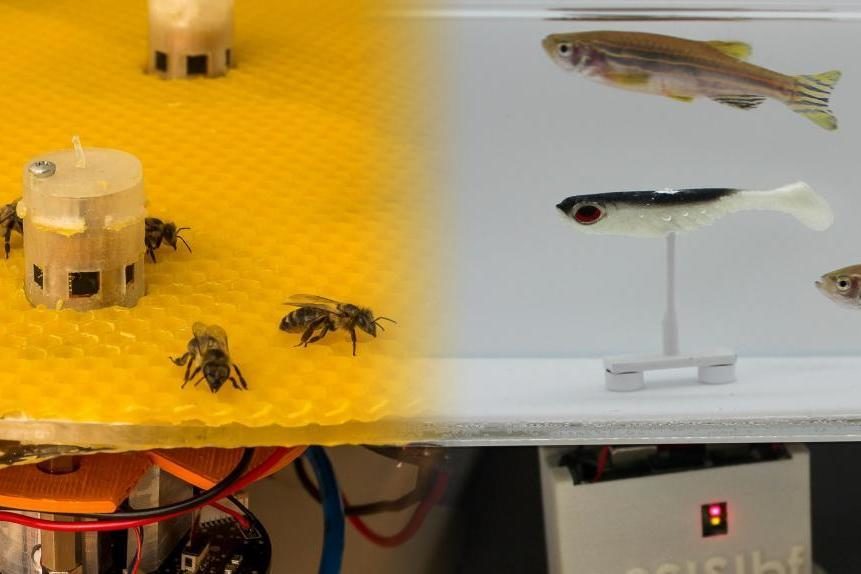
© EPFLRobotics spies capable of interspecies translation helped groups of bees and fish talk to each other.
Bees and fish can now converse with each other thanks to new robotics technology designed by researchers in Europe.

Scientists developed robots to translate and deliver signals from groups of bees and schools of fish. The robots traded signals across an international border, allowing bees in Austria to talk to fish a few hundred miles away in Switzerland.

"We created an unprecedented bridge between the two animal communities, enabling them to exchange some of their dynamics," Frank Bonnet, a robotics engineer at the Swiss Federal Institute of Technology in Lausanne, or EPFL, said in a news release.

Previously, researchers at EPFL's Mobile Robots Group have designed and deployed "spy" robots that blend in with groups of animals. Most recently, the team used a robot to infiltrate a school of zebrafish and influence its swimming direction.

For the latest experiment, scientists decided to use the fish spy to help different species communicate.

Comment: Interspecies communication: Beluga rooming with dolphins learns their language


Brain

Can zapping the brain with lasers cure alcoholism? Scripps scientists think so

Man drinking alcohol
© Getty Images/IStock
Anyone who has ever had first-hand experience of substance abuse will know that, however much a person might want to quit, ending this kind of dependency isn't a simple on/off mechanism. But what if it could be? While science has not yet advanced to that point with humans, researchers from Scripps Research have demonstrated that it is possible to reverse the desire to drink in alcohol-dependent rats - by targeting a part of the brain using lasers.

"This research identifies a specific neuronal population in a deep region of the brain that is activated during alcohol withdrawal and which controls alcohol drinking in a rodent model of alcoholism," Olivier George, an associate professor at Scripps Research, told Digital Trends. "We also identify by which downstream pathways these neurons control the rest of the brain to produce addiction-like behaviors. What is so exciting about these findings is that we were able to control the motivation to drink alcohol in severely dependent individuals with the flip of a switch. By implanting fiber optics deep in the brain and turning on a laser that inhibits these neurons specifically we could dramatically decrease alcohol drinking and the physical symptoms of withdrawal."

Galaxy

Scientists meet to investigate the 'Great Silence': Are we in a 'galactic zoo'?

meti telescope
© GettyShould we be sending more messages to aliens?
Are we alone? Probably not. After all, astronomers have already found 4,001 confirmed exoplanets in our Milky Way galaxy, and expect there to be over 50 billion exoplanets out there. For scientists gathering in Paris today, the question is different: why haven't we made contact with alien civilizations?

What is the Fermi Paradox and the "Great Silence?"

Italian physicist Enrico Fermi asked 'where is everybody?' back in 1950 in what's now called the Fermi Paradox. It addresses a contradiction in astronomy, and can be summarized thus: if extraterrestrial life and even intelligent alien civilizations are not just likely, but highly probable, then why have none of them been in contact with us? Are there biological or sociological explanations for this "Great Silence?"

"We are very interested in the scientific approach used in the analysis of the Fermi Paradox and the search for intelligent life in the universe," said Cyril Birnbaum and Brigitte David at the Cité des Sciences et de l'Industrie (Cité), the science museum in Paris that's hosting today's meeting. "The question 'Are we alone?' affects us all, because it is directly related to humanity and our place in the cosmos."

Comment: It's rather curious that it's often supposed that the overseers of this zoo are benevolent. Particularly when other notable, although much less publicized, perspectives have been put forward, and with supporting evidence: Also check out SOTT radio's:


Fish

Devolution as evolution?

Daihua sanqiong
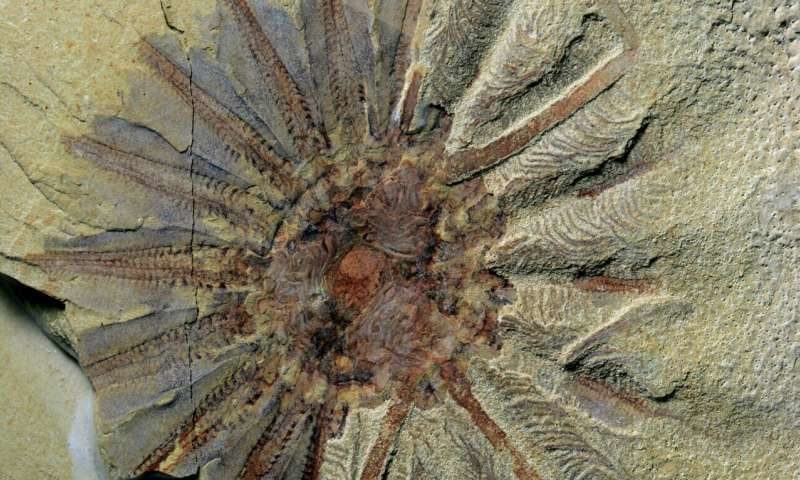
© Yang ZhaoThe holotype specimen of Daihua sanqiong.
Today there's a Press Release provided by the University of Bristol about comb jellies from the Cambrian, found outcrops south of Kunming in the Yunnan Province, South China by Professor Hou Xianguang, co-author of the study.

Of interest, given the recent release of Michael Behe's new book, Darwin Devolves, is the following statement:
The study shows how comb jellies evolved from ancestors with an organic skeleton, which some still possessed and swam with during the Cambrian. Their combs evolved from tentacles in polyp-like ancestors that were attached to the seafloor. Their mouths then expanded into balloon-like spheres while their original body reduced in size so that the tentacles that used to surround the mouth now emerges from the back-end of the animal.

"With such body transformations, I think we have some of the answers to understand why comb jellies are so hard to figure out. It explains why they have lost so many genes and possess a morphology that we see in other animals," added co-author Dr. Luke Parry.

Comment: That's kind of a problem for Darwinism isn't it? What is known so far is that anything resembling Darwinian evolution involves loss of a function or genes. See also:


Solar Flares

Huge new sunspot AR2736 forms rapidly as Solar Minimum underway

sunspot AR2736
Two days ago, sunspot AR2736 didn't exist. Now the rapidly-growing active region (movie) stretches across more than 100,000 km of the solar surface and contains multiple dark cores larger than Earth. Moreover, it has a complicated magnetic field that is crackling with C-class solar flares. The sunspot is inset in this magnetic map of the sun from NASA's Solar Dynamics Observatory:

The rapidly-growing sunspot AR2736
© NASAThe rapidly-growing sunspot AR2736.

Info

Rogue waves are becoming rarer and more extreme

Rogue Wave
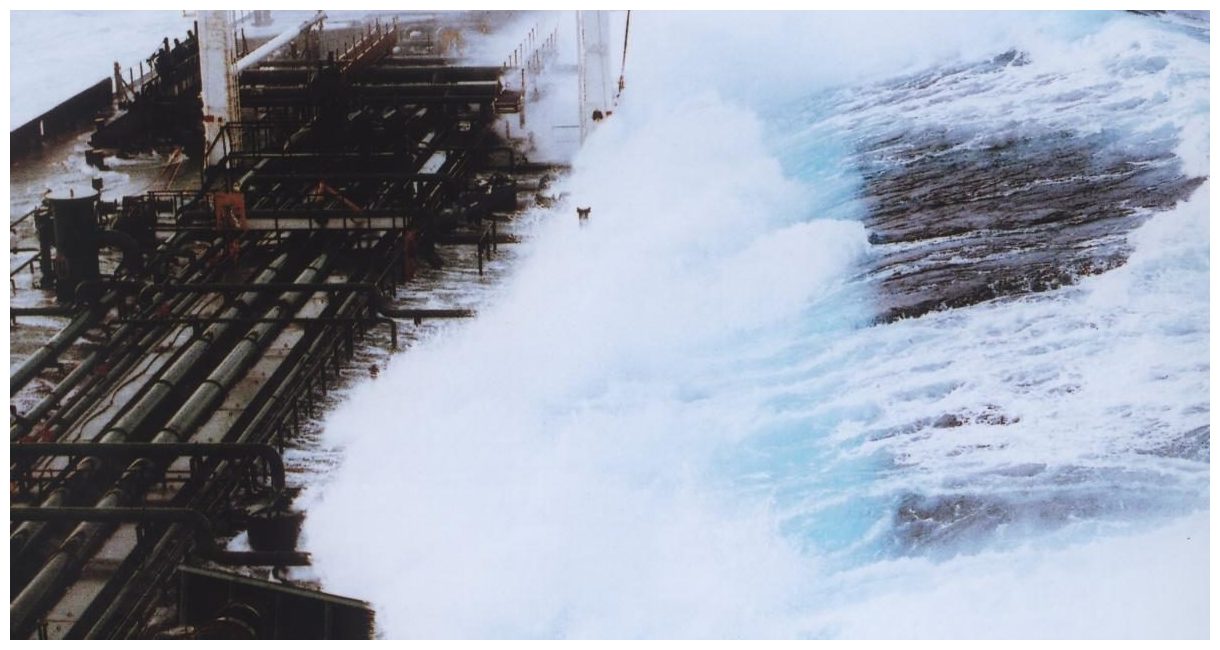
© Captain Roger Wilson/NOAA60-foot wave hitting tanker off Alaska.
Research led by the University of Southampton suggests that 'rogue' waves are occurring less often, but becoming more extreme.

Scientists have, for the first time, used long-term data from a wide expanse of ocean to investigate how these rare, unexpected and hazardous ocean phenomena behave. Their findings are published in the journal Scientific Reports.

Waves are classed as 'rogue' when they are over twice the height of the average sea state around them. From trough to peak, past observations have put some at over 30 metres high. The fiercest are capable of damaging or sinking ships, can wound or kill crew members and on occasions have swept people off the shoreline and out to sea.

A team of engineers and oceanographers from the University of Southampton, together with researchers from The National Oceanography Centre (NOC), examined over 20 years of information (sourced between 1994-2016) from 15 buoys which provide surface data along the US western seaboard - stretching from Seattle in the north, to San Diego in the south.
The data showed instances of rogue waves vary greatly, depending on the area of sea and time period focused on. On average though, the team found instances of rogue waves (across the two decade window) fell slightly, but that rogue wave size, relative to the background sea, increased by around one per cent year-on-year.

Info

Programmable self-assembling DNA created by scientist

Programmable DNA Molecules
© Demin Liu and Damien WoodsComputer scientists at UC Davis, Maynooth University and Caltech have created DNA molecules that can self-assemble by carrying out a Boolean logic computation. Highlighted in green is the “circuit diagram” made up of DNA tiles that fit together according to inputs and outputs. Below is an atomic force microscope image of a self-assembled DNA ribbon that carried out the same computation. In the background are other ribbons, with different barcode labels, that carried out different computations.
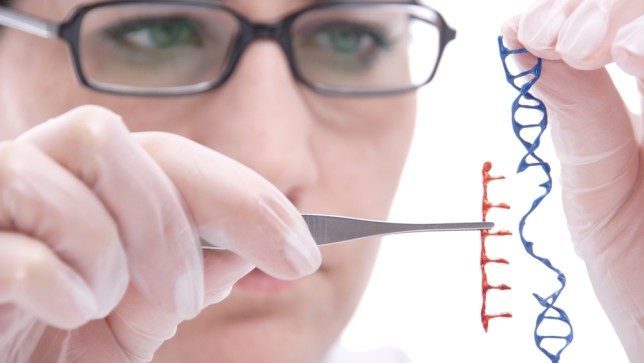
Computer scientists at the University of California, Davis, and the California Institute of Technology have created DNA molecules that can self-assemble into patterns essentially by running their own program. The work is published March 21 in the journal Nature.

"The ultimate goal is to use computation to grow structures and enable more sophisticated molecular engineering," said David Doty, assistant professor of computer science at UC Davis and co-first author on the paper.

The system is analogous to a computer, but instead of using transistors and diodes, it uses molecules to represent a six-bit binary number (for example, 011001). The team developed a variety of algorithms that can be computed by the molecules.

"We were surprised by the versatility of algorithms we were able to design, despite being limited to six-bit inputs," Doty said. The researchers were able to design and run 21 algorithms over the course of the experiments, demonstrating the potential of the system, he said.

Working initially as postdoctoral scholars with Professor Erik Winfree at Caltech, Doty and co-lead author Damien Woods, now at Maynooth University, Ireland, designed a library of short pieces, or tiles, of DNA. Each DNA tile consists of 42 bases (A, C, G or T) arranged in four domains of 10-11 bases. Each domain can represent a 1 or 0 and can stick to some of the domains on other tiles. No two tiles are a complete match.

Info

Scientists develop liquid metal that stretches like T-1000 Terminator

Liquid Metal
© American Chemical Society
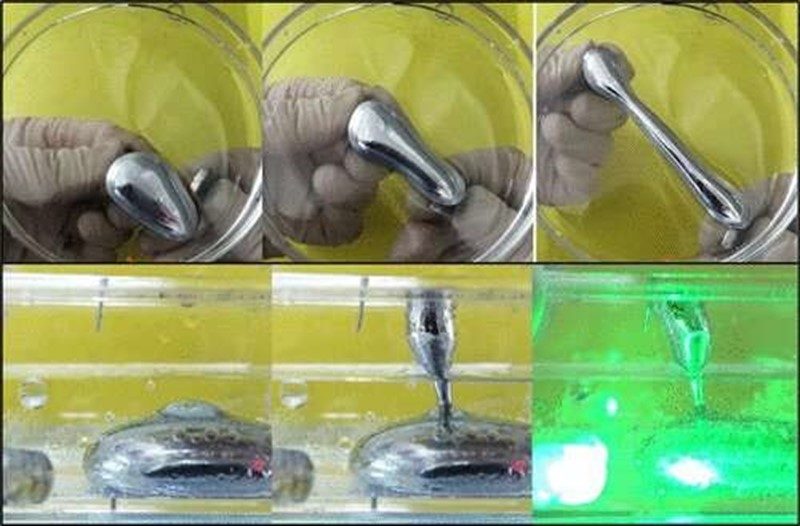
In the blockbuster Terminator movie franchise, an evil robot morphs into different human forms and objects and oozes through narrow openings, thanks to its "liquid-metal" composition. Although current robots don't have these capabilities, the technology is getting closer with the development of new liquid metals that can be manipulated in 3-D space with magnets. Reported in ACS Applied Materials & Interfaces, the materials could someday find applications in soft robotics.

Metals that are liquids at room temperature, such as gallium and certain alloys, have unique properties including high conductivity, low melting point and high deformability. These properties make them attractive for use in soft robots and flexible electronics. By adding magnetic particles, such as nickel or iron, researchers can produce liquid metals that they can manipulate with magnets. However, because of their high surface tension, most magnetic liquid metals can only move horizontally, and they must be immersed completely in liquid to avoid forming a paste. Liang Hu, Jing Liu and colleagues wanted to make a magnetic liquid metal that they could move and stretch both horizontally and vertically, without needing to put the material completely in a liquid.

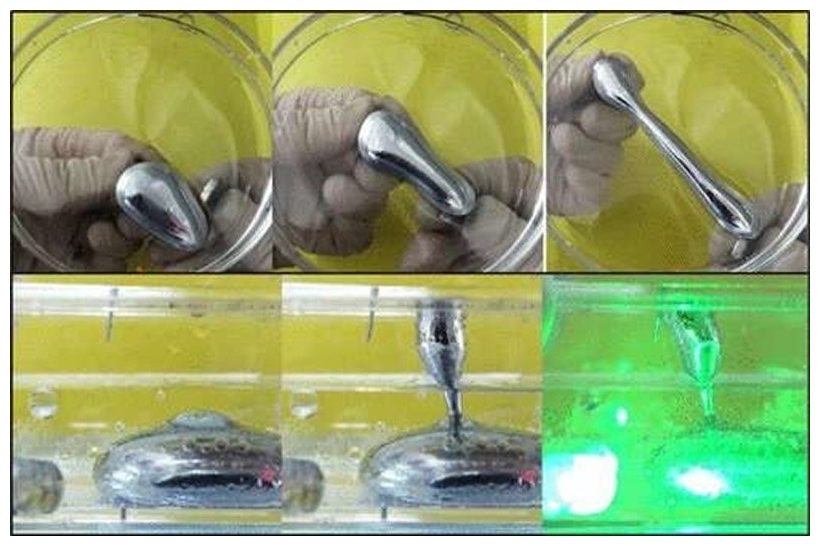
To do so, the researchers first worked with the material submersed in liquid. They added iron particles to a droplet of a gallium, indium and tin alloy immersed in hydrochloric acid. A gallium oxide layer formed on the droplet surface, which lowered the surface tension of the liquid metal. When the team applied two magnets in opposite directions, they could stretch the droplet to almost four times its resting length. They could also manipulate the liquid metal to connect two immersed, horizontal electrodes and, by virtue of its conductive properties, light up an LED bulb. The liquid metal could even stretch vertically and then move horizontally to connect two electrodes-the upper one exposed to air, and the lower one in the hydrochloric acid. This demonstrated that the material didn't have to be fully immersed in liquid. In this way, the magnetic liquid metal was reminiscent of an upright walking amphibian, the researchers say.

Monkey Wrench

More than 20 gene-edited crops have been given 'non-regulated' status by the USDA

CRISPR
According to new research carried out by Testbiotech, the United States Department of Agriculture (USDA) has already given non-regulated status to more than 20 plants genetically engineered with so-called genome editing techniques. None of the applications registered at the USDA were referred for further more detailed assessment.

The Testbiotech report published today shows that there are however significant differences in methods of production, traits and risks of the non-regulated plants in comparison to those derived from conventional breeding.

These differences are not caused by the newly introduced gene sequences but by e.g. the patterns of genetic changes. 'Gene-scissors' such as CRISPR/Cas can delete whole families of gene variants all at once - this is either impossible or barely possible with current conventional breeding methods. A further specific difference: in a first step, older methods such as the 'gene gun' (biolistic method) or gene transfer via agrobacterium tumefaciens are commonly used. However, the USDA completely ignores these differences to conventional breeding.

Dominoes

Quantum Physics: More than one version of reality exists

Quantum image
© ShutterstockDifferent observations of the same reality (in photons) may both be correct, according to quantum mechanics.
Can two versions of reality exist at the same time? Physicists say they can - at the quantum level, that is.

Researchers recently conducted experiments to answer a decades-old theoretical physics question about dueling realities. This tricky thought experiment proposed that two individuals observing the same photon could arrive at different conclusions about that photon's state - and yet both of their observations would be correct.

For the first time, scientists have replicated conditions described in the thought experiment. Their results, published Feb. 13 in the preprint journal arXiv, confirmed that even when observers described different states in the same photon, the two conflicting realities could both be true. [The Biggest Unsolved Mysteries in Physics]

"You can verify both of them," study co-author Martin Ringbauer, a postdoctoral researcher with the Department of Experimental Physics at the University of Innsbrück in Austria, told Live Science.