Science & TechnologyS


Galaxy

NASA images show how solar wind heats up Jupiter's atmosphere faster and deeper than previously thought

Jupiter
© NAOJ and NASA/JPL-CaltechScientists used red, blue and yellow to infuse this infrared image of Jupiters atmosphere, which was recorded by the Subaru Telescope on the summit of Mauna Kea, Hawaii on Jan. 12, 2017.
New Earth-based telescope observations show that auroras at Jupiter's poles are heating the planet's atmosphere to a greater depth than previously thought - and that it is a rapid response to the solar wind.

"The solar wind impact at Jupiter is an extreme example of space weather," said James Sinclair of NASA's Jet Propulsion Laboratory in Pasadena, California, who led new research published April 8 in Nature Astronomy. "We're seeing the solar wind having an effect deeper than is normally seen."

Auroras at Earth's poles (known as the aurora borealis at the North Pole and aurora australis at the South Pole) occur when the energetic particles blown out from the Sun (the solar wind) interact with and heat up the gases in the upper atmosphere. The same thing happens at Jupiter, but the new observations show the heating goes two or three times deeper down into its atmosphere than on Earth, into the lower level of Jupiter's upper atmosphere, or stratosphere.

Comment: Evidently the planets within our solar system are intimately connected to our star in ways we've yet to fully comprehend: Also check out SOTT radio's: Behind the Headlines: The Electric Universe - An interview with Wallace Thornhill


Bizarro Earth

California's 'earthquake pause' is unprecedented

San Andreas Fault
© ShutterstockThe San Andreas Fault runs through the Carrizo Plain in California.
It's a little too quiet in California, seismically speaking.

The state is experiencing a century-long lull in large, ground-rupturing earthquakes, temblors that actually offset the earth at the surface. The 7.9-magnitude Great San Francisco Earthquake of 1906 was a ground-rupturing quake; photographs taken in its aftermath show roads and fences with new bends and twists.

Now, new research finds that this 100-year earthquake gap is very unlikely to be a statistical fluke. Instead, something geological is probably causing the peaceful period.

"We're unusually quiet," said study co-author Glenn Biasi, a geophysicist at the U.S. Geological Survey (USGS) in Pasadena, California. "The biggest faults and the faults carrying most of the slip have not ponied up."

Cassiopaea

NASA's new aurora experiment colors the sky in Norway

aurora experiment
© Frank Olsen via Facebook
Auroras are spectacular light shows, but a recent display in the skies over northern Norway was out of this world - sort of.

On Friday (April 5), clusters of purple, blue and yellow lights appeared in the country's night sky; as the ghostly shapes hovered, their eerie glow and unusual formation invited speculation about visiting alien spacecraft.

But extraterrestrials weren't behind the demonstration. It was NASA, launching a new rocket system from Norway to study the flow of winds in Earth's upper atmosphere, representatives of the agency's Wallops Flight Facility in Wallops, Virginia, tweeted that day.

Following the appearance of an aurora that night, NASA created another spectacular light show with chemical compounds, expelled by the Auroral Zone Upwelling Rocket Experiment (AZURE). This is the first of eight rocket missions to launch from Norwegian bases in Andøya and Svalbard. The missions will analyze the interactions of Earth's magnetic field lines and particles from space that bombard our planet, according to a NASA statement.

Comment: There couldn't be a more important time to study our changing atmosphere:


Network

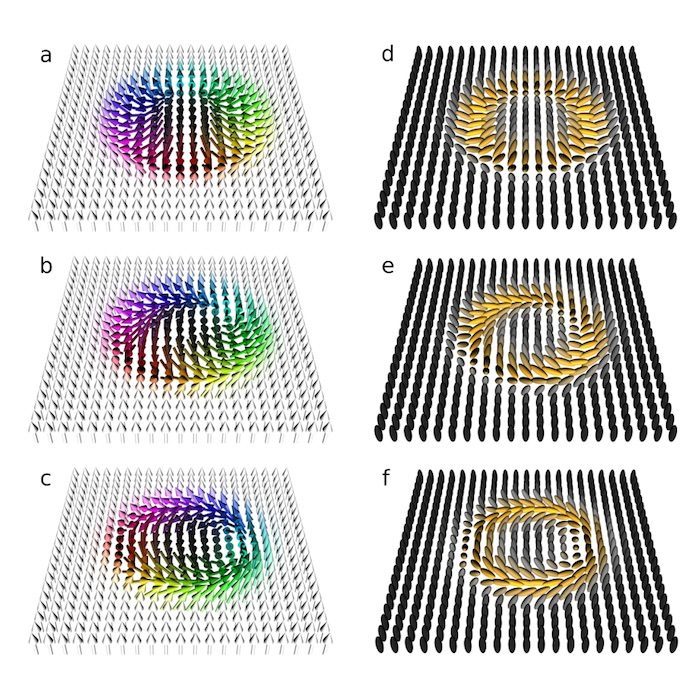
Scientists discover exotic new patterns of synchronization

fireflies
© Spencer Black Blackvisual.comIn a world seemingly filled with chaos, physicists have discovered new forms of synchronization and are learning how to predict and control them.

This time-lapse photo of blue ghost fireflies during mating season was taken in the woods near Brevard.
When the incoherent claps of a crowd suddenly become a pulse, as everyone starts clapping in unison, who decided? Not you; not anyone. Crickets sing in synchrony; metronomes placed side by side sway into lockstep; some fireflies blink together in the dark. All across the United States, the power grid operates at 60 hertz, its innumerable tributaries of alternating current synchronizing of their own accord. Indeed, we live because of synchronization. Neurons in our brains fire in synchronous patterns to operate our bodies and minds, and pacemaker cells in our hearts sync up to generate the beat.

Objects with rhythms naturally synchronize. Yet the phenomenon went entirely undocumented until 1665, when the Dutch physicist and inventor Christiaan Huygens spent a few days sick in bed. A pair of new pendulum clocks - a kind of timekeeping device that Huygens invented - hung side by side on the wall. Huygens noticed that the pendulums swung exactly in unison, always lurching toward each other and then away. Perhaps pressure from the air was synchronizing their swings? He conducted various experiments. Standing a table upright between the clocks had no effect on their synchronization, for instance. But when he rehung the clocks far apart or at right angles to each other, they soon fell out of phase. Huygens eventually inferred that the clocks' "sympathy," as he called it, resulted from the kicks that their swings gave each other through the wall.

Comment: See also: And check out SOTT radio's:


Snowflake

Why Behe is right about polar bears: Part 2 - The APOB gene and damaging mutations

polar bear
© Jacqueline Godany via Unsplash.
There is an old joke that goes like this:
Question: When does "damaging" not mean "damaging"?

Answer: When a peer-reviewed paper in a top scientific journal says over 40 times that mutations are predicted to be "damaging," but then an ID guy comes along and cites the paper to suggest the mutations are probably damaging.
Actually that's not an old joke, but maybe someday it will be. Anyway, it perfectly describes what is going on right now with critics of Michael Behe and his argument about mutations in polar bear genes.

In Darwin Devolves, Behe cites a paper in the journal Cell, Liu et al. (2014). He does so as evidence that the adaptive mutations in the polar bear gene APOB were "very likely to be damaging - that is, likely to degrade or destroy the function of the protein" (pp. 16-17). Two ID critics, biologists Nathan Lents and Arthur Hunt, object that Behe is wrong because only "some" but "[d]efinitely not all of them or even most of" the mutations in the gene were probably damaging. They go even further and claim that "the authors [of Liu et al. (2014)] do not expect the polar bear APOB to be broken or damaged" and "There is no evidence for Behe's claim that APOB is degraded or diminished in polar bears."

Comment: See part 1 here:


Pi

India to develop new directed energy weapons after successfully testing 'satellite-killer'

India satellite weapon
After successfully testing an anti-satellite (ASat) missile last month, India is now also working to develop other counterspace capabilities like directed energy weapons (DEWs) and co-orbital killers as well as the ability to protect its own satellites from electronic or physical attacks.

"We are working on a number of technologies like DEWs, lasers, electromagnetic pulse (EMP) and co-orbital weapons etc. I can't divulge the details, but we are taking them forward," said DRDO chief G Satheesh Reddy on Saturday. The A-Sat missile that destroyed the Microsat-R satellite, at an altitude of 283-km in the low-earth orbit (LEO) on March 27, was a "directascent, kinetic kill" weapon. It's "feasible" to target multiple satellites with multiple launches of the three-stage interceptor missile, which can go up to 1,000 km into space," said the DRDO chief.
A coorbital weapon, in turn, is basically a satellite equipped with some explosive, weapon or DEW device, which is first put into orbit and then later manoeuvred to target the enemy satellite. Apart from these kinetic kill weapons, other ASAT weapons like lasers jammers, EMP and high-powered microwaves are being rapidly developed by China, which first tested an A-Sat missile against a LEO weather satellite in January 2007.

Microscope 1

A biomedical engineer's verdict: Darwinism flunks science criteria

evoloution science darwin
© Rob Stadler
In The Scientific Approach to Evolution, biomedical engineer Rob Stadler applies quality science reasoning to the popular Darwin sludge. Here he offers UD readers a rundown:
When assessing the validity of a scientific theory, the available evidence should not be weighted equally as if it were equally valid. Rather, the evidence must be prioritized according to the level of confidence that it provides. Evidence that provides high confidence must be prioritized over evidence that only provides low confidence.

Guidelines for the practice of medicine and agencies like the Food and Drug Administration have long recognized that higher confidence evidence is:

1) repeatable, 2) obtained through prospective study (i.e., through experiments designed in advance to block out confounding factors, rather than through retrospective study), 3) directly measured (e.g., blood pressure measured directly via an arterial catheter, rather than indirectly measured via a cuff around the arm), 4) obtained with minimal bias, 5) obtained with minimal assumptions, and 6) summarized with sober judgement, not amplified or extrapolated beyond the experimental conditions.

These 6 criteria can be applied to any field of science to indicate the relative level of confidence in the available evidence. The criteria are not black-and-white, but rather provide a spectrum of levels of confidence.

Comment:


Beaker

EVE therapy: Artificial wombs - the ex-vivo uterine environment

EVE therapy
© Medical Xpress
In 2017, a team of Australian and Japanese scientists announced a breakthrough that could someday save the lives of countless babies. They used an artificial womb to keep premature lamb fetuses alive and healthy enough for them to be later delivered without serious health complications. This month, that same team announced a leap forward in their technology, now claiming it can keep even extremely premature lambs alive.

Their artificial womb is called the ex-vivo uterine environment (EVE) therapy. On its surface, it looks like a pillowcase-sized, transparent bag. Once the fetus is inside EVE, though, it is surrounded by a protective bath of sterilized, artificial amniotic fluid, which is routinely filtered out and replaced. Infusions of vital nutrients like amino acids and medications like antibiotics are regularly provided via IV. The womb also acts as a lung, pumping out carbon dioxide and pumping in fresh air.

Comment: Ectogenesis: Artificial wombs could soon be a reality
The key to survival through ectogenesis is reproducing the conditions of the womb. As scientists become better at that, the gap between the longest time embryos can survive and the earliest time a foetus is viable will narrow. When the two timescales meet, we will have the technology for a complete external womb.


Ice Cube

Why Behe is right about polar bears: Part 1 - Setting the stage

polar bear
© Sean Kilpatrick/The Canadian PressA polar bear eats a piece of whale meat as it walks along the shore of Hudson Bay near Churchill, Man.
Critics of intelligent design in the little world of anti-ID blogging have fastened onto an exciting meme. The idea is that biochemist Michael Behe made egregious errors about polar bears in Darwin Devolves and in his subsequent posts at Evolution News arguing with critics. Scientists including Nathan Lents, Arthur Hunt, Jerry Coyne, Joshua Swamidass, and Richard Lenski have been promoting this meme. They complain that Behe refuses to acknowledge and retract his errors. Of course, real errors should be corrected, whether by Behe or anyone else. However, a closer look shows that Behe's arguments are essentially correct, and no retractions are needed.

The story is a bit long and complex. That's good, though. Let's take the opportunity to hold an informal seminar from which it's hoped that the critics will learn and benefit. Starting today, you're invited to sit back and enjoy a five-part series on polar bear genes in light of Behe's thesis in Darwin Devolves.

SOTT Logo Radio

SOTT Focus: MindMatters: Matter, Information, or Mind - Which Is The Most Fundamental?

information mind matter
© SOTT
On today's show we discuss the research of computer engineer Bernardo Kastrup, a man who has devoted a significant amount of his professional life to developing a robust and comprehensive critique of the materialist worldview. He is the author of numerous books, including The Idea of the World: A multi-disciplinary argument for the mental nature of reality, and Why Materialism is Baloney, as well as many articles. Today we'll be discussing one of his latest articles, "Physics Is Pointing Inexorably to Mind".

For centuries the extreme success of the physical sciences have lent credibility the materialist worldview. However, the success of the scientific enterprise as a whole continues to reveal a world of startling intelligence that cannot be explained by the mere accidents of matter but seem plausible only in the light of an intelligent mind. As Kastrup writes, "This mental universe is what physics is leading us to." We'll be discussing this mental universe, the problems of materialism and more today, on MindMatters.


Running Time: 01:04:17

Download: MP3 - 58.9 MB