Science & TechnologyS


Gear

Darwin Devolves — Evidence Keeps Rolling In

dolphin
© christels via Pixabay
Several new papers have appeared that reinforce key points of my recent book, Darwin Devolves. (Hat tip to Paul Nelson.) The first one — "Quantifying the pathways to life using assembly spaces" — is from a group of theoreticians at Arizona State and the University of Glasgow. (The work was discussed by one of the authors, Sara Imari Walker, at a meeting this July in Italy, "Mind Matters: Intelligence and Agency in the Physical World." Walker is a frequent collaborator of Paul Davies.)

Reeking of ID

The paper investigates phenomena that reek of intelligent design, but the authors ascribe design either to an extrinsic agent or to (presumably undirected) evolution.
Herein, we present the foundations of a new theoretical approach to agnostically quantify the amount of potential pathway assembly information contained within an object. This is achieved by considering how the object can be deconstructed into its irreducible parts, and then evaluating the minimum number of steps necessary to reconstruct the object along any pathway. ... This allows determining when an extrinsic agent or evolutionary system is necessary to construct the object ...
Their only gesture at justifying the mythic powers ascribed to mutation and selection is to cite a single, decade-old, semi-theoretical, non-experimental paper. The authors hope that their work will "help identify the new physical and chemical laws needed to understand what life is, by quantifying what life does." Well, it would be great if they could indeed reliably identify biological objects whose assembly is beyond random processes. But, as I documented in Darwin Devolves, no sign of a mysterious new mind-like law was seen in Richard Lenski's evolution experiments, or the development of chloroquine resistance by the malaria parasite, or any of the best relevant data from other work. Maybe there is no such law.

Microscope 2

Beyond Einstein: Physicists solve mystery surrounding photon momentum

COLTRIMS
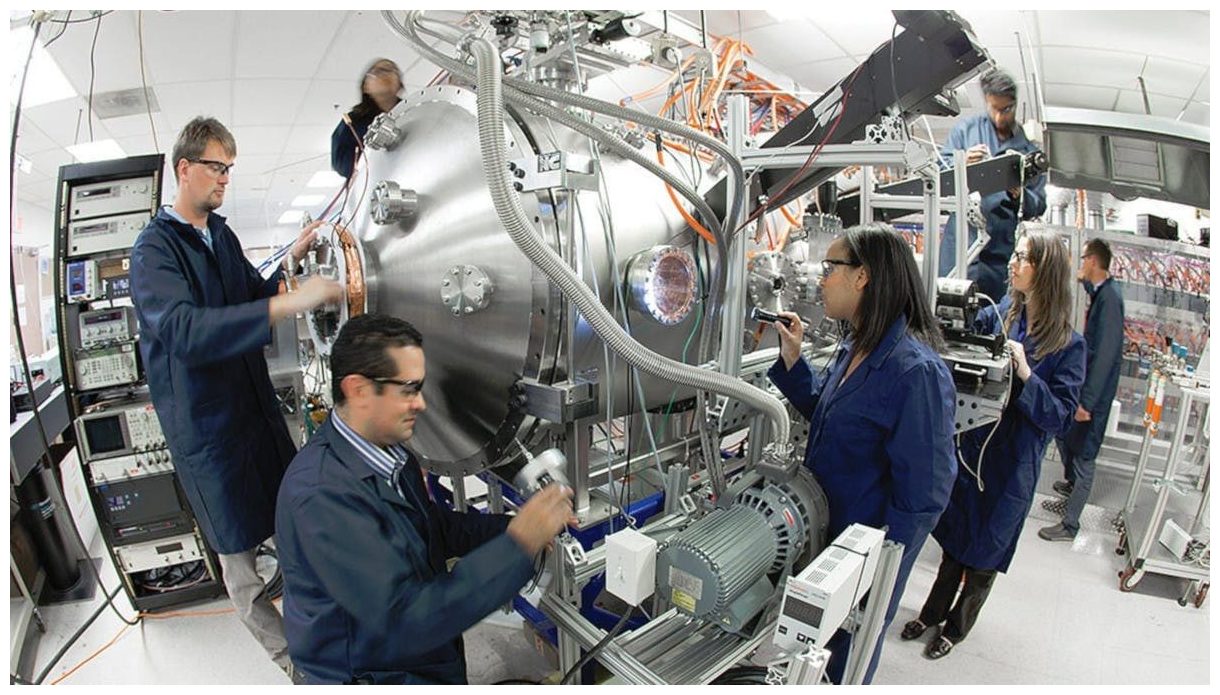
© Alexander HartungA photo of the COLTRIMS reaction microscope built by Alexander Hartung as part of his doctoral research in the experiment hall of the Faculty of Physics.
Albert Einstein received the Nobel Prize for explaining the photoelectric effect: in its most intuitive form, a single atom is irradiated with light. According to Einstein, light consists of particles (photons) that transfer only quantised energy to the electron of the atom. If the photon's energy is sufficient, it knocks the electrons out of the atom. But what happens to the photon's momentum in this process? Physicists at Goethe University are now able to answer this question. To do so, they developed and constructed a new spectrometer with previously unattainable resolution.

Doctoral student Alexander Hartung became a father twice during the construction of the apparatus. The device, which is three meters long and 2.5 meters high, contains approximately as many parts as an automobile. It sits in the experiment hall of the Physics building on Riedberg Campus, surrounded by an opaque, black tent inside which is an extremely high performing laser. Its photons collide with individual argon atoms in the apparatus, and thereby remove one electron from each of the atoms. The momentum of these electrons at the time of their appearance is measured with extreme precision in a long tube of the apparatus.

The device is a further development of the COLTRIMS (Collision Optical Laser Testing Reaction Interacting Momentum System) principle that was invented in Frankfurt and has meanwhile spread across the world: it consists of ionising individual atoms, or breaking up molecules, and then precisely determining the momentum of the particles. However, the transfer of the photon momentum to electrons predicted by theoretic calculations is so tiny that it was previously not possible to measure it. And this is why Hartung built the "super COLTRIMS."

Yoda

Quillette's response to Jerry Coyne on his (non)defense of Neo-Darwinism

gorilla suset
Jerry Coyne has offered a response in the pages of Quillette to David Gelernter's provocative article, "Giving Up Darwin." Gelernter rejected the standard model of neo-Darwinian evolution for a simple reason: he looked at three pieces of scientific evidence that appeared to be incompatible with that model:
  • The sudden appearance of new body plans in the fossil record.
  • The extreme rarity of protein folds.
  • The absence of early-acting beneficial mutations, the kind that would be needed to generate new animal body plans.
In knowing where to look, Gelernter had help from Stephen Meyer's Darwin's Doubt, and David Berlinski's The Deniable Darwin. These books both contain many references to the literature. Gelernter also highlighted the book Debating Darwin's Doubt, which responded in detail to all notable critiques of the arguments that swayed him. For all that, Coyne faulted Gelernter for not examining counter-arguments to his own position. "One simply can't do good science," Coyne wrote, "by spouting only one side of an argument and ignoring the claims of the other." A certain measure of irony is conveyed by this unjustified remark. Had Coyne followed it more faithfully, he would have spared himself some embarrassment.

Stormtrooper

Super soldiers? DARPA pushes for using gene editing on American troops

supersoldiers
© Getty Images/mikkelwilliam
A US Department of Defense agency is currently looking at ways to alter one's biology to provide adequate protection for personnel from chemical and biological attacks.

There will come a time where sci-fi movies write themselves. These moving pictures wouldn't even be referred to as science-fiction, as they would more or less be based on reality. Where it isn't yet based on reality, it has to be said that we are getting to a stage now where it is probably only a matter of time until that concept has been actualized by government-funded scientists who seek to aid the US military.

According to the Defense Department, the Defense Advanced Research Projects Agency (DARPA) is currently advancing a notion known as gene editing (or genome editing) with a view of it benefiting US military personnel. Gene editing is essentially a group of technologies that allow scientists to change an organism's DNA, by adding, removing or altering genetic material at particular locations in the genome.

Comment: See also:


Ambulance

'First responders': Researchers find a new code in disordered proteins, pointing to intelligent design

Human “first responders”
© Frmatt [CC BY-SA 3.0], via Wikimedia CommonsHuman “first responders”
Scientists from the University of Washington have glimpsed possible reasons for intrinsically disordered domains in heat shock proteins. If confirmed, their observations open up phenomenal possibilities for intelligent design in these and other intrinsically disordered protein domains.
Rather than behaving as a completely 2 intrinsically disordered region, we find it to be quasi-ordered, with six sub-regions that display 3 distinct properties and binding preferences. The results reveal that, contrary to expectation, the high degree of heterogeneity and polydispersity that is a defining feature of HSPB1 (and other human sHSPs) derives not from fuzzy disorder but rather from an array of combinatorial interactions that involve discrete NTR sub-regions and specific surfaces on the structured ACD. We expect other oligomeric sHSPs are similarly defined.... [Emphasis added.]
It's just a preprint in bioRxiv, but this paper could represent a giant leap in debunking the old junk-DNA paradigm. Its title, "Interplay of disordered and ordered regions of a human small heat shock 1 protein yields an ensemble of 'quasi-ordered' states," introduces quasi-ordered as a term to describe intrinsically disordered proteins, or IDPs. The work presented in this paper should not be discounted for lacking peer review at the time of publication. Six researchers in the University of Washington's Departments of Biochemistry and Medicinal Chemistry based their models on nuclear magnetic resonance (NMR) imaging and hydrogen-deuterium exchange mass spectrometry (HDX), so the work is not armchair speculation.

Back in May, Evolution News introduced one example of an IDP with a function, and asked: "Will other IDPs be found to quickly change from flopping strands into functional regulators based on environmental changes? Will the DNA sequences that produce IDPs continue to confirm the sequence hypothesis?"

Galaxy

Alien probes spying on Earth? Scientist warns of possible 'lurkers' in our solar system

asteroid
© AFP / NASA Handout
Is Earth under the watchful eye of "lurking" extraterrestrial spy probes? One US physicist argues that while it's a distant possibility - it wouldn't hurt to send out probes of our own to take a look and make sure.

Physicist and independent SETI (Search for Extraterrestrial Intelligence) researcher James Benford posited that nearby asteroids that track with Earth's orbit - also known as co-orbitals - would make the ideal place for an otherworldly spy post. He published his findings, titled "Looking for Lurkers," in the peer-reviewed Astronomical Journal last month.

"A probe located nearby could bide its time while our civilisation developed technology that could find it, and, once contacted, could undertake a conversation in real time," Benford wrote in the paper.

In his paper, Benford not only offers "possible sites for extraterrestrial probes," but suggests ways researchers might look for evidence of the alien tech, ranging from using optical and radio telescopes to sending a spacecraft outright.

Given its close and constant presence near Earth, one might think the moon would make a better spy station than more distant co-orbitals, but Benford said any particular section of the moon's surface is "in darkness for two weeks at a time," depriving any probe of the solar energy it might need to function. Placing the probes too close to Earth might also pose a problem, as Benford argues the ETs would likely wish to remain undetected.

Galaxy

C/2019 Q4: ANOTHER interstellar object to pass through our solar system

Oumuamua
© ESA/Hubble, NASA, ESO, M. Kornmesser'Oumuamua, the first object ever seen passing through our solar system from interstellar space, is shown in this artwork to be faintly outgassing as the Sun warms its ice.
Very big news: A comet discovered just a couple of weeks ago appears to be one the most rare and exciting of all cosmic beasts: An interstellar visitor — literally an object coming from interstellar space, from an alien star!

The object is called C/2019 Q4 (Borisov) — though that name may change, as I'll get to in a sec — and it was discovered in observations taken on August 30, 2019 at the Crimean Astrophysical Observatory by Gennady Borisov using a custom 0.65-meter telescope. It didn't take long to find the object had an, um, unusual orbit, and follow-up observations taken a few days later using a much larger telescope confirmed its strange nature. There have now been quite a few observations, and although many mysteries remain, we can be pretty sure this thing came from Out There.

To be probably too careful here, I want to say that there is a slim chance it's not from outside our solar system, but honestly at this point I wouldn't put much money on that. As more observations come in it looks more and more like this is the real deal.

Comment: Either they're much more common than we thought, or there's a significant uptick in activity:


Mars

NASA scientist: World not prepared for when we find life on Mars

InSight probe sitting on Mars surface
© NASAInSight probe sitting on Mars surface.
As we humble earthlings begin to learn more about the universe and potentially stand on the cusp of great discoveries about the planet Mars, we may not be prepared for what's in store of us, warns the chief scientist of U.S. space agency NASA.

Dr. Jim Green believes that as two rovers from NASA and the European Space Agency (ESA) prepare to embark for Mars next summer, humanity could be overwhelmed by the implications of studies to come.

Speaking to the Telegraph, the director of NASA's Planetary Science Division compared the potential discoveries to Rennaissance-era astronomer Nicolaus Copernicus' theory that postulated that the Earth revolves around the Sun, rather than vice-versa.

The Copernican model, which is credited with revolutionizing science during the 16th century, earned him the condemnation of the Roman Catholic Church due to the model's impact on the Church's doctrines relating to astronomy.
"It will start a whole new line of thinking. I don't think we're prepared for the results.

I've been worried about that because I think we're close to finding it and making some announcements."
The ESA's ExoMars Rover and NASA's Mars 2020 are set to drill 6.5 feet into the Red Planet's core to take samples in hopes of finding evidence of life on. The samples will be processed and examined in a mobile laboratory that will look for any traces of organic matter.

Comment: Mars most likely did have life. And its water may have been there a lot later in time than many scientists assume:


Nebula

Radiation levels in Seoul similar to Tokyo - Japanese embassy publishes data following concerns from South Korea

Radiation levels in 2017
© http://www.simplyinfo.org/?page_id=16704Japanese governments radiation map for 2017.
Fukushima Radiation Maps.

The Japanese government has created radiation level maps for the Fukushima region and beyond since early 2011. These are now updated about once a year and posted on Japan’s nuclear regulator’s website. The data is collected by aircraft equipped with radiation monitoring equipment.
Japan's Embassy in South Korea has begun publishing daily measurements of radiation levels in Fukushima Prefecture and Seoul after new questions were raised about the lingering effects of the 2011 nuclear disaster.

The embassy website said the information reflects the fact that "interest in radiation levels in Japan has recently been increasing, particularly in South Korea."

The move comes amid worsening ties between Japan and South Korea over a long-running dispute about Japan's use of forced labor in South Korea during World War II.

The two countries have taken retaliatory trade measures against one another, and South Korea has tightened its radiation checks on food imports from Japan.

According to the embassy, the readings show that radiation levels in three Japanese cities are almost the same as in major cities outside of Japan, including Seoul.

Comment: Whilst Fukushima is not an exact comparison to Chernobyl there do appear to be valuable insights that can be gleaned from the earlier disaster and into the behaviour and long term effects of radiation - and it appears it's not exactly what scientists expected:


Info

Japanese researchers have developed artificial blood for patients of any blood type

Artificial Red Blood
© Provided by National Defense Medical College associate professor Manabu KinoshitaArtificially created red blood cells.
Japanese researchers said they have developed artificial blood that can be transfused into patients regardless of their blood type and can vastly improve the chances for survival of seriously injured people.

The artificial blood created by a team of scientists primarily from the National Defense Medical College has proved effective in experiments on rabbits.

For possible applications on humans, the artificial blood gets around problems with identifying blood types in emergency situations and overcomes limits on storing real blood from donors.

A severe loss of blood platelets that stop bleeding and red blood cells that carry oxygen to body cells will lead to death.

Platelets can be stored for four days if shaken to prevent solidification, while red blood cells can be kept for 20 days at low temperatures.

A large amount of platelets and red blood cells from donors of all blood types must be secured for emergencies.

The team's artificial blood consists of platelets and red blood cells. Each component is put in tiny bags known as liposome derived from the cell membrane to stop bleeding and transfer oxygen.