
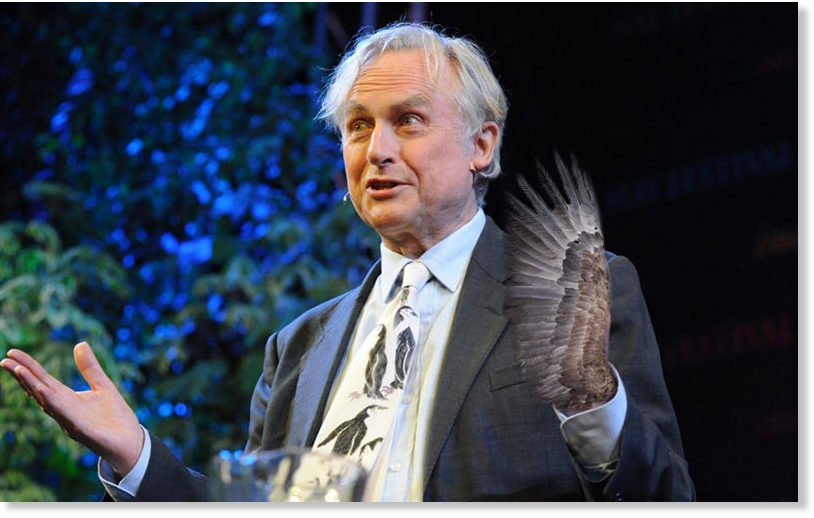
Evolution in progress. You are now obsolete and awaiting removal by natural selection.
"Half a wing is indeed not as good as a whole wing, but it is certainly better than no wing at all. Half a wing could save your life by easing your fall from a tree of a certain height. And 51 per cent of a wing could save you if you fall from a slightly taller tree. Whatever fraction of a wing you have, there is a fall from which it will save your life where a slightly smaller winglet would not. The thought experiment of trees of different height, from which one might fall, is just one way to see, in theory, that there must be a smooth gradient of advantage all the way from 1 per cent of a wing to 100 per cent."If Richard Dawkins had 1% of a wing, he'd be really happy to have such a magnificent evolutionary advantage. He could fall from 1cm higher than you without dying. His offspring would fill the earth, and we would all die out. Natural selection would somehow make sure of that. 1,000 generations later, somebody would evolve 2% of a wing, and the one-percenters would die out because there's no way they could compete with 2% of a wing. This has to happen very slowly and gradually but never leave any incriminating evidence in the fossil record. It's evolution, baby!











Comment: This article is the sixth in a series. For part 7, go here:
How the Incoherent Theory of Evolution Distorts Our Thinking