
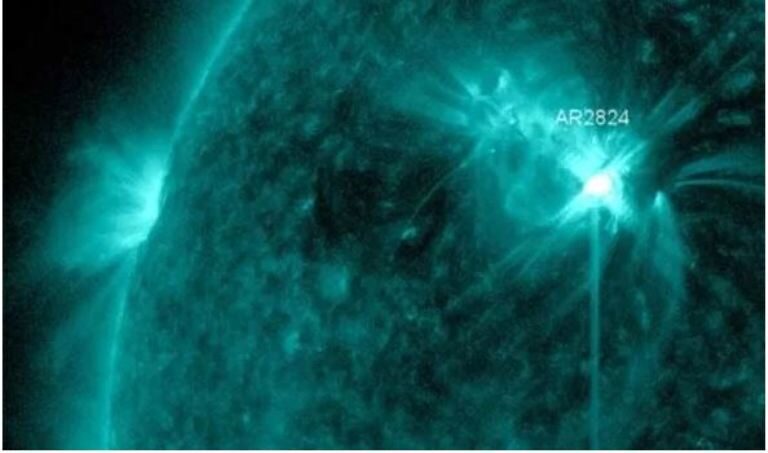
© SPACE WEATHERSunspot awakes from slumber to douse Earth in radiation which downs radio signals
Solar flares can be detrimental to radio waves as when they hit the atmosphere, ionisation occurs which saps energy from radio waves.
The sunspot in question has been dubbed AR2824 which was first found last week.
However, it went quiet for a few days before waking up and blasting solar flares into the cosmos.
Dr Tony Philips of astronomy site Space Weather wrote on his blog: "After nearly a week of somnolent quiet, sunspot AR2824 is flaring again.
"An impulsive C4.8-class flare during the late hours of May 21st (1928 UT) was followed by an even stronger C6.1-flare on May 22nd (0256 UT).
"AR2824 is now strobing Earth with pulses of ultraviolet radiation.













Comment: The effects of solar flares on Earth's magnetosphere