Science & TechnologyS


Telescope

Asteroid Steins will be tracked by ESA's Rosetta comet chaser

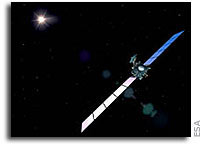
Heading toward its first target-asteroid, (2867) Steins, ESA's Rosetta spacecraft has started using its cameras to visually track the asteroid and eventually determine its orbit with more accuracy.

Image
©ESA

Rosetta started the optical navigation campaign on 4 August 2008, at a distance of about 24 million km from Steins; the campaign will continue until 4 September, when the spacecraft will be approximately 950 000 km from the asteroid.

"The orbit of Steins, with which Rosetta will rendezvous on 5 September, closing to a distance of 800 km, is only known thanks to ground observations, but not yet with the accuracy we would like for the close fly-by," said Gerhard Schwehm, Rosetta Mission Manager based at ESA's European Space Astronomy Centre (ESAC), near Madrid, Spain.

"We will be able to use the first data set for the trajectory correction manoeuvre planned for mid-August."

Light Saber

'Gravity tractor' could deflect asteroids

A "gravity tractor" could deflect an Earth-threatening asteroid if it was deployed when the asteroid was more than one orbit away from the potential impact, according to a new study. If the space rock was found heading straight for Earth, a combination of techniques - including a gravity tractor - might save the day.

Comment: And don't forget to check out Signs of the Times' very own Special Report:

Meteorites, Asteroids, and Comets: Damages, Disasters, Injuries, Deaths, and Very Close Calls


Better Earth

Mexican crater could give clues to ancient Mars

A prehistoric crater left by an asteroid collision in Mexico's Yucatan Peninsula could yield clues about what Mars was like billions of years ago, a NASA scientist says.

Sherlock

UK: Large Roman settlement unearthed by builders


Kinghills dig
©Unknown
Oxford Achaeology's team on the Kingshill site

A huge early Roman settlement unearthed in Cirencester is the most significant historical discovery ever made in the town, archaeologists said this week.

The encampment which covers several hectares, dates back to the late-Iron Age in the 1st century ad, and was likely to have been occupied by the first Roman settlers in Cirencester.

Info

Brightest, Sharpest, Fastest X-ray Holograms Yet

The pinhole camera, a technique known since ancient times, has inspired a futuristic technology for lensless, three-dimensional imaging. Working at both the Advanced Light Source (ALS) at the U.S. Department of Energy's Lawrence Berkeley National Laboratory, and at FLASH, the free-electron laser in Hamburg, Germany, an international group of scientists has produced two of the brightest, sharpest x-ray holograms of microscopic objects ever made, thousands of times more efficiently than previous x-ray-holographic methods.

Image
©DOE/Lawrence Berkeley National Laboratory
A coherent x-ray beam illuminates both the sample and a uniformly redundant array (URA) placed next to it. The CCD detector (whose center is shielded from the direct beam) collects diffracted x-rays from both sample and URA. Processing the resulting interference patterns subsequently yields a hologram.

Clock

US: White House Briefed On Potential For Mars Life

The White House has been alerted by NASA about plans to make an announcement soon on major new Phoenix lander discoveries concerning the "potential for life" on Mars, scientists tell Aviation Week & Space Technology.

Sources say the new data do not indicate the discovery of existing or past life on Mars. Rather the data relate to habitability--the "potential" for Mars to support life--at the Phoenix arctic landing site, sources say.

The data are much more complex than results related NASA's July 31 announcement that Phoenix has confirmed the presence of water ice at the site.

Telescope

Victor Emerges in Stormy Battle on Jupiter

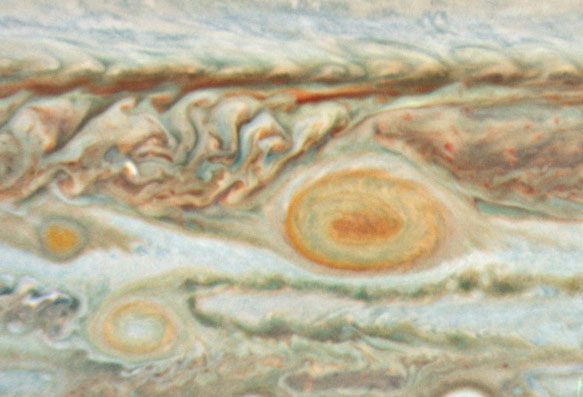
Jupiter's Great Red Spot has roughed up a younger rival storm and may consume it altogether.

The baby red spot appears to have gotten the worst of its whirlwind encounter with the ravenous super-storm that has dominated Jupiter for at least two centuries. Their tussle was captured in a recent series of images by the Hubble Space Telescope.

Scientists may be watching historical shifts in action as they learn how the giant planet's storms grow and change over decades and centuries.

Great Red Spot
©NASA/ESA/A. Simon-Miller (NASA Goddard Space Flight Center)
An image of the baby red spot (left), the Little Red Spot (lower left), and the Great Red Spot (right). The image was taken on May 15, 2008 by the Hubble Space Telescope.

The smaller storm first appeared earlier this year, but had the misfortune to get caught up in the reverse cyclone spin of the Great Red Spot. That left the baby red spot deformed and sapped of color as it spun off to the east of the greater storm. Astronomers predict that the Great Red Spot will eventually pull in and absorb the baby red spot - a possible reason why the super-storm has sustained its power for so long.

Star

How the First Stars Were Born

A new supercomputer simulation offers the most detailed view yet of how the first stars evolved after the Big Bang.

The model follows the simpler physics that ruled the early universe to see how cold clumps of gas eventually grew into giant star embryos.

Image
©Yoshida et al/Astrophysical Journal
Projected gas distribution around the protostar. The large-scale gas distribution around the cosmological halo.

"Until you put that physics in the code, you can't evaluate how the first protostars formed," said Lars Hernquist, an astrophysicist at Harvard University whose early-stars model is detailed in this week's issue of the journal Science. His remarks were made Wednesday during a press teleconference.

Mysterious "dark matter" provided the first gravitational impetus for hydrogen and helium gas to start clumping together, Hernquist said. The gas began releasing energy as it condensed, forming molecules from atoms, which further cooled the clump and allowed for even greater condensing.

Bizarro Earth

Drastic climate chill came exactly 12,679 years ago, happened in less than a year: study

A drastic cooling of the climate in western Europe happened exactly 12,679 years ago, apparently after a shift to icy winds over the Atlantic, scientists said on Friday, giving a hint of how abruptly the climate can change.

Comment: Almost exactly three 4,200 year periods back from the present.


Star

The Pole star comes to life again


pole star
©Unknown
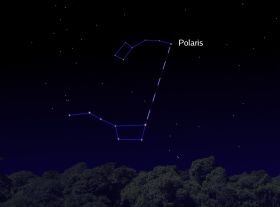
Artist's impression of Polaris and the constellations of the Big and Small Dippers.

The Northern Star, whose vibrations were thought to be dying away, appears to have come to life again.

An international team of astronomers has observed that vibrations in the Pole star, which had been fading away to almost nothing over the last hundred years, have recovered and are now increasing. And the astronomers don't know why.