Science & TechnologyS


Magnify

Chronic Exposure To Estrogen Impairs Some Cognitive Functions


Estradiol Researchers
©L. Brian Stauffer, U. of I. News Bureau
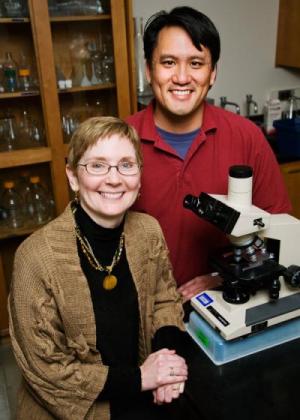
Veterinary biosciences professor Susan Schantz and graduate student Victor Wang found that rats exposed to estradiol were significantly impaired on tasks involving working memory and response inhibition.

University of Illinois researchers report this week that chronic exposure to estradiol, the main estrogen in the body, diminishes some cognitive functions. Rats exposed to a steady dose of estradiol were impaired on tasks involving working memory and response inhibition, the researchers found.

Telescope

'Cosmic Ghost' Discovered By Volunteer Astronomer In Archived Images Of Night Sky

When Yale astrophysicist Kevin Schawinski and his colleagues at Oxford University enlisted public support in cataloging galaxies, they never envisioned the strange object Hanny van Arkel found in archived images of the night sky.

Hannys Voorwerp
©Dan Smith, Peter Herbert, Matt Jarvis & the ING
Image of Hanny's Voorwerp and IC 2497.

The Dutch school teacher, a volunteer in the Galaxy Zoo project that allows members of the public to take part in astronomy research online, discovered a mysterious and unique object some observers are calling a "cosmic ghost."

van Arkel came across the image of a strange, gaseous object with a hole in the center while using the website to classify images of galaxies.

When she posted about the image that quickly became known as "Hanny's Voorwerp" ( Dutch for "object") on the Galaxy Zoo forum, astronomers who run the site began to investigate and soon realized van Arkel might have found a new class of astronomical object.

Telescope

Thousands Of 5 Billion Year-old Globular Clusters Identified In Virgo Cluster Of Galaxies

The NASA/ESA Hubble Space Telescope has identified thousands of more than 5 billion year-old globular clusters in the Virgo cluster of galaxies. One of the results of these discoveries led astronomers to understand more about the life and evolution of cannibal galaxies.

Image
©NASA, ESA and Eric Peng (Peking University, China)
These images taken by the NASA/ESA Hubble Space Telescope show four members of the Virgo cluster of galaxies, the nearest large galaxy cluster to Earth. They are part of a survey of globular star clusters in 100 of Virgo's galaxies.

Globular star clusters, dense bunches of hundreds of thousands of stars, contain some of the oldest surviving stars in the Universe. A new international study of globular clusters outside our Milky Way Galaxy has found evidence that these hardy pioneers are more likely to form in dense areas, where star birth occurs at a rapid rate, instead of uniformly from galaxy to galaxy.

Astronomers used the NASA/ESA Hubble Space Telescope to identify over 11 000 globular clusters in the Virgo cluster of galaxies, most of which are more than 5 billion years old. Comprised of over 2 000 galaxies, the Virgo cluster is located about 54 million light-years away and is the nearest large galaxy cluster to Earth. Along with Virgo, the sharp vision of Hubble's Advanced Camera for Surveys (ACS) resolved the star clusters in 100 galaxies of various sizes, shapes, and brightness - even in faint, dwarf galaxies.

Question

Schizophrenia: Costly By-product Of Human Brain Evolution?

Metabolic changes responsible for the evolution of our unique cognitive abilities indicate that the brain may have been pushed to the limit of its capabilities. Research published today in BioMed Central's open access journal Genome Biology adds weight to the theory that schizophrenia is a costly by-product of human brain evolution.

Image
©iStockphoto/Vasiliy Yakobchuk
Scientists have identified the molecular changes that took place over the course of human evolution and considered those molecular changes observed in schizophrenia.

Philipp Khaitovich, from the Max-Planck-Institute for Evolutionary Anthropology and the Shanghai branch of the Chinese Academy of Sciences, led a collaboration of researchers from Cambridge, Leipzig and Shanghai who investigated brains from healthy and schizophrenic humans and compared them with chimpanzee and rhesus macaque brains. The researchers looked for differences in gene expression and metabolite concentrations and, as Khaitovich explains, "identified molecular mechanisms involved in the evolution of human cognitive abilities by combining biological data from two research directions: evolutionary and medical".

The idea that certain neurological diseases are by-products of increases in metabolic capacity and brain size that occurred during human evolution has been suggested before, but in this new work the authors used new technical approaches to really put the theory to the test.

Bulb

Large Hadron Collider to be launched Oct. 21 - Russian scientist


Image
©Unknown

The Large Hadron Collider (LHC), the world's largest and most powerful particle accelerator, will be officially unveiled on October 21, a Russian scientist said Tuesday.

LHC is a particle accelerator that will smash together opposing beams of protons to explore the validity and limitations of current particle physics theory.

"The collider is to be inaugurated on October 21," said Alexander Vodopyanov, of the Integrated Institute of Nuclear Research. "This means at least one test-run of proton beams around the accelerator ring will be conducted prior to inauguration."

Sherlock

Teasing, NASA style: Martian soil may contain toxic compounds harmful to life

Data gathered by NASA's Phoenix lander on Mars have revealed the red planet's soil could contain a toxic substance that would make it less likely that life formed there.

Earlier NASA said Phoenix analyzers detected water in the soil, which suggested that Mars could have the conditions for life. However, if the presence of perchlorate were confirmed, the probability of detecting living organisms there would be reduced.

"The Phoenix team has been waiting for complementary results from the Thermal and Evolved-Gas Analyzer, or TEGA, which also is capable of detecting perchlorate. TEGA is a series of ovens and analyzers that "sniff" vapors released from substances in a sample," NASA said on its website.

Info

Lost world frozen 14m years ago found in Antarctica

A lost world has been found in Antarctica, preserved just the way it was when it was frozen in time some 14 million years ago.

The fossils of plants and animals high in the mountains is an extremely rare find in the continent, one that also gives a glimpse of a what could be there in a century or two as the planet warms.

A team working in an ice-free region has discovered the trove of ancient life in what must have been the last traces of tundra on the interior of the southernmost continent before temperatures began to drop relentlessly.

Meteor

Planets and Perseids should keep stargazers looking up

Meteor shower expected to hit its peak on August 12.

This is a special month for sky watchers to focus on the western sky, with four planets scuttling back and forth in what appears to be a celestial game of tag.

August also means the arrival of bits of debris trailing in the path of comet Swift-Tuttle, which we call the Perseid meteor shower, usually the best of the year.

Sherlock

New life given to ancient Egyptian texts stored at Stanford for decades

They're torn and faded and have the woven texture of a flattened Triscuit. At first glance, the ancient Egyptian texts look like scraps of garbage. And more than 2,000 years ago, that's exactly what they were - discarded documents, useless contracts and unwanted letters that were recycled into material needed to plaster over mummies, like some precursor to papier-mâché.

papyri1
©L.A. Cicero
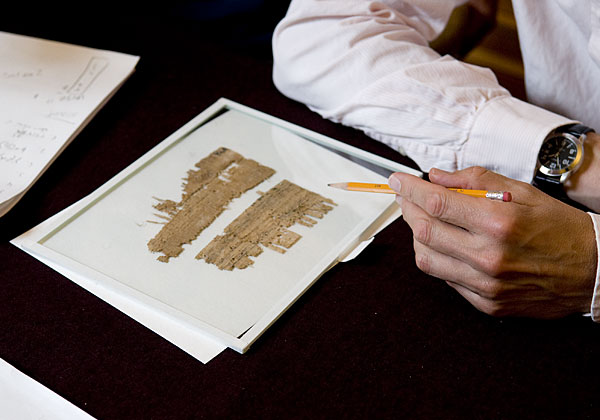
Approximately 70 pieces from Stanford's papyri collection are being analyzed after being kept in storage since the 1920s.

Sherlock

Found: The hottest water on Earth


Image
©NOAA
A black smoker

Even Jules Verne did not foresee this one. Deep down at the very bottom of the Atlantic Ocean, geochemist Andrea Koschinsky has found something truly extraordinary: "It's water," she says, "but not as we know it."

At over 3 kilometres beneath the surface, sitting atop what could be a huge bubble of magma, it's the hottest water ever found on Earth. The fluid is in a "supercritical" state that has never before been seen in nature.

The fluid spews out of two black smokers called Two Boats and Sisters Peak.

Koschinsky, from Jacobs University in Bremen, Germany, says it is somewhere between a gas and a liquid. She thinks it could offer a first glimpse at how essential minerals and nutrients like gold, copper and iron are leached out of the entrails of the Earth and released into the oceans.