
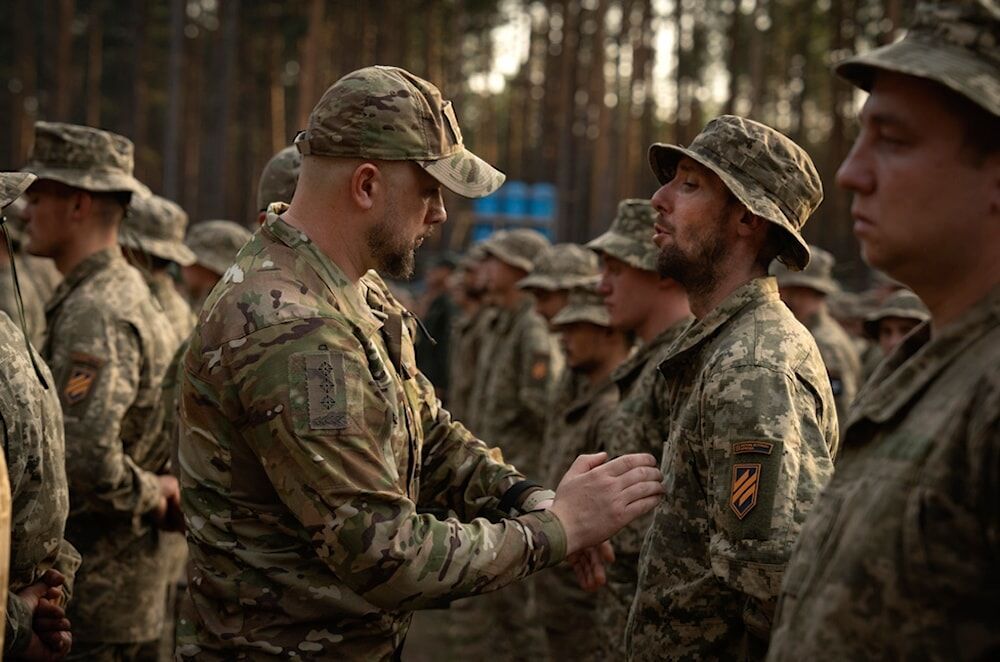
© APNewly recruited soldiers who mark the end of their training at a military at a military base close to Kyiv, Ukraine, on September 25, 2023.
Ukrainian conscription officers kidnapped a 14-year-old during an attempt to forcibly enlist him with the military.
According to the Bessarabia Info website, the teenager was walking to his friend's house in the village of Priozernoye, Odessa, when a white minivan pulled up next to him. Four officers masked in balaclavas jumped him, pressed a rifle onto his head, and forced him into the van.
As the kid fought back, the officers restrained him, tied his hands with plastic bands, and beat him up with an assault rifle. After asking him what age he was, the officers refused to believe the teenager was actually 14 until they obtained his passport and confirmed it.
He was thrown out of the van almost immediately after they confirmed his age and was threatened to not report the incident to Ukrainian authorities. However, the incident made its way to the police after the minor informed his school teachers of what happened.
Local authorities were reportedly investigating the incident.
Desperate times call for desperate measures
This comes as a facet of the desperate measures Ukraine has resorted to amid a severe shortage in manpower, which jeopardizes its position in the war against Russia.
The Wall Street Journal reported on March 25 that alongside the shortage of soldiers, recruitment efforts were hindered due to "politics, demographics and Ukrainians' increasing reluctance to join the military."
The report emphasized that the Ukrainian armed forces desperately need recruits, but "political dithering" is leaving frontline units in a dire state, highlighting that a draft law aimed at expanding conscription is still stalled in the Ukrainian parliament after months of debate.
According to the newspaper, the law's proposed changes are "somewhat modest", as the draft age will be reduced from 27 to 25 years, soldiers will be eligible to leave the Ukrainian army after three years of service, and penalties will be imposed on men who avoid conscription.
However, the newspaper highlighted that the Ukrainian parliament is struggling against large segments of the population unwilling to fight, even to approve these amendments to the law.
It noted that men aged between 18 and 60 have been prevented from leaving the country since the start of the war, although only those under 27 are eligible for conscription, with most of the country's youth exempted.
The newspaper confirmed that hundreds of thousands of Ukrainian men continue to evade conscription. Some reported being beaten or detained for several days until they signed conscription papers.






Comment: It turned out the story already ran in Fourteen-year-old Ukrainian violently abducted by conscription officers - media Tracing the original for this article, there was from Bessarabia Inform the story in Russian and in Ukrainian. The original has this image:
Having lost hundreds of thousands with the encouragement from the Maidan coup masters and 'friends' in the EU and NATO, the recruiters in Ukraine who are tasked with finding people have a difficult job. Below are some headlines, which in no way do justice to the numerous videos, that have come out from Ukraine.
- Finland removes protection permit for foreign residents from Ukraine who fled conflict seeking asylum
- Estonia, Germany, say it will not deport Ukrainian men, as Poland considers it to bolster conscription crisis
- Best of the Web: Poland begins extraditing Ukrainian men who fled conscription
Outside of Ukraine, conscription is also a topic:Europe
- Russian ombudsman says excluding women from military conscription is a violation of their rights
- Putin signs new conscription law
- Russian Orthodox Church believes army conscription isn't ideal, and Putin agrees
- Professionals only: Military conscription in Russia to become a thing of the past - Putin
- UK, German officials are latest in Europe calling for conscription 'in the event of war'
- Sweden aims to reactivate civil conscription to shore up defences
- Germany considers bringing back conscription to boost falling army numbers
- Baltic leaders urge NATO to bring back conscription, suggest 'defence tax' and doubling of defence spending
Middle East