Science & TechnologyS


Network

With Security at Risk, a Push to Patch the Web

Since a secret emergency meeting of computer security experts at Microsoft's headquarters in March, Dan Kaminsky has been urging companies around the world to fix a potentially dangerous flaw in the basic plumbing of the Internet.

While Internet service providers are racing to fix the problem, which makes it possible for criminals to divert users to fake Web sites where personal and financial information can be stolen, Mr. Kaminsky worries that they have not moved quickly enough.

Pharoah

Ancient device yields secrets


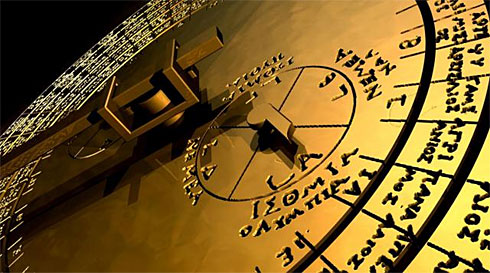
Olympic Dial
©Tony Freeth, Antikythera Mechanism Research Project
A computer image reconstruction of the Olympiad Dial, showing the four-year cycle of the Panhellenic Games.

Archaeologists had long known the Antikythera Mechanism, a bronze relic pulled from a Roman shipwreck, had been an astronomical calculator used by the ancient Greeks to predict phases of the moon and planets.

Now, a study out Wednesday shows the mechanism, which is at least 2,100 years old, also revealed the timing of the Greek Olympics, kept tabs on the local calendar and was used for eclipse predictions, making the device surprisingly practical.

Telescope

NASA Moon Probe Launch Delayed for Military Payload

NASA has delayed the launch of its Lunar Reconnaissance Orbiter (LRO) aboard a United Launch Alliance Atlas 5 rocket from late this year until the end of February at the earliest to make way for a military payload slated to fly atop a similar vehicle.

Question

UK: Part of a rockery - or priceless relic?


Image
©Unknown
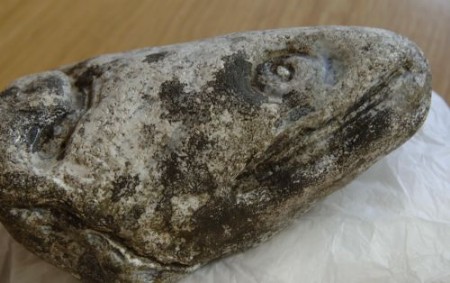
The fossil - alive when T-rex was king of the world

This may seem like a lump of old rock to you, but to one expert it is priceless.

Until a few weeks ago the 80 million-year-old fossilised fish head was part of a garden rockery - until a chance conversation led to it being viewed by Dr Ed Jarzembowski, Maidstone Museum's keeper of natural history.

"I have never seen one of these before. Quite simply it's priceless," he said.

The cod-like creature, which stares eerily from its prison of rock, probably roamed the open ocean at around the same time as Tyrannosaurus Rex still lived on what would become the continent of North America.

Bulb

Snapshot of past climate reveals no ice in Antarctica millions of years ago

A snapshot of New Zealand's climate 40 million years ago reveals a greenhouse Earth, with warmer seas and little or no ice in Antarctica, according to research published this week in the journal Geology.

A snapshot of New Zealand's climate 40 million years ago reveals a greenhouse Earth, with warmer seas and little or no ice in Antarctica, according to research published this week in the journal Geology.

The study suggests that Antarctica at that time was yet to develop extensive ice sheets. Back then, New Zealand was about 1100 km further south, at the same latitude as the southern tip of South America - so was closer to Antarctica - but the researchers found that the water temperature was 23-25°C at the sea surface and 11-13°C at the bottom.

Meteor

Ex-Astronaut Slams Asteroid Plan


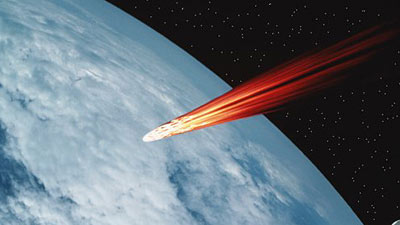
Fireball / Asteroid
©Sky News

A former Nasa astronaut claims plans to blast Earth-bound asteroids out of space with nuclear weapons is not the best way to beat the threat.

Comment: The notion that "we can do something about this" may be an indulgence in more than a little wishful thinking.


Display

Former Googleers unveil Cuil, a new search engine

A start-up led by former star Google engineers on Sunday unveiled a new Web search service that aims to outdo the Internet search leader in size, but faces an uphill battle changing Web surfing habits.

Cuil Inc (pronounced "cool") is offering a new search service at www.cuil.com that the company claims can index, faster and more cheaply, a far larger portion of the Web than Google, which boasts the largest online index.

Star

Watching A 'New Star' Make The Universe Dusty

Using ESO's Very Large Telescope Interferometer, and its remarkable acuity, astronomers were able for the first time to witness the appearance of a shell of dusty gas around a star that had just erupted, and follow its evolution for more than 100 days.

Image
©Unknown
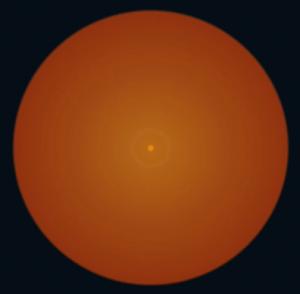
Artist's impression of the shell as deduced from the observations made in the mid-infrared (in the visible, it is almost opaque), using ESO's Very Large Telescope Interferometer.

This provides the astronomers with a new way to estimate the distance of this object and obtain invaluable information on the operating mode of stellar vampires, dense stars that suck material from a companion.

Although novae were first thought to be new stars appearing in the sky, hence their Latin name, they are now understood as signaling the brightening of a small, dense star. Novae occur in double star systems comprising a white dwarf - the end product of a solar-like star - and, generally, a low-mass normal star - a red dwarf. The two stars are so close together that the red dwarf cannot hold itself together and loses mass to its companion. Occasionally, the shell of matter that has fallen onto the ingesting star becomes unstable, leading to a thermonuclear explosion which makes the system brighter.

HAL9000

US to develop new navigation system for moon

The US space agency, National Aeronautics and Space Administration (NASA), is seeking to develop a new navigation system for use on the moon, an official said.

The space agency has awarded $1.2 million to an Ohio State University research team who would develop the new system over the next three years.

The device would be a lot like the Global Positioning System (GPS) on Earth, the university announced Monday.

Wine

Y chromosome study sheds light on Athapaskan


geronimo
©Unknown
Geronimo, a well-known military leader of the Chiricahua Apache in New Mexico, may have been a descendant of subarctic Athapaskan immigrants.