Animals
S


Doberman

Woman killed by 3 pit bull terriers in Houston

PIT BULL ATTACK
A woman is dead and another is injured after authorities say they were attacked by three pit-bulls in north Houston.

Houston police say they were called to the 5500 block of Arlington Street near East Hamilton around 5:45 a.m. after a man said his wife had been attacked by dogs.

Police say the woman was taken to the hospital in stable condition.

Moments later, another call came in from the owner of the dogs who said his dogs had attacked another woman and she was lying in the ditch.


Bug

Somalia hit by worst desert locust invasion in 25 years

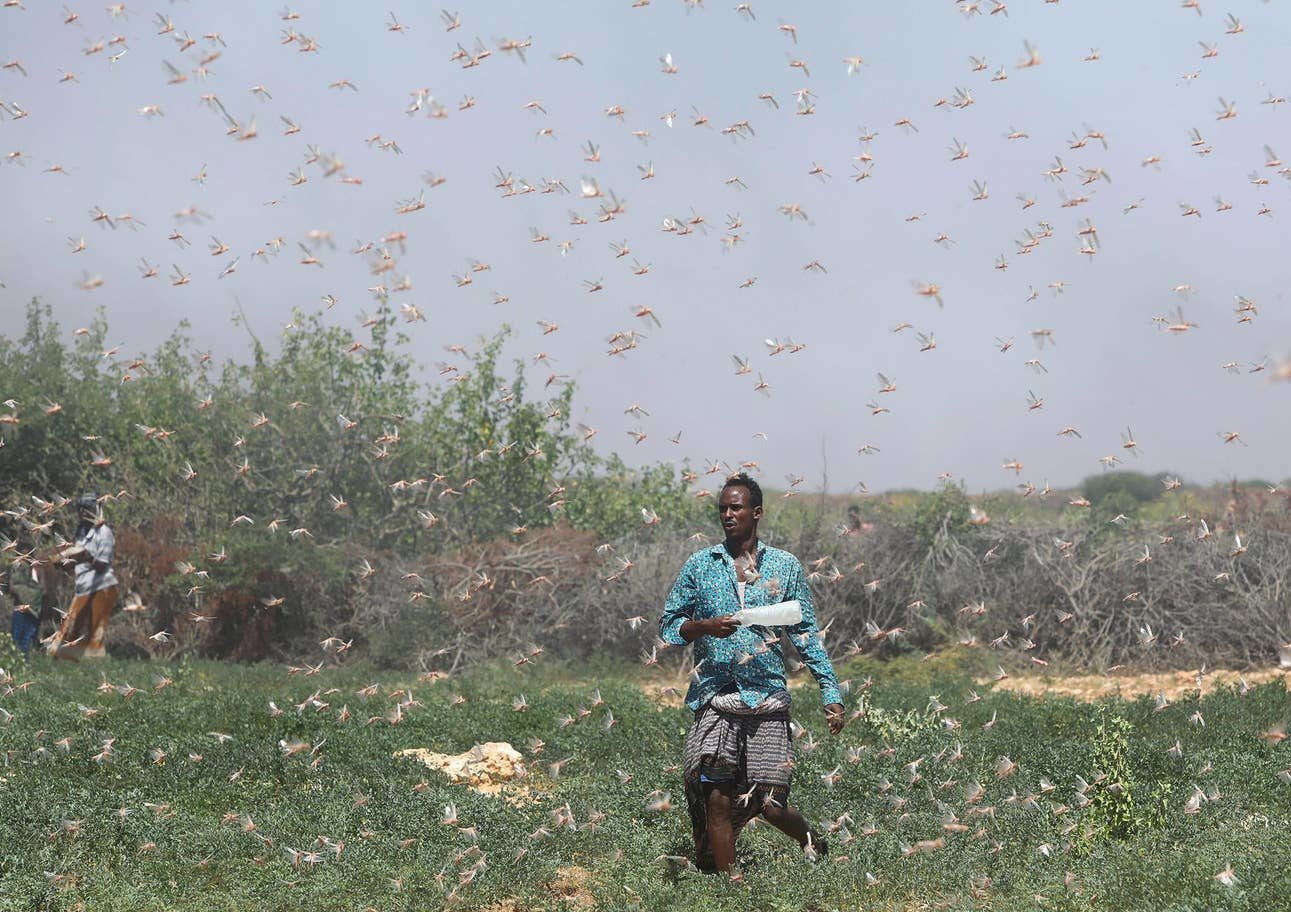
A farmer walks among a swarm of locusts on grazing land in Galmudug region, Somalia
© ReutersA farmer walks among a swarm of locusts on grazing land in Galmudug region, Somalia
Desert locusts are destroying tens of thousands of hectares of crops and grazing land in Somalia in the worst invasion in 25 years, the United Nations food agency said on Wednesday, and the infestation is likely to spread further.

The locusts have damaged about 70,000 hectares of land in Somalia and neighboring Ethiopia, threatening food supplies in both countries and the livelihoods of farming communities, the Food and Agriculture Organization (FAO) said.

An average swarm will destroy crops that could feed 2,500 people for a year, the FAO said.

Conflict and chaos in much of Somalia make spraying pesticide by airplane - which the FAO called the "ideal control measure" - impossible, the agency said in a statement. "The impact of our actions in the short term is going to be very limited."

Ashagre Molla, 66, a father of seven from Woldia in the Amhara region 700 km (435 miles) north-east of the Ethiopian capital Addis Ababa, said he had so far received no help from the government.

Comment: Earlier this year Iran faced it's worst locust attack in 40 years.


Attention

Killer whales migrate from Iceland to Italy for the first time in recorded history

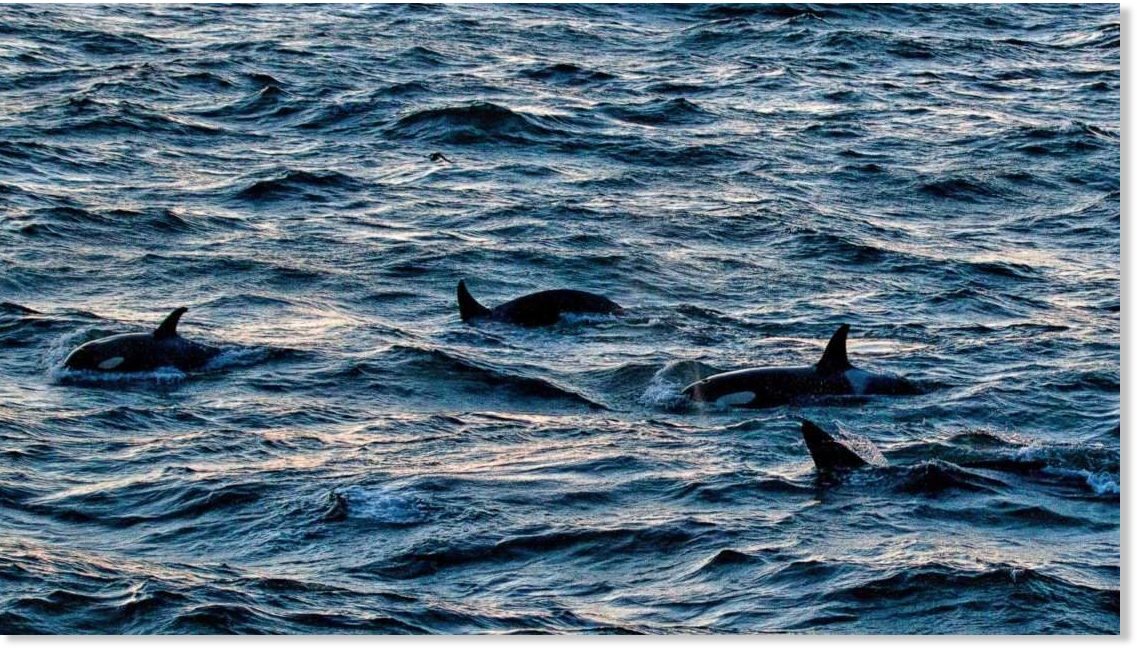
The dorsal fins and backs of a pod of killer whale breaks the surface of the icy waters of the Denmark Strait, off the Westfjords peninsula of Iceland.
© Arnold DrapkinThe dorsal fins and backs of a pod of killer whale breaks the surface of the icy waters of the Denmark Strait, off the Westfjords peninsula of Iceland.
A pod of Orca whales has made an unprecedented trip from Iceland to Genoa, Italy, according to a nonprofit organization that tracks the pod.

Included in the pod of four was a female whale carrying her dead calf, according to Orca Guardians Iceland.

The organization was able to identify the whales using photos of their fins and eye patches sent to them by the University of Genoa and comparing them with photos in the organization's own database.

The migration is the first-ever record of killer whales migrating from Iceland to Italy and one of the largest migration routes ever recorded, according to the organization, which described it as "the most exciting news ever."

Attention

Rare Hector dolphin found dead in Milford Sound, New Zealand

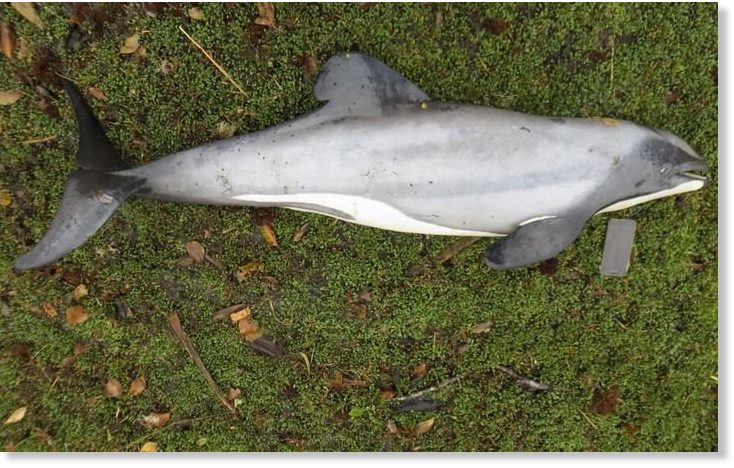
The Hector's dolphin was found dead at the head of Milford Sound in Fiordland.
© Bruce FraserThe Hector's dolphin was found dead at the head of Milford Sound in Fiordland.
A mature female Hector's dolphin has been found dead at the head of Milford Sound in Fiordland.

The Department of Conservation (DOC) said there were no obvious signs of the cause of death and the animal had been sent away to be examined.

DOC said while other dolphin species were seen in the sound, sightings of Hector's, either dead or alive, were rare.

It said while they inhabited the West Coast, they didn't usually travel this far south.

Hector's were nationally endangered with a population of around 10,000.

Comment: Also within the past few days a dead whale washed up on the coast of California while another appeared at a beach on Rhode Island.


Biohazard

Indonesia the latest country hit by African Swine Fever outbreak

pig dead
Millions of pigs have been culled across Asia in a bid to curb the spread of the disease
Indonesia is the latest country to confirm African swine fever. The disease was detected in the North Sumatra (far northwest part of the multi-island nation) province, however, an official announcement was not unexpected as reports of increased pig mortality have been coming in from that region since late September.

The United Nation's Food and Ag Organization is coordinating with the country's Livestock and Animal Health Services on containment and control of the virus.

The majority of Indonesians practice Islam, but more than 80 percent of the people living on the tourist island of Bali identify as Hindu and do consume pork.

Comment: This outbreak is showing no signs of slowing and the impact on the food supply is beginning to be felt, and could ultimately be disastrous:


Snowflake Cold

Icelandic farmer digs out horses buried under deep snow

dig out
This morning, Magnús Ásgeir Elíasson, a farmer from Hvammstangi, had a sudden feeling that he should check on his horses. It was a lucky intuition, as Magnús arrived to his fields to find a large group of his horses stuck in the snow. Thankfully, he had arrived just on time to bring all of them to safety and warmth, he told Vísir.

Apparently, after he finished the morning feeding, something snapped in him. "As I was walking into the house, I felt someone stopping me and saying, 'Go check on the horses.' I then turned around, looked up [onto the mountain] and saw my herd," Magnús explained. His horses were freezing in the snow.


Comment: Iceland blizzard brings 149 mph winds, up to 10 feet of accumulating mountain snow


Fish

Thousands' of dead mackerel found in Hauraki Gulf, New Zealand

"The birds had picked the eyes out but the flesh had not been touched," Wendy Morrell said.
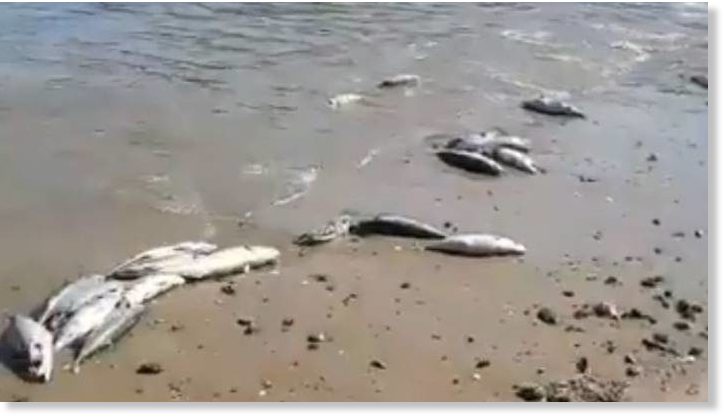
There's something fishy going on in the Hauraki Gulf - thousands of dead mackerel were found floating in the sea near an island beach.

Wendy Morrell - steward of the Twitter account 'Adventures of Mr Muppet and first mate, Oscar' - documented the curious event while sailing near Auckland's Kawau Island on Thursday.

The biblical scene got "weirder and weirder" as she got closer to the shore near Bostaquet Bay.

"About midway through our journey from Algies Bay to Kawau Island we saw the odd fish bobbing on the surface," Morrell told Stuff.


Bizarro Earth

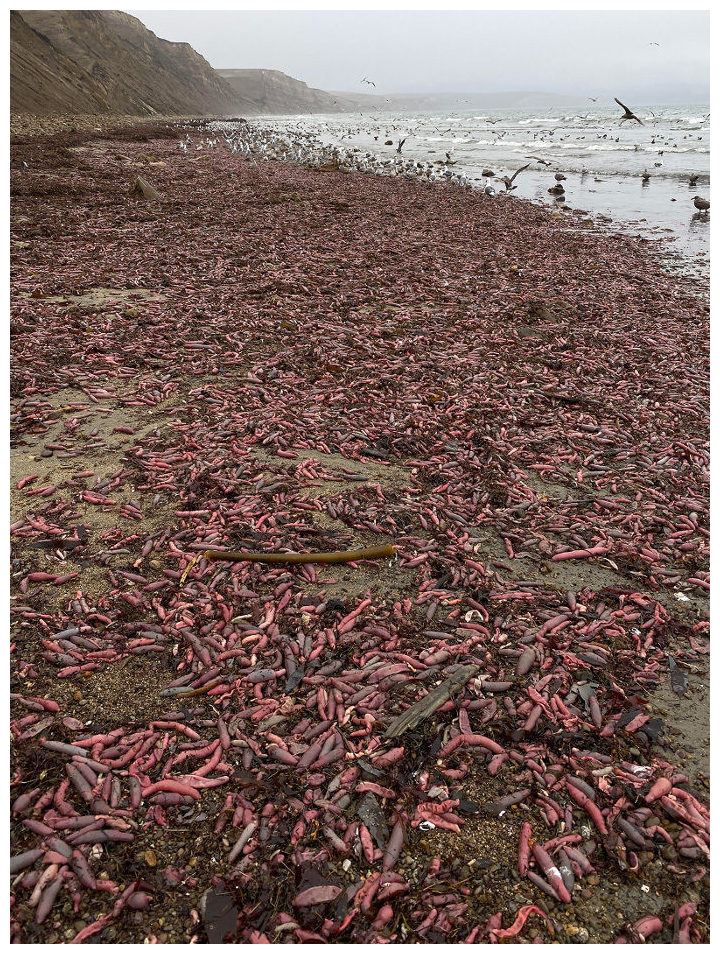
Thousands of innkeeper worms wash up on a California beach

I saw thousands of these on Drakes Beach on Dec. 6, after the recent storm. What happened? - David Ford
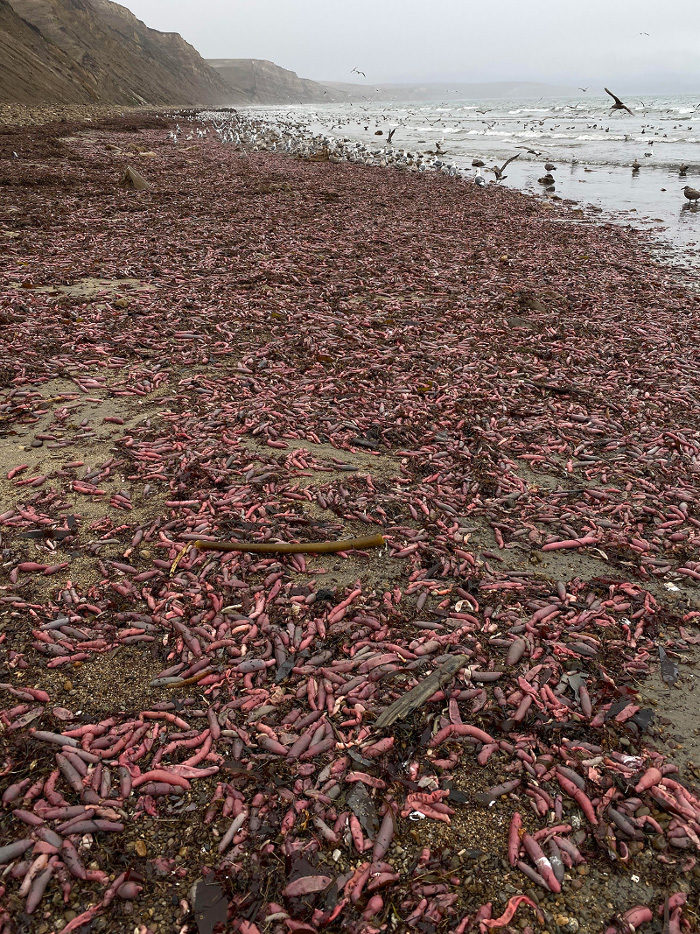
Beach littered with Innkeeper Worms
© Photo courtesy David FordThe ocean probably shouldn’t have hit send on this one.
You could be forgiven for being offended by the above photo: thousands of 10-inch wiggly pink sausages strewn about Drakes Beach. The same phenomenon has been reported over the years at Pajaro Dunes, Moss Landing, Bodega Bay, and Princeton Harbor. I've heard my share of imaginative theories from beachcombers, such as flotsam of a wrecked bratwurst freighter. In truth, these are living denizens of our beaches rudely, yet also mercifully, mostly called "fat innkeeper worms."

What in the name of Secretariat is a fat innkeeper worm? The fat innkeeper worm (Urechis caupo) is a type of spoonworm (Ehciuroidea), an order of non-segmented marine worms identified by a spatula-shaped proboscis used for feeding and sometimes grasping or swimming. The fat innkeeper's family (Urechidae) contains only four species worldwide, collectively known as either innkeeper worms or, well, penis fish. This is why we prefer scientific names. U. caupo is the sole representative in North America, found only from Southern Oregon to Baja, with the bulk of sightings between Bodega Bay and Monterey. So, whether or not you feel privileged by its presence, U. caupo is an almost uniquely California experience, perhaps having the best claim for State Worm.


Info

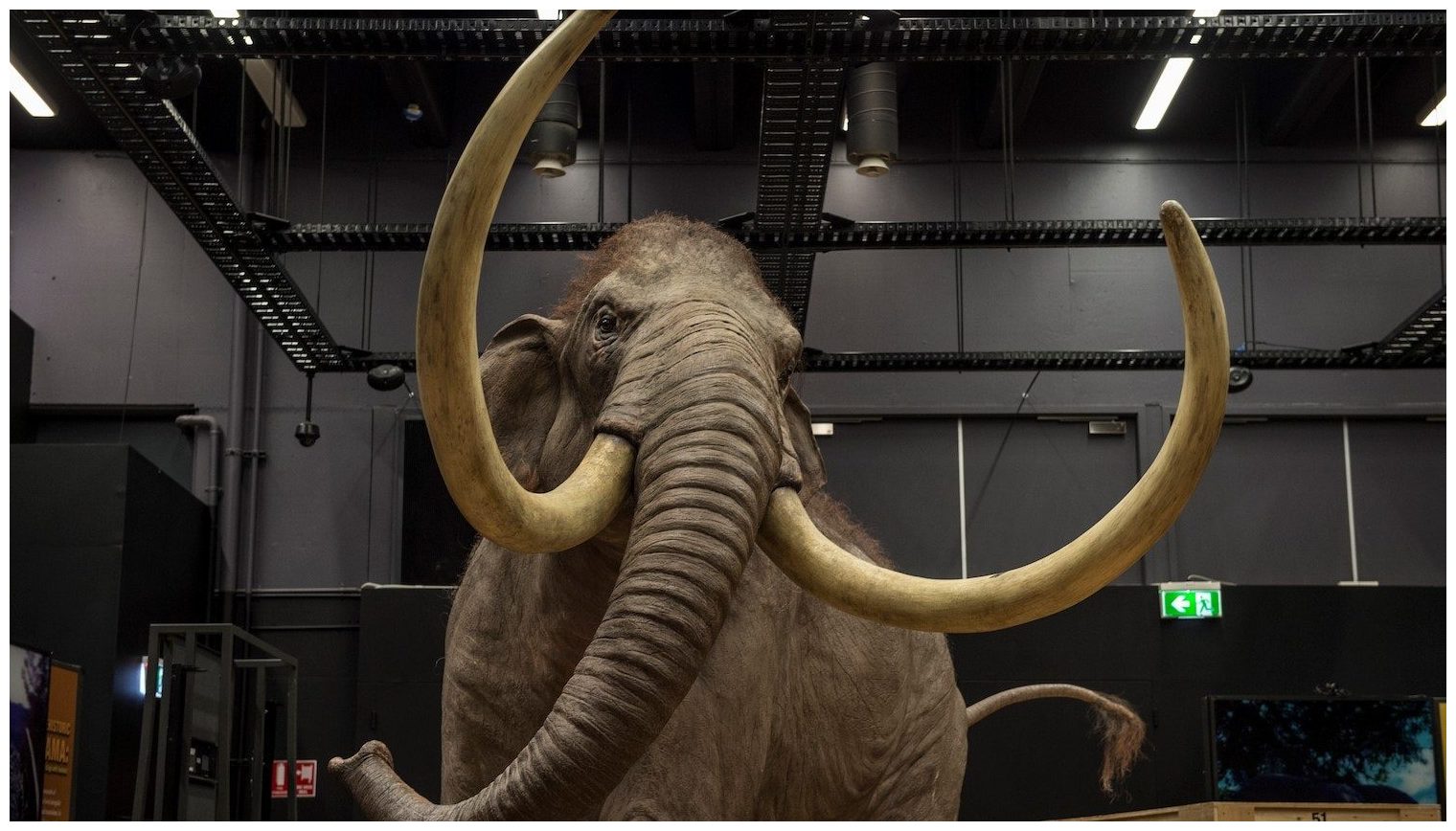
Study suggests genetics can predict a species' maximum lifespan

Wolly Mammoth
© AUSTRALIAN MUSEUMA new “genetic clock” can reveal the lifespans of extinct species such as woolly mammoths.
"Would you want to know when you'll die?" has always been a hypothetical question - until now.

A study published in the journal Scientific Reports reveals that researchers from Australia's CSIRO and the University of Western Australia have figured out a way to tell how long a species' life clock will keep ticking.

"Our method for estimating maximum natural lifespan is based on DNA," says Ben Mayne, a postdoctoral fellow with CSIRO. "If a species' genome sequence is known, we can estimate its lifespan."

The "lifespan clock" screens 42 selected genes from short pieces of DNA in 252 vertebrate species. The density of these genes is correlated with lifespan to predict how long members of a given vertebrate species may live.

The authors suggest that their findings may inform research into the ecology and evolution of living and extinct species, the protection of threatened species, and sustainable fishing.

"Until now it has been difficult to estimate lifespan for most wild animals, particularly long-living species of marine mammals and fish," Mayne says.

When studying extinct animals, researchers used a species' descendant as reference.

Attention

Signs and Portents: Cat gives birth to a two-headed kitten in Thailand

The two-headed baby cat on the palm of its owner in Ratchaburi province.
© Saichon SrinuanchanThe two-headed baby cat on the palm of its owner in Ratchaburi province.
Persian cat has given birth to a rare two-headed kitten and her owner is determined to keep it alive as long as possible.

Chabaprai Nilpet, 52, of Moo 2 village of tambon Don Krabueang in Ban Pong district, said the mother cat gave birth to a normal kitten on Monday, but appeared to have difficulty delivering more.

She took it to a clinic where the veterinarian performed a caesarean, delivering two more kittens - and to the surprise of everyone, one of them had two heads, Mrs Chabaprai said.