Earthquakes
S


Seismograph

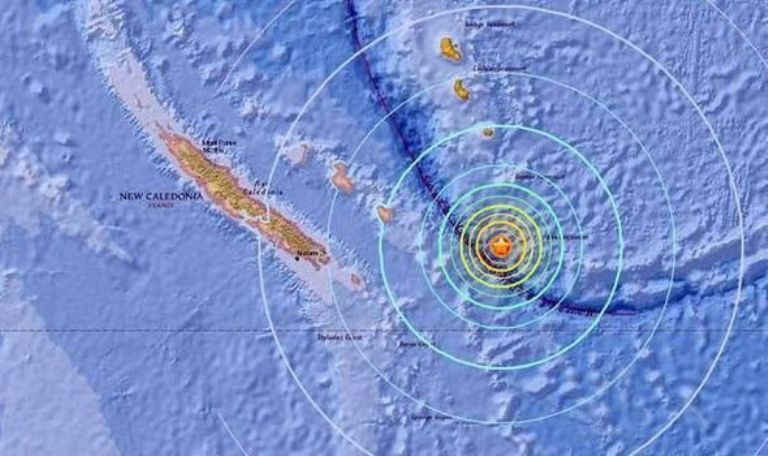
Powerful 7.6 magnitude earthquake strikes off New Caledonia in South Pacific - Magnitude 7.0 aftershock

New Caledonia earthquake
© GETTYNew Caledonia earthquake evacuations: The country was hit by a 7.6 magnitude earthquake on Wednesday
Tsunami waves have been spotted after a powerful undersea earthquake in New Caledonia in the South Pacific.

Evacuations were ordered after hazardous waves up to three metres tall were expected to rise following the 7.6 magnitude quake on Wednesday.

People on the east coast have been told to retreat at least 300m from the shore and to get to ground at least 12m in altitude.

The quake struck about 104 miles east of Tadine at a shallow depth of six miles, according to the US Geological Survey.

"Tsunami waves reaching 1 to 3 metres above the tide level are possible along some coasts of New Caledonia and Vanuatu," the Pacific Tsunami Warning Centre said.

Oil Well

M4.5 earthquake and aftershock in B.C., Canada, "very likely" caused by fracking

earthquake near Fort St. John, B.C.
© Google MapsThe location of the Nov. 29, 2018 earthquake near Fort St. John, B.C.
An earthquake that struck northeastern B.C. on Thursday evening was "very likely" caused by fracking, a preliminary investigation has found.

Earthquakes Canada said the quake had a preliminary magnitude of 4.5, with the epicentre about 16 kilometres southwest of Fort St. John.

It hit around 5 p.m. PT, followed by another tremor of similar magnitude, classified as an aftershock, less than an hour later.

Comment: This quake is reported to have occurred around 5pm, and earlier in the day, at around 8am, Alaska was hit with a strong M7. And so, when we considering the evidence linking fracking induced earthquake activity, along with the 2000% increase in major earthquakes since the 1900s, the rise in sinkholes, landslides and so on, it's clear society is suicidal in its pursuit of profit.

See also:


Map

Unstable planet: Is the giant 7.0 earthquake in Anchorage, Alaska a precursor to a devastating convulsion in the west coast?

Anchorage quake
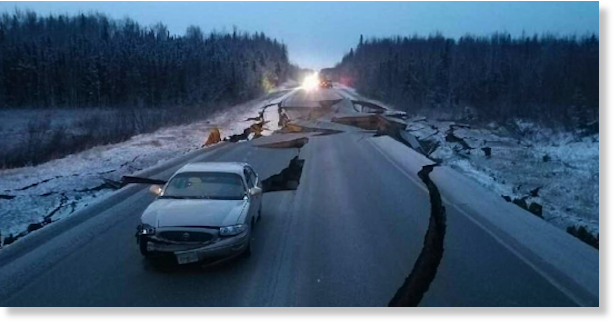
We just got more evidence that our planet is becoming increasingly unstable. On Friday a magnitude 7.0 earthquake destroyed homes, ripped apart roads and destroyed infrastructure all throughout Anchorage, Alaska. According to the USGS, the earthquake hit at 8:29 AM and the epicenter was approximately 7 miles north of Anchorage. That quake was followed by a highly destructive magnitude 5.7 aftershock just a little while later. Alaska Governor Bill Walker has declared a state of emergency, and the entire region is in a state of chaos. Unfortunately, as global seismic activity continues to increase, more quakes like this are inevitable. Like Alaska, the entire west coast of the United States sits directly along the "Ring of Fire", and many have warned that "the Big One" is coming sooner rather than later.


Tonight, large numbers of Anchorage residents are suddenly homeless, and that includes Alaska's most famous politician...
Light fixtures fell, glass shattered, roadways and supermarket aisles were awash from food spilled from broken jars. Video images showed some roadways had collapsed. One man tweeted a photo of his toppled chimney and a local television station showed its studio filled with debris.

Former Alaska governor and vice presidential candidate Sarah Palin tweeted, saying her family is intact but her "house is not."

Comment: See also:


Seismograph

Adapt 2030 Ice Age Report: Electric earthquakes in Alaska and strange global ringing sounds

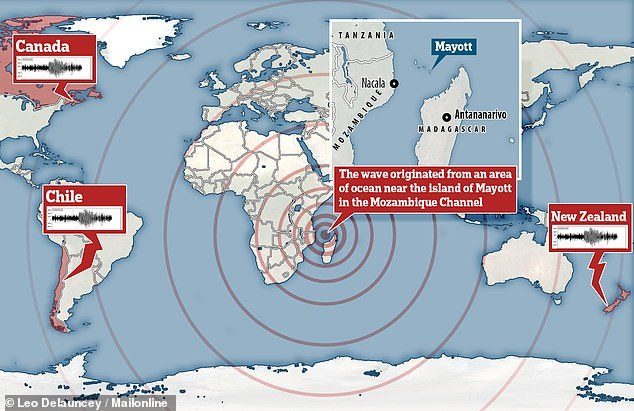
Seismic signals originating off the coast of the small French island of Mayott
© Leo Delauncey / MailonlineSeismic signals originating off the coast of the small French island of Mayott were detected at seismology station ranging from Chile to New Zealand.
Strange vibrations from the Earth registered around the planet for 20 minutes with cause still unknown. Now a 7.0+ quake over Alaska directly under an area disturbed in the Ionosphere. Our planet is now experiencing an uptick in electric earthquakes and extreme climate and seismic events as the next step down further into the Grand Solar Minimum. Global Electric Circuit.


Comment: Strange seismic event 'shook' the planet for 20 minutes on November 11 - And no one felt it


Seismograph

6.3-Magnitude earthquake strikes Tanimbar Islands, Indonesia, no tsunami warning issued

earthquake indonesia Tiakur 603
Tiakur, Tanimbar Islands
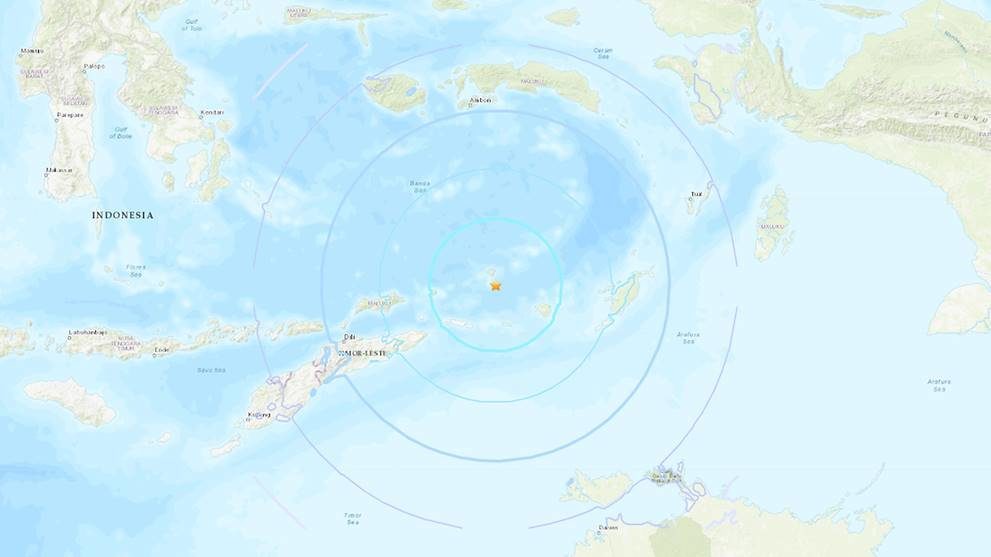
The quake hit in the sea in southwest Indonesia, about 130 kilometres (80 miles northeast of the city Tiakur at 10:27 pm (0127 GMT), at a depth of 140 kilometres, according to the US Geological Survey.

A deep 6.3-magnitude earthquake struck in eastern Indonesia Saturday night, US seismologists said, but no tsunami warning was issued.

The quake hit in the sea in southwest Indonesia, about 130 kilometres (80 miles northeast of the city Tiakur at 10:27 pm (0127 GMT), at a depth of 140 kilometres, according to the US Geological Survey.

The national disaster agency said the quake was felt weakly in Tiakur for about three to five seconds.

Seismograph

Strange seismic event 'shook' the planet for 20 minutes on November 11 - And no one felt it

Seismic signals originating off the coast of the small French island of Mayott
© Leo Delauncey / MailonlineSeismic signals originating off the coast of the small French island of Mayott were detected at seismology station ranging from Chile to New Zealand.
Mysterious seismic waves picked up by monitoring stations from Madagascar to Canada were most likely caused by an underwater volcano, an earthquake expert claims.

A low-rumbling that could not be felt above ground was detected on November 11 and narrowed down the origin to a region just off the coast of the island of Mayotte.

They were similar to those typically seen after large earthquakes, which are known to travel great distances - but, no such earthquake took place.

Theories as to what caused the cryptic rumble ranged from a slow earthquake to an undetected meteor strike.


Comment: This has created a buzz in the scientific community, because seismic signals from earthquakes and volcanic eruption are 'spikier' and don't look 'harmonious' like this.
Strange seismic waves rippled around the world and scientists don't know why

Here in New Zealand, GeoNet seismologist John Ristau said he saw his contemporaries discussing the unusual activity on Twitter when it first happened.

"It is a very strange signal and it can be seen pretty much everywhere around the world. The signal is clearly not like a regular earthquake, it's more like a burst of energy."
Strange waves rippled around the world, and nobody knows why

Helen Robinson, a Ph.D. candidate in applied volcanology at the University of Glasgow: "They're too nice; they're too perfect to be nature," she joked. "What baffles me is how evenly spaced out they were," she said. "I have no idea how to explain that."
Geologists Joke About 'Sea Monster' After Mysterious 30-Minute Rumble Emanates from Waters Near Madagascar

One segment of the signal also featured several high-frequency blips, each separated by roughly a minute of time, a bit like a regular, ticking clock. Stephen Hicks, a seismologist at the University of Southampton, highlighted the phenomenon in a November 12 tweet.

"Something biggggg, yet strangely slow, sent seismic rumblings around the surface of much of the planet yesterday," he wrote. [...]

"It's like a ringing bell. If you want to get a very low frequency, a very low tone, you need that bell to be huge," Ampuero explained.
It's gotta be something cosmic. Did Earth just get 'pinged'?! (And no, not by 'aliens' - rather, by something "bigggggg" but as yet unseen...)

By the way, one week later, this happened:

Despite unusually quiet Sun, solar wind recently produced 'musical waves' in Earth's magnetic field


Seismograph

6.3 magnitude earthquake strikes Iran-Iraq border - 361 injured UPDATE

earthquake iran iraq novermber 2018 6.3
© Twitter / CSEM EMSK
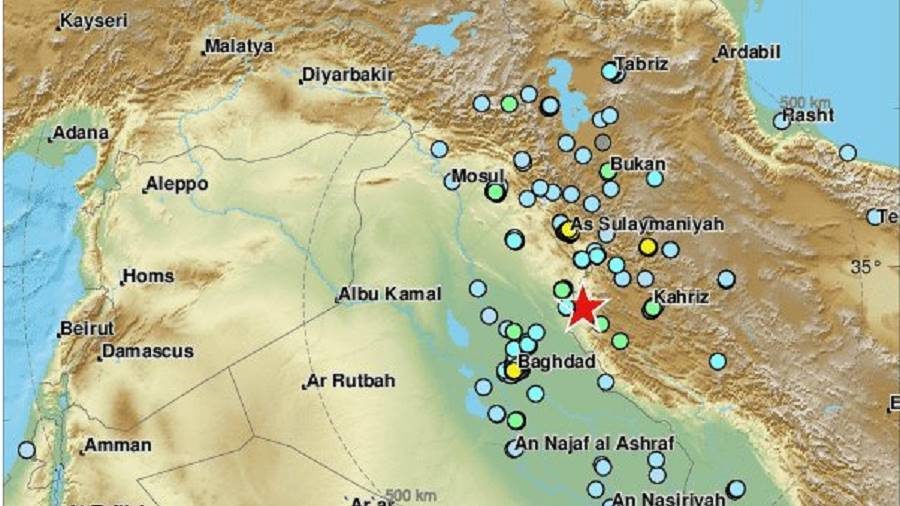
A magnitude 6.3 earthquake has struck northeast of Baghdad. It has been felt in Iraq, Kuwait, and northern Iran.

The quake hit the Iran-Iraq border region and had a depth of 10 kilometers, according to the European-Mediterranean Seismological Centre (EMSC).

The EMSC reported that the quake was widely felt more than 500 kilometers away from its epicenter.

Comment: Sputnik reports the number of injured has reached 361:
"The number of people, who asked for medical treatment, amounts to 361," Kolivand said, quoted by the Fars news agency.

Earlier media reports said that people had been injured in the cities of Gilan Gharb, Sarpol Zahab and Qasr-e Shirin.

The European-Mediterranean Seismological Center (EMSC) said that the Iraqi-Iranian border region had been hit by the 6.3-magnitude earthquake. The tremors were registered at 16:37 GMT, 163 kilometers (over 100 miles) northeast of the Iraqi capital of Baghdad and 20 kilometers southwest of the Iranian city of Sarpol Zahab.

Iran has faced several powerful quakes recently. Last year, a disastrous 7.2-magnitude quake killed and wounded hundreds. Earthquakes are common in mountainous Iran, due to the convergence of four major tectonic plates in the region.


Seismograph

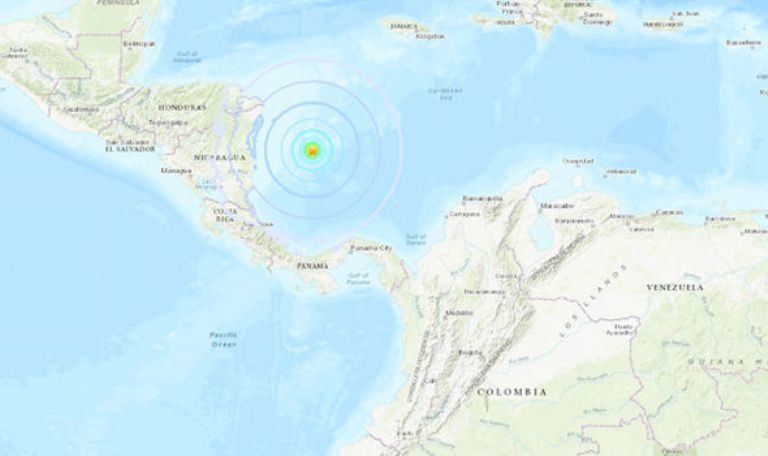
Earthquake at 6.1 magnitude strikes off Colombia coast

magnitude 6.1 earthquake struck near the Colombian coast
© USGSA massive magnitude 6.1 earthquake struck near the Colombian coast on Saturday
An earthquake measuring 6.1 magnitude struck off the Colombian coast on Saturday, and while there was no major tsunami threat, there was a possibility of tsunamis along the nearby coast, the European earthquake monitoring agency EMSC and the Pacific Tsunami Warning Center said.

The quake epicenter was 36 km (22 miles) southeast of Mountain, Colombia, and at a depth of 10 km (six miles).

Windsock

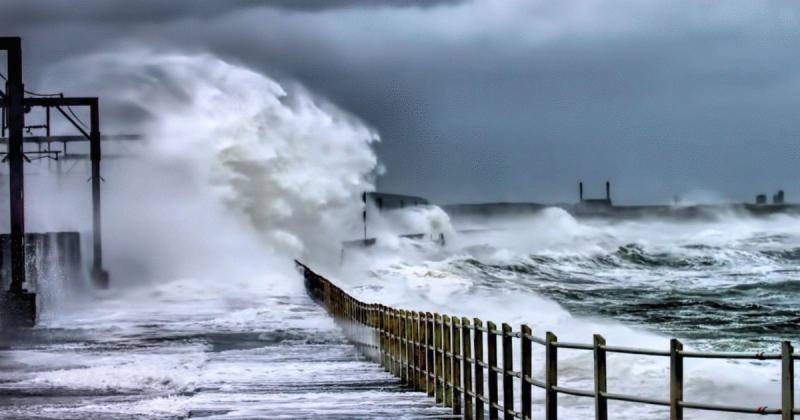
Seismic records show Newfoundland was literally shaking from vicious windstorm

Giant waves in Canada

Seismometer in St. John's shows how intense Thursday's winds were


The waves crashing into the rugged shoreline of Newfoundland and Labrador this week led to waves of a different kind.

The squiggly black lines produced by a Natural Resources Canada seismometer show the seismic activity of a vicious windstorm that whipped across the province on Wednesday and Thursday.

The wind and waves were so strong, the island was shaking.

"What we saw over the past 48 hours was quite a dramatic change in [activity]," said John Cassidy, an earthquake seismologist with Natural Resources Canada.

"It was very noticeable and in our seismic data, our plots, it just jumped off the page. You could just see that shaking."


Comment: The windstorm that struck Newfoundland and Labrador was the "most intense storm" on the planet, according to a meteorologist in Gander. Wild, whipping winds gusting upwards of 130 km/h caused huge waves, delays, cancellations and closures across the province reports CBC.

According to the Weather Network the effects of the incredibly strong low pressure system that moved through Atlantic Canada would cause more than ripples across the Atlantic Ocean this week, causing giant waves to track towards Europe and Africa. See also: Enormous waves wipe away balconies in Tenerife, Canary Islands


Seismograph

6.7-Magnitude undersea earthquake off Fiji, but no tsunami

graph
A 6.7-magnitude earthquake struck off the coast of Fiji Monday, the United States Geological Survey said, but it was too deep to cause any damage.

It was centred 534 kilometres (331 miles) deep and 283 kilometres east of the capital Suva where residents said they did not notice any shaking.

The Pacific Tsunami Warning Center said there was no tsunami threat from the tremor which occurred at 9:25 am (2025 GMT Sunday).

The area is prone to deep undersea earthquakes and was hit with a 7.8-magnitude tremor two months ago.

Source: Agence France-Presse