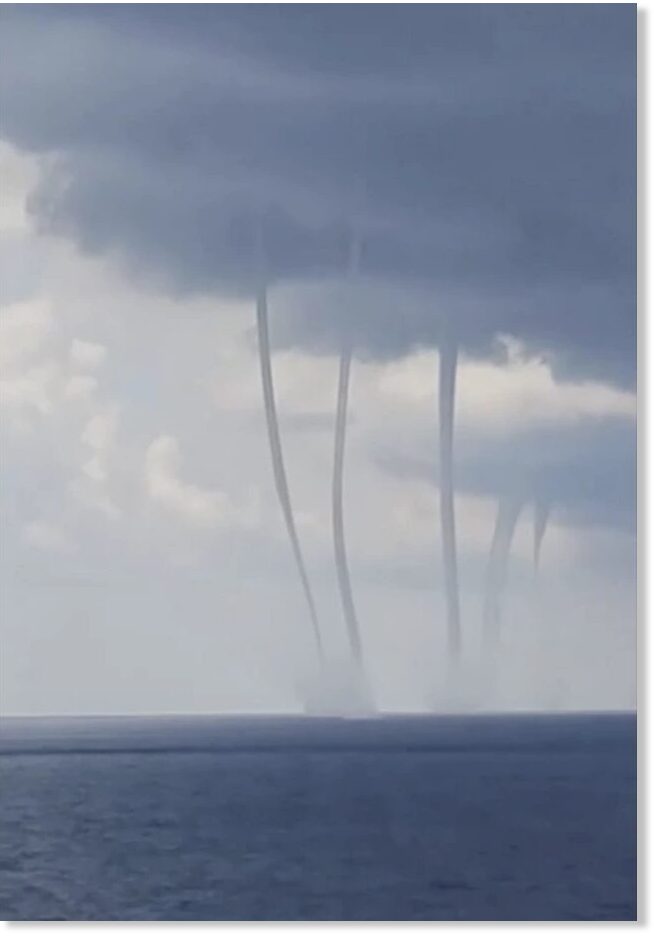
Multiple waterspouts were spotted swirling simultaneously off Louisiana's coast on August 20, as severe storms battered the region with hail.
This footage shot by Frank Leday in the Gulf of Mexico captures at least six of the watery vortexes spiraling skyward against a blanket of dark storm clouds.
"Wow!! Ever see 6 water spouts at once?" Leday wrote on Facebook.
The storms came as the US National Weather Service predicted two tropical depressions — one in the North Atlantic and another in the Carribean — could develop into hurricanes upon hitting the Gulf. According to US media, it would be the first instance of two separate tropical storm systems in the basin in over 60 years.
The historically active 2020 Atlantic hurricane season continues to ramp up, with the National Hurricane Center identifying two tropical depressions, both of which could strengthen as they head toward the Gulf of Mexico and the U.S. coastline.
KEY FACTS
The National Hurricane Center projects Tropical Depression Thirteen, over the central Atlantic, and Tropical Depression Fourteen, in the western Caribbean, will strengthen from their 35 mph sustained winds as they move toward the U.S.
There's still a great deal of uncertainty about how strong the storms could become, but it seems very likely they will become the 12th and 13th named storms — Laura and Marco — over the next day or so.
Disaster authorities in Vietnam report that 7 people have died and 1 is still missing after heavy rainfall triggered flash floods and landslides.
According to Vietnam Disaster Management Authority (DMA), heavy rain, flooding and landslides have caused damage in the provinces and cities of Yen Bai, Hoa Binh, Phu Tho, Ha Giang, Hanoi, Binh Duong, Vinh Phuc, Son La, Tuyen Quang, Lai Chau, Cao Bang, Dien Bien, Quang Ninh.
Some areas of Vietnam saw more than 300mm of rain in a period 16 to 19 August, including Cai Chien in Quang Ninh Province, Cat Ba in Hai Phong and Thai Nguyen City. The heavy rain fall is associated with Tropical Storm Higos which made landfall in the southern Guangdong province of China on 19 August before moving towards Vietnam and Laos.
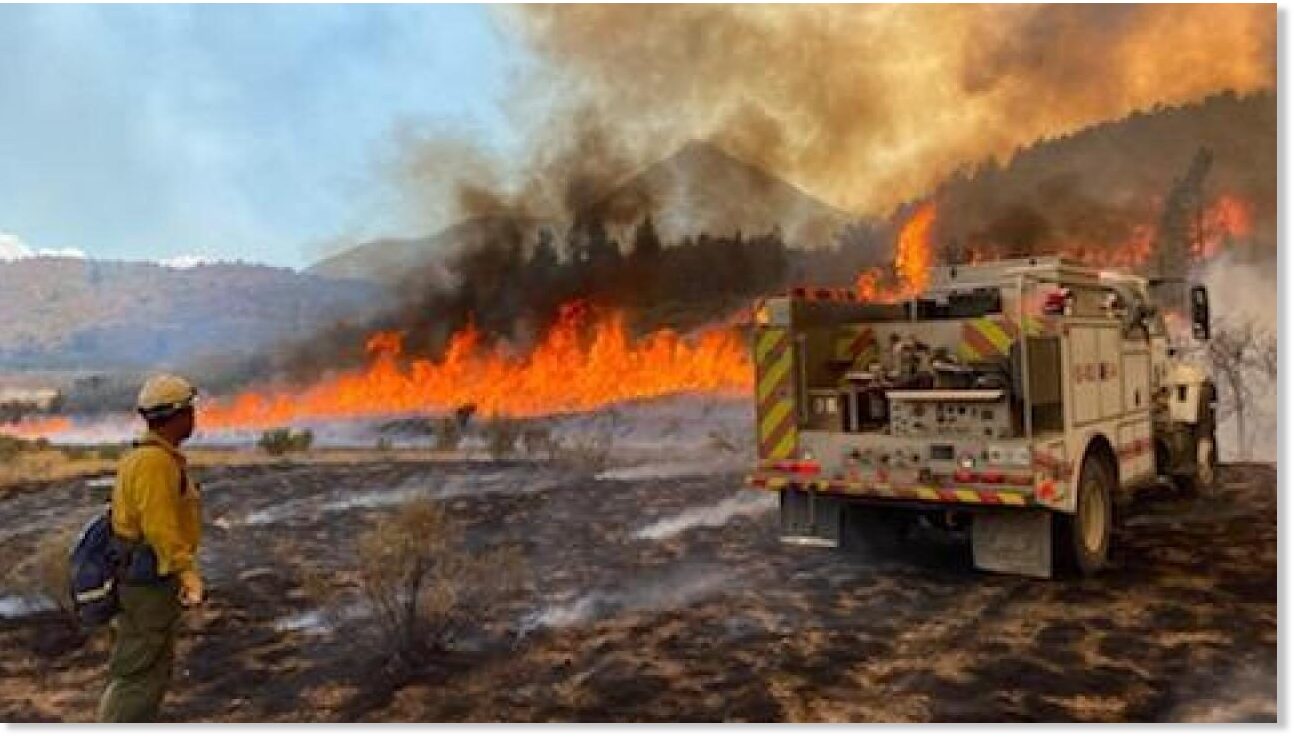
The Pine Gulch Fire continues to burn on the western slope, north of Grand Junction, and is steadily approaching state history. A Wednesday update on acres burned now puts it second only behind the Hayman Fire on the list of largest in Colorado history.
Currently, the fire has burned 125,108 acres, according to the Rocky Mountain Area Coordination Center. For reference, the Hayman Fire burned 137,760 acres in 2002. The Spring Creek Fire, which was second on the list, burned 108,045 acres in southern Colorado in 2018.
What would you do if the ground opens up and swallow your car? That's right - nothing. That's exactly what happened in what seems to be a parking lot in front of a shopping mall in China.
Caught by the country's state CCTV (embedded on top), a massive sinkhole opened up and devoured at least 21 cars. The disaster happened on the evening of August 19, 2020, Wednesday.
According to reports, 15 vehicles were recovered - most likely wrecked - from the site with zero casualties. Authorities in the country are still investigating the cause of the accident, but the current weather in the area could be the culprit.
The shopping mall is situated near the Yangtze River in Sichuan province. The province is experiencing torrential rainfalls, prompting the authorities to raise its emergency response to a maximum level.
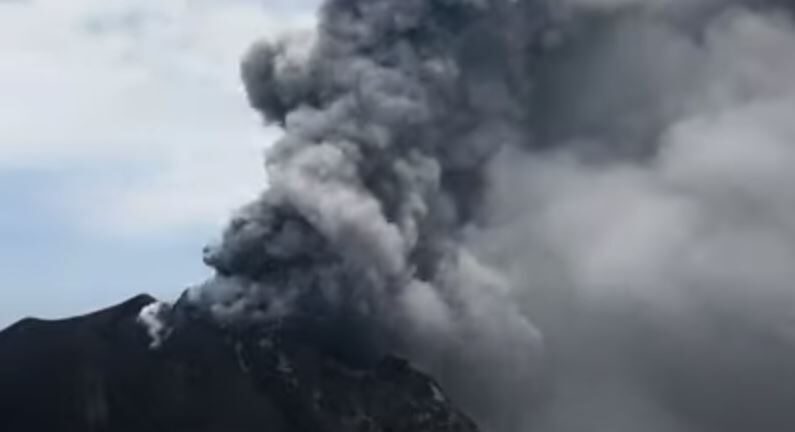
Stunning time-lapse footage shows Indonesia's Mount Sinabung erupting on August 18, 2020, sending thick plumes of ash into the air. The volcano located in North Sumatra, has erupted several times already this month. No injuries or major damage have been reported.
Comment: The volcanic activity of Indonesia's Mount Sinabung continues. Also this month:
As reported by Dr. Tony Philips recently in Space Weather Archive:
"During the next solar cycle, we could see cosmic ray dose rates increase by as much as 75%," says lead author Fatemeh Rahmanifard of the University of New Hampshire's Space Science Center.
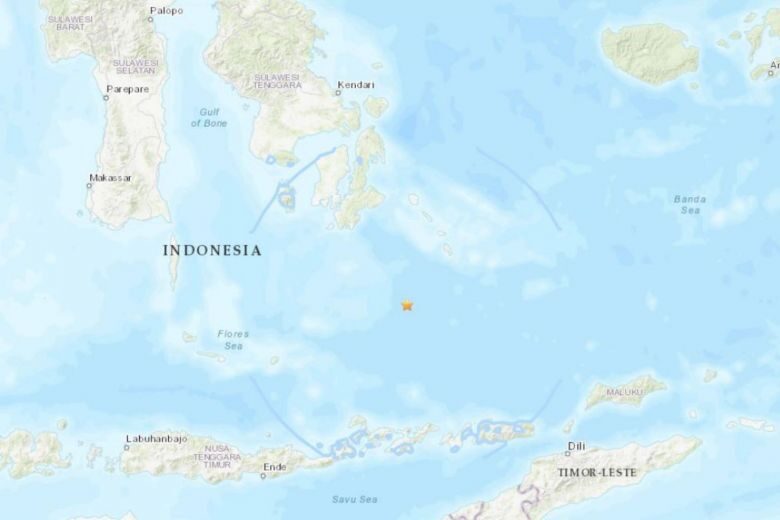
A 6.9-magnitude quake struck eastern Indonesia on Friday (Aug 21), the US Geological Survey (USGS) reported, but there was no tsunami warning issued and no immediate reports of casualties or major damage.
In Kupang city, far south of the quake's epicentre in the Banda Sea, frightened residents ran outside as buildings and streetlights swayed.
"I was in the shopping centre when the quake hit," said resident Engky Nussi. "Many people ran outside as stuff started falling off the shelves and we were afraid something worse might happen."
The undersea tremor struck at a depth of more than 600km about 220km south of Katabu on the island of Sulawesi, the USGS said.
Deep quakes tend to cause less damage than shallow ones and USGS said there was a low likelihood of casualties and damage.
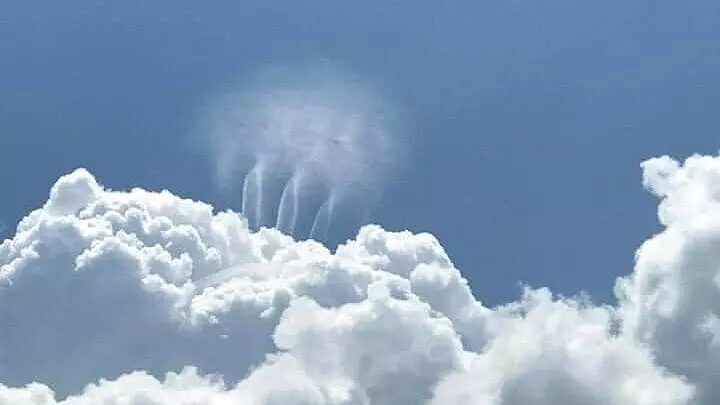
Following on the heals of summer snow in Beijing the last days of July, another summer snow event occurred August 18th in Yunnan Province, a month ahead of the earliest snow recorded in the area. Food bank lines are the longest ever seen and match new reports on rental housing availability by state. Unidentifiable clouds over Alabama, do you know what it is?
Shannon Heckt 1011now.com Wed, 19 Aug 2020 18:17 UTC
People in Mankato, Kansas are cleaning up after softball-size hail caused major damage across Jewell County Friday night. Around 8 p.m. the severe storm, including a funnel cloud, passed over Jewell County. Following it was a hail storm with rare late-summer softball-sized stones.
"Really never seen anything like this before. Dealt with a lot of storms but this was the biggest," Jewell County EMS Director Shannon Meier said.
Meier was out storm spotting that night. As he watched the funnel cloud he was caught in the hail and had to pull over to the side of the road. His truck was smashed and he took cover as glass flew around him.
"My concern then was there were other vehicles out so I had requested that we get units out to do a search of the highways," Meier said.
Ignacio Martínez De Jesús Phys.org Thu, 20 Aug 2020 19:05 UTC
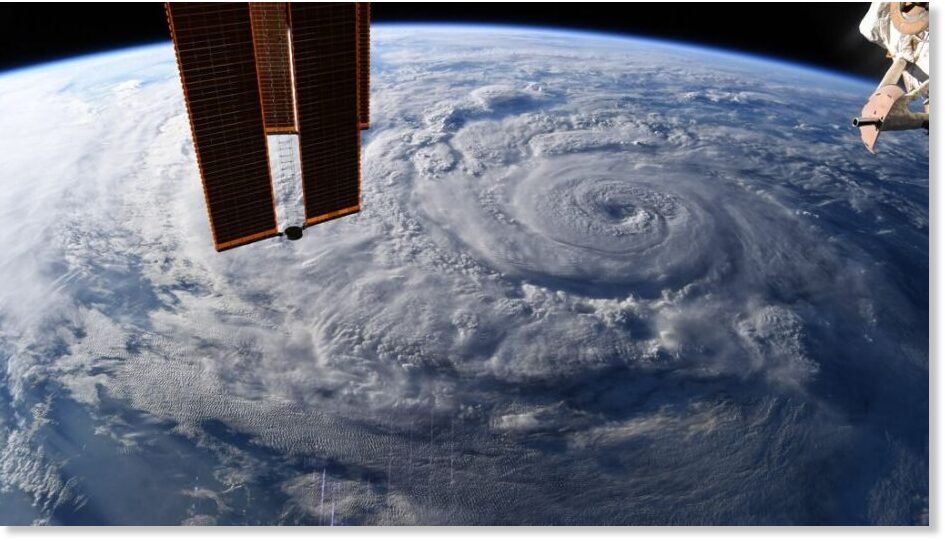
NASA astronaut captures stunning pictures of hurricane Genevieve from space
Hurricane Genevieve lost some of its punch as it passed the southern end of Mexico's Baja California Peninsula Thursday, though it is still lashed the tourist region with hurricane-force gusts and heavy rains.
Genevieve had a been a powerful Category 4 hurricane with winds of 130 mph (215 kph) on Tuesday, but weakened to Category 1 strength as it pushed past the Los Cabos region, the U.S. National Hurricane Center said.
Meanwhile a new tropical depression formed in the Atlantic and it was expected to become a tropical storm that would move near or north of the Leeward Islands, the Virgin Islands and Puerto Rico.
The center said the hurricane was expected to stay out in the Pacific while moving northwestward along the Baja coast and weakening Thursday and Friday. But it was raking the shore with tropical storm-forces winds and hard rains that carried the potential for dangerous flooding.
"The purpose of GLADIO was to attack civilians, the people - women, children, innocent people, unknown people, far removed from any political game. The reason was quite simple: to force the public to turn to the State and demand greater security. Under a strategy of tension, you 'destabilize in order to stabilize', to create tension within society and promote conservative, reactionary social and political tendencies."
~ Italian neo-fascist whose prosecution led to the discovery of NATO's 'Gladio' networks across Western Europe
- Vincenzo Vinciguerra
”
Recent Comments
Likewise, the bipartisan support for Israel in Congress is still upheld. There is a bill being drafted in Congress, which would integrate the...
Comment: See also: