Secret HistoryS


Holly

The legend and the truth about St. Patrick's Day

St. Patrick's Day
© AP Photo/John CogillA man dressed as Saint Patrick blesses the crowd in Dublin as the parade makes its way through the Irish capital in 1998.
In 1997, my students and I traveled to Croagh Patrick, a mountain in County Mayo, as part of a study abroad program course on Irish literature I was teaching for the University of Dayton. I wanted my students to visit the place where, each July, thousands of pilgrims pay homage to St. Patrick, who, according to lore, fasted and prayed on the summit for 40 days.

While there, our tour guide relayed the story of how St. Patrick, as he lay on his death bed on March 17 in A.D. 461, supposedly asked those gathered around him to toast his heavenly journey with a "wee drop of whiskey" to ease their pain.

The mention of whiskey left me wondering if St. Patrick may have unintentionally influenced the way most of the world celebrates the holiday today: by drinking.

It wasn't always this way. The Festival of St. Patrick began in the 17th century as a religious and cultural commemoration of the bishop who brought Christianity to Ireland. In Ireland, there's still an important religious and cultural component to the holiday, even as it has simply become an excuse to wear green and heavily drink in the rest of the world.

Comment: See also:

Happy St. Patrick's Day: The Irish Holocaust, an untold history lesson


Dig

Long lost ancient Maya kingdom unearthed in a backyard in Mexico

maya tablet
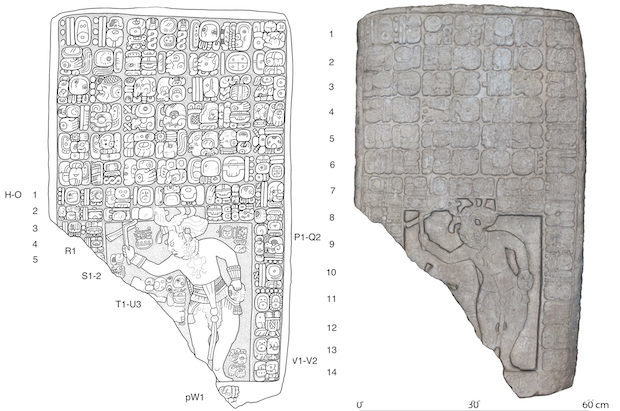
© Stephen Houston (Brown University)/Charles Golden (Brandeis)Left, drawing of a tablet found at the site. Right, a digital 3D model.
Associate professor of anthropology Charles Golden and his colleagues have found the long-lost capital of an ancient Maya kingdom in the backyard of a Mexican cattle rancher.

Golden, in collaboration with Brown University bioarchaeologist Andrew Scherer and a team of researchers from Mexico, Canada and the United States, began excavating the site in June 2018.

Among their findings is a trove of Maya monuments, one of which has an important inscription describing rituals, battles, a mythical water serpent and the dance of a rain god. They've also found remnants of pyramids, a royal palace and ball court.

Comment: See also:


Colosseum

Best of the Web: Mysterious 25,000-year-old circular structure built from bones of 60 mammoths discovered in Russia's forest steppe

mammoth structure
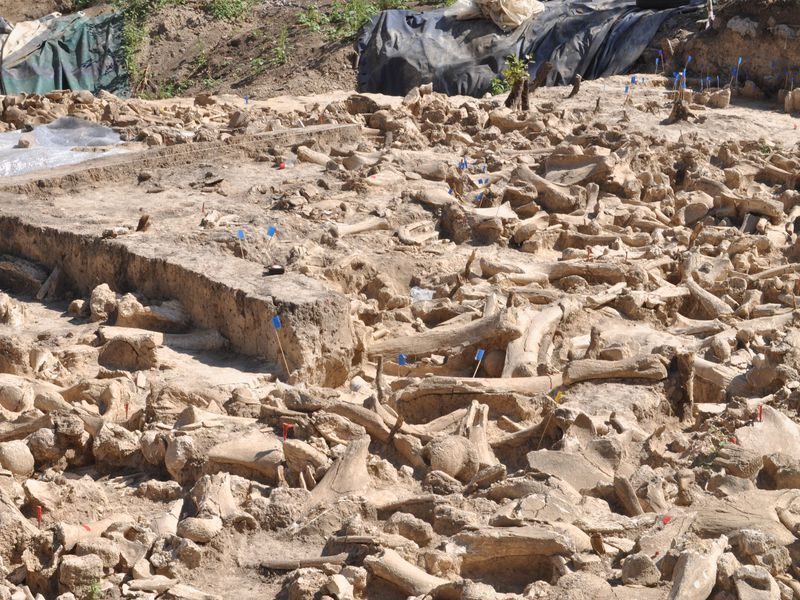
© A. E. DudinThe purpose of such an elaborate structure remains a big open question. The remains of the newly discovered structure.
A jaw-dropping example of Ice Age architecture has been unearthed on Russia's forest steppe: a huge, circular structure built with the bones of at least 60 woolly mammoths. But exactly why hunter-gatherers enduring the frigid realities of life 25,000 years ago would construct the 40-foot diameter building is a fascinating question.


Comment: It is perhaps (a little) less perplexing when you realise that back then the area wasn't "frigid" at all and in fact its climate was temperate. See Pierre Lescaudron's Of Flash Frozen Mammoths and Cosmic Catastrophes for more.


"Clearly a lot of time and effort went into building this structure so it was obviously important to the people that made it for some reason," says Alexander Pryor, an archaeologist at the University of Exeter (U.K.). He is the lead author of a new study published this week in the journal Antiquity describing the find at Kostenki, a place where many important Paleolithic sites lie clustered around the Don River.

Comment: See also:


Arrow Down

Standing at the precipice of a financial collapse: Time for a 21st century Pecora commission

financial collapse
As Republican and democrat politicians hold emergency meetings to decide how to avoid a meltdown of Wall Street, the smell of hyperinflation looms in the air as much today as it did in Germany during the opening months of 1922. This week, markets were propped up by a record breaking offering of $1.5 Trillion in liquidity injections over the coming months (added to the $9 trillion already injected over the past six months), and rather than deal with the real reasons for this oncoming financial collapse, the media has brainwashed the west that everything would have been just fine, "if only coronavirus had not become a pandemic".

But what is really being bailed out here exactly and why? Is this money actually making it to the real economy? Is it being invested to rebuild America's farms, businesses and industry?

The reality is that the only thing being saved are the "Too Big to Fail" banks that are sitting atop a $1.5 quadrillion of derivatives bomb. Of the most bankrupt of America's speculators are JPMorgan Chase, Citigroup and Goldman Sachs, whose derivatives exposure hit $48 trillion, $47 trillion and $42 trillion respectively in recent years.

It is my contention that Trump is genuine in his desire to "drain the swamp" and rebuild America's lost industrial base. I also genuinely believe that Trump wishes to establish positive relations with Russia, China and other sovereign nation states which has drawn the ire of the international deep state. However Trump's potentially fatal blind spot appears to be his tendency to believe the lie that Wall Street's wellbeing is somehow indicative of America's wellbeing.

Info

Ancient Indonesian rock art discovered

Ancient Art Work
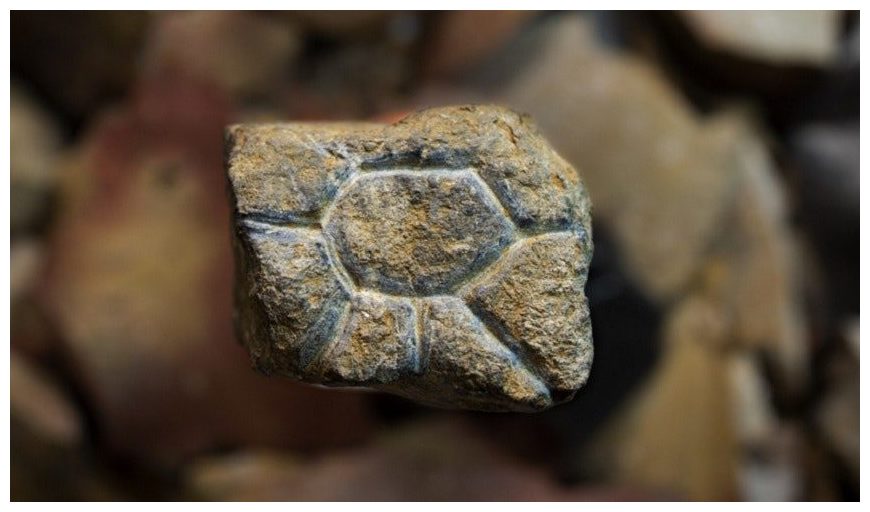
© CARLEY ROSENGREENThe pocket-sized artwork with an eye-like sunburst, resembling a simple drawing of a sun.
Two pocket-sized stone artworks found in an ancient pile of Indonesian cave rubbish have put the out-dated notion that Europe was the cradle of artistic expression on ever shakier ground.

The stone 'plaquettes' were unearthed by a team of Australian and Indonesian archaeologists working in the Leang Bulu Bettue cave, one of the dozens of caves scattered across the limestone-rich southern part of Sulawesi in central Indonesia.

They published their discovery in the journal Nature: Human Behaviour.

One is etched with the outline of the head and upper body of an anoa - a species of dwarf buffalo that lives exclusively on Sulawesi to this day. In pre-historic times, hunter-gatherers relied on anoa for food, and used its bones and horns for toolmaking.

The other is adorned with an eye-like 'sunburst' - an image reminiscent of a child's simple depiction of a circular sun with rays extending outwards or an eye surrounded by thick lashes.

Archaeologists led by Adam Brumm at Griffith University in Brisbane, Australia, unearthed the rare finds in 2017 and 2018 from sediments rich in the refuse of daily life during the end of the Pleistocene - the last ice age that ended some 12,000 years ago.

Other artefacts, such as stone tools, the butchered and burnt remains of animal bones, as well as beads and ochre - evidence of body ornamentation - indicate that hunter-gatherers used the site frequently.

The plaquettes themselves date to a time between 26,000 and 14,000 years ago.

Palette

Depicting plasma? Ancient 'mantis-man' petroglyph discovered in Iran

petroglyph
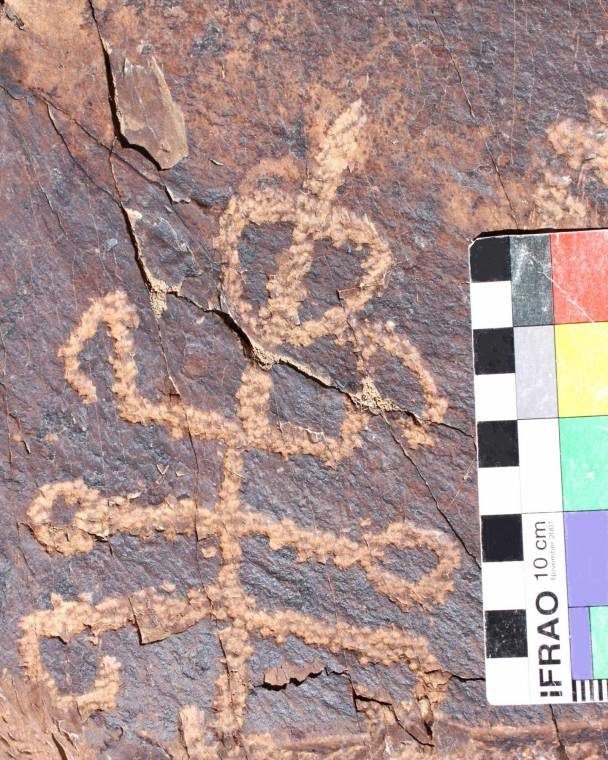
© Dr. Mohammad NaserifardThe 'squatter mantis man' petroglyph next to a 10 cm scale bar.
A unique rock carving found in the Teymareh rock art site (Khomein county) in Central Iran with six limbs has been described as part man, part mantis. Rock carvings, or petroglyphs, of invertebrate animals are rare, so entomologists teamed up with archaeologists to try and identify the motif. They compared the carving with others around the world and with the local six-legged creatures which its prehistoric artists could have encountered.

Entomologists Mahmood Kolnegari, Islamic Azad University of Arak, Iran; Mandana Hazrati, Avaye Dornaye Khakestari Institute, Iran; and Matan Shelomi, National Taiwan University teamed up with freelance archaeologist and rock art expert Mohammad Naserifard and describe the petroglyph in a new paper published in the open access Journal of Orthoptera Research.

Comment: Since we know that ancient man was usually more than capable of accurately depicting the wildlife he saw around him, it's more likely that this 'unusual mantis' was an attempt to document other phenomena, as is noted above and has also been seen in many other areas and instances: Also check out SOTT radio's:


Attention

Why was it so dangerous to live in Russia in the 1990s?

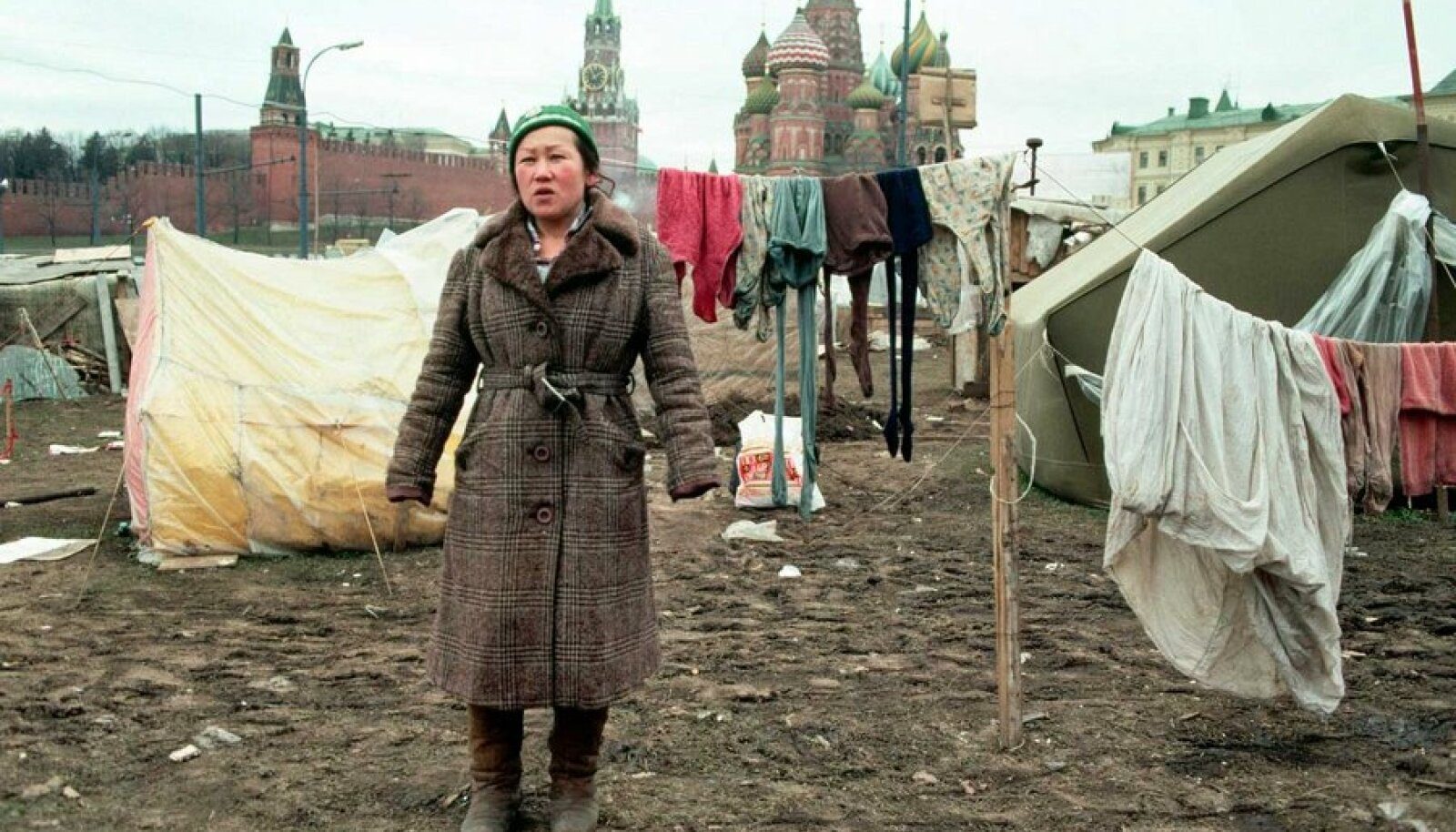
Tent town at the Kremlin 1990
© UnknownTent town at the Kremlin 1990
The country verged on anarchy and collapse. Laws were meaningless, might made right, and wealth walked hand in hand with Death.

Comment: See also:


Sherlock

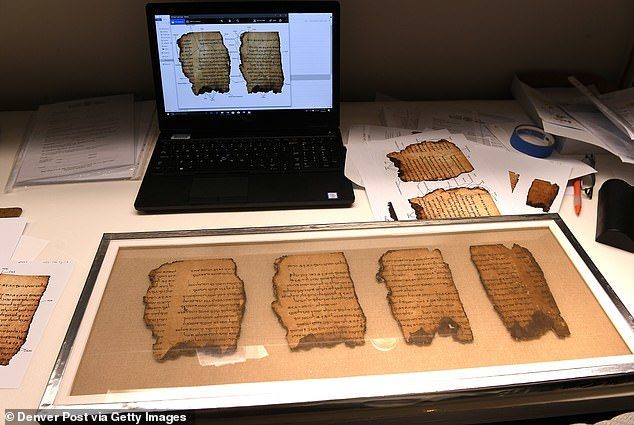
'Dead Sea Scrolls' at the Museum of the Bible are ALL forgeries

Dead sea scrolls
Real pieces of Dead Sea Scrolls like the one pictured had a number of discrepancies compared to the faked counterparts, including the materials on which they were inscribed (stock)
On the fourth floor of the Museum of the Bible, a sweeping permanent exhibit tells the story of how the ancient scripture became the world's most popular book. A warmly lit sanctum at the exhibit's heart reveals some of the museum's most prized possessions: fragments of the Dead Sea Scrolls, ancient texts that include the oldest known surviving copies of the Hebrew Bible.

But now, the Washington, D.C. museum has confirmed a bitter truth about the fragments' authenticity. On Friday, independent researchers funded by the Museum of the Bible announced that all 16 of the museum's Dead Sea Scroll fragments are modern forgeries that duped outside collectors, the museum's founder, and some of the world's leading biblical scholars. Officials unveiled the findings at an academic conference hosted by the museum.

"The Museum of the Bible is trying to be as transparent as possible," says CEO Harry Hargrave. "We're victims — we're victims of misrepresentation, we're victims of fraud."

Comment: See also: And check out SOTT radio's:


Sun

Coronavirus and the sun: A lesson from the 1918 influenza pandemic

1918 influenza epidemic Boston
© National ArchivesInfluenza patients getting sunlight at the Camp Brooks emergency open-air hospital in Boston. Medical staff were not supposed to remove their masks.
Fresh air, sunlight and improvised face masks seemed to work a century ago; and they might help us now.

When new, virulent diseases emerge, such SARS and Covid-19, the race begins to find new vaccines and treatments for those affected. As the current crisis unfolds, governments are enforcing quarantine and isolation, and public gatherings are being discouraged. Health officials took the same approach 100 years ago, when influenza was spreading around the world. The results were mixed. But records from the 1918 pandemic suggest one technique for dealing with influenza — little-known today — was effective. Some hard-won experience from the greatest pandemic in recorded history could help us in the weeks and months ahead.

Put simply, medics found that severely ill flu patients nursed outdoors recovered better than those treated indoors. A combination of fresh air and sunlight seems to have prevented deaths among patients; and infections among medical staff.[1] There is scientific support for this. Research shows that outdoor air is a natural disinfectant. Fresh air can kill the flu virus and other harmful germs. Equally, sunlight is germicidal and there is now evidence it can kill the flu virus.

Comment: See also:


Archaeology

Churchill's secret WWII army bunker discovered

Bunker
© Twitter/@cloudshillpressBunker was home to Churchill's 'secret army' in WWII
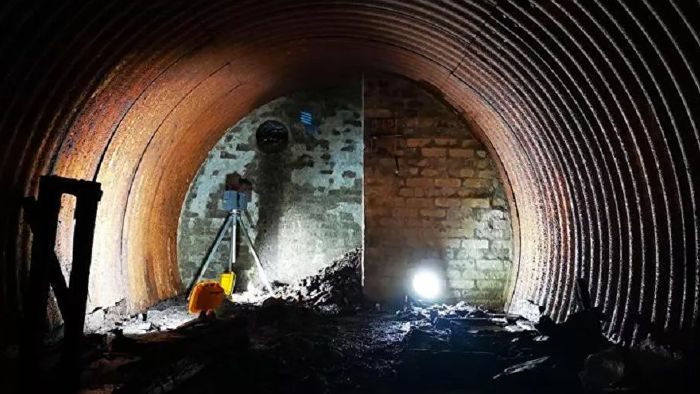
A clandestine bunker used by Britain's most secretive soldiers during World War II - an elite unit commonly known as 'Churchill's secret army' - was recently discovered in southern Scotland by forestry workers.

The fortified hideout stretches about 23 feet long (7 meters) and is 10 feet wide (3 meters), the Daily Mail reported, citing archaeologists. According to the media report, forestry workers in south Edinburgh uncovered the bunker buried four feet (1,5 meters) underground and consisting primarily of a tin roof and brick walls.

Archaeologists suggested that the bunker could house seven soldiers from the ranks the the so-called 'Churchill secret army' including bunk beds, a table and a cooking stove. Forestry and Land Scotland (FLS) archaeologist Matt Ritchie said, cited by The Daily Mail:
"This discovery gives us an insight into one of the most secretive units that were operating during WW2. It's quite rare to find these bunkers as their locations were always kept secret - most were buried or lost. From records, we know that around seven men used this bunker and at the time were armed with revolvers, Sten guns, submachine guns, a sniper's rifle and explosives."
'Churchill's secret army', also known as the 'Scallywags', was reportedly trained in guerilla warfare and had a special order to fight to the death in the event of a Nazi invasion. In case of enemy invasion, the orders for the Auxiliary Unit volunteers were to disappear without telling anyone and to report to hidden bases in the countryside, the media report said.