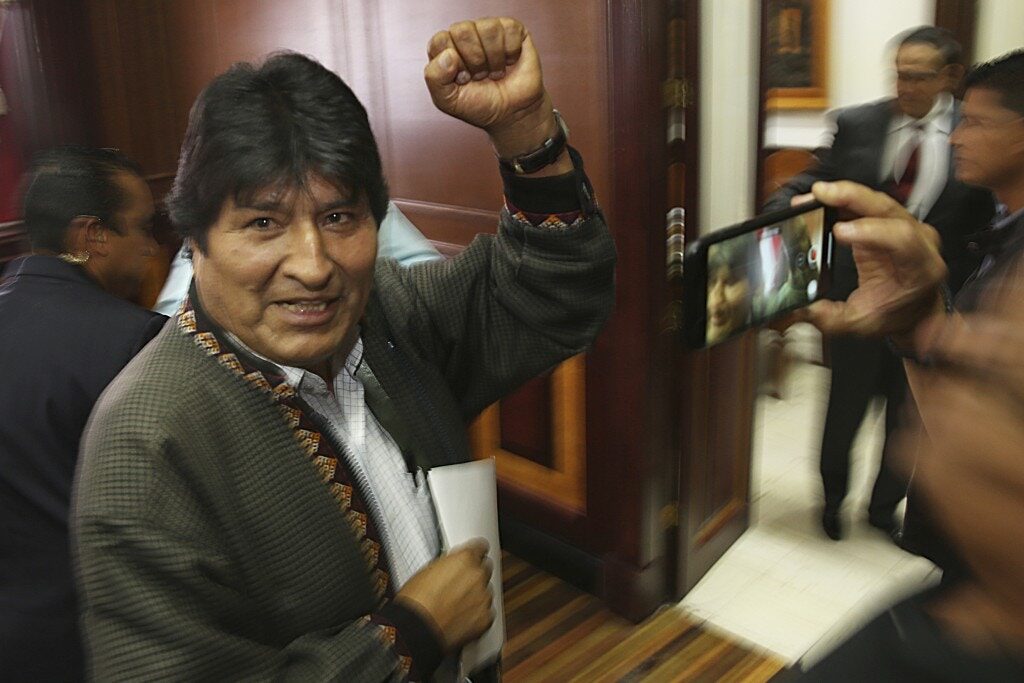
© AP Photo/Marco UgarteIn this Nov. 27, 2019, photo, Bolivia's former President Evo Morales pumps his fist after a press conference at the journalists club in Mexico City.
In November 2019, Bolivia's three-term left-wing president, Evo Morales, was forced by the country's military and police forces to flee to Mexico after Morales, the prior month, had been officially
certified as the winner of his fourth consecutive presidential election. It was unsurprising that Morales won. As the Associated Press
noted in 2014, his governance was successful by almost every key metric, and he was thus "widely popular at home for a pragmatic economic stewardship that spread Bolivia's natural gas and mineral wealth among the masses."
While Morales's popularity had marginally waned since his 2014 landslide victory, he was still the
most popular politician in the country. On the night of the October 21, 2019, vote, Bolivia's election board certified that Morales's margin of victory against the second-place candidate exceeded the ten percent threshold required under Bolivian law to avoid a runoff, thus earning him a fourth term. But allegations of election fraud were quickly voiced by Morales's right-wing opponents, leading to his expulsion from the country on November 11.
Once he fled, Bolivia's first-ever president from the country's Indigenous population was replaced by a little-known, white, far-right senator, Jeanine Áñez, from the country's
minority European-descendent, Christian, wealthy region. Her new, unelected government
promptly massacred dozens of Indigenous protesters and then vested the responsible soldiers with immunity.
Seven months later, Áñez predictably continues to rule Bolivia as "interim president" despite never having run for president, let alone having been democratically elected.













Comment: New studies are showing that at least 60% of people are naturally resistant to SARS-COV2: See also: WHO does a 180, now says asymptomatic spread of coronavirus 'very rare'