- The third group is extremely large: it is the rest of the population. The upper class treat them as regrettable dead weight and expect nothing from them except silence and submission. Its members often have a hard time making ends meet. They pay taxes but can see that a growing portion is being used to subsidize the very people who drove them out of their suburban homes.
- For the moment, Macron does not seem to want to recognize that these people even exist.
- When Macron lowered the taxes of the wealthiest but increased the taxes of these "peripherals" by means of a fuel tax, it was seen as the last straw -- in addition to his arrogant condescension.
- "Today, most of those who protest do not attack the police. But instead of acting to bring down the violence, the police are receiving orders pushing them to be very violent. I do not blame the police. I blame those who give them orders". - Xavier Lemoine, the mayor of Montfermeil, a city in the Eastern suburbs of Paris where the 2005 riots were extremely destructive,
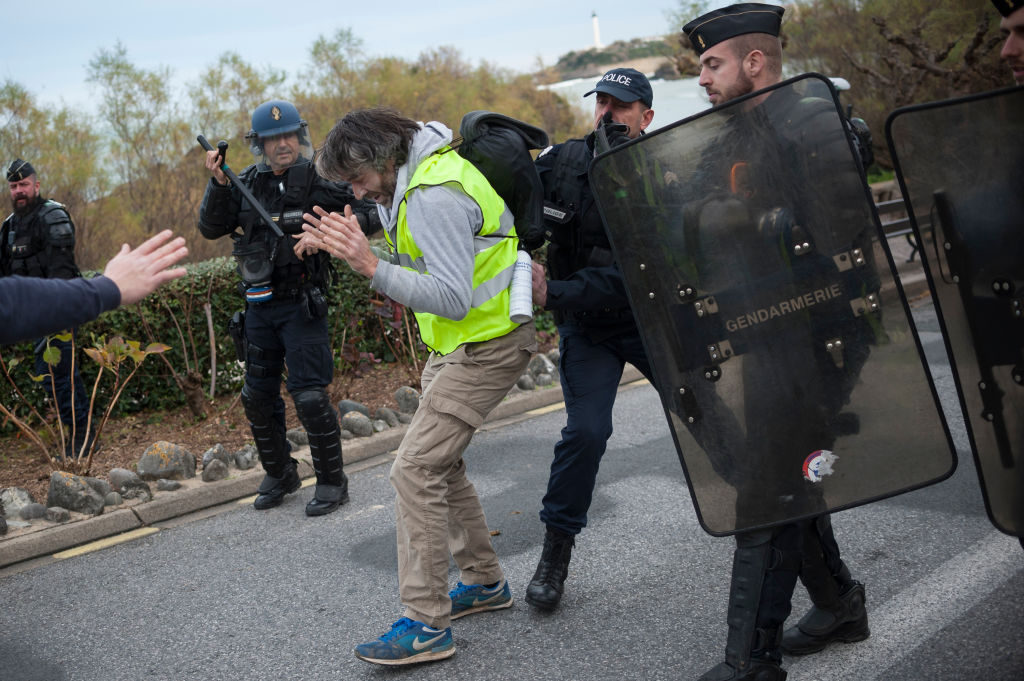
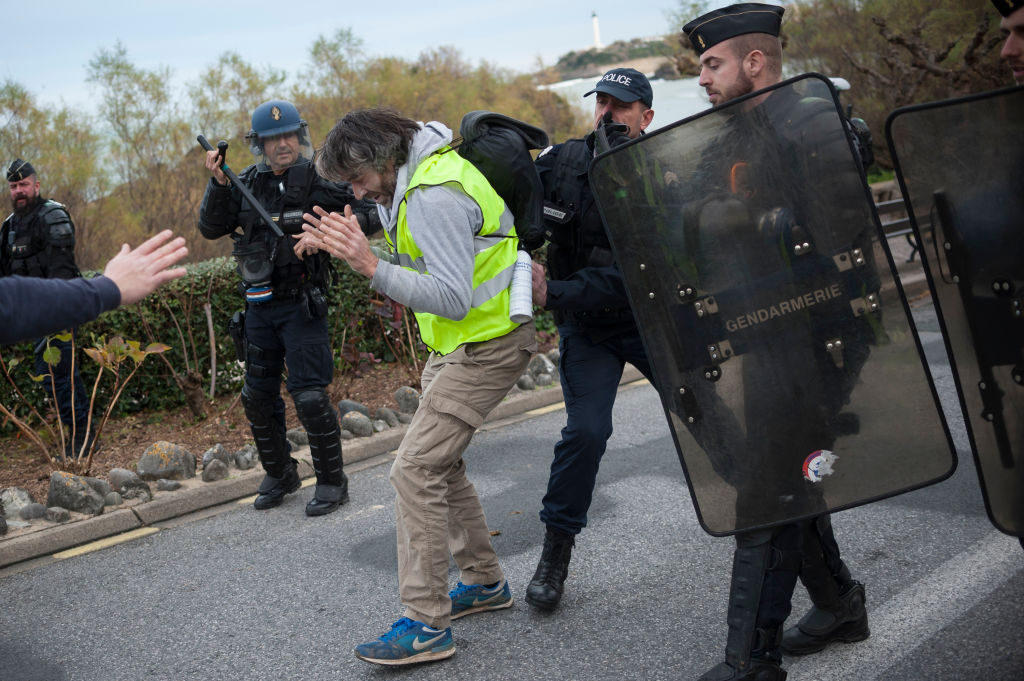
© Gari Garaialde/Getty ImagesPolice scuffle with a yellow vest protester on December 18, 2018 in Biarritz, France.
Saturday, January 26
th 2019. "Yellow vests"
protests were being organized in the main cities of France. Mobilization was not weakening. Support from the population had decreased slightly but was still huge (60%-70%, according to
polls). The main slogan has remained the same since November 17, 2018: "Macron must resign". In December, another slogan was added: "
Citizens' initiative referendum".
The government and French President Emmanuel Macron have been doing everything they can to crush the movement. They have tried insults, defamation and have said the demonstrators were both "
seditious people" wishing to overthrow the institutions and fascist "
brown shirts". On December 31, Macron described them, as "
hateful crowds". The presence of some anti-Semites led a government spokesman (incorrectly) to describe the entire movement as "
anti-Semitic".
The Minister of the Interior, Christophe Castaner, ordered the police to resort to a degree of violence not seen since the time of the Algerian war (1954-62). During the two last decades in France, other riots have taken place many times. In 2005, for instance, when the whole country was subjected to arson and riots for weeks, the number of wounded rioters remained low. But violence has consequences. In just the last few weeks, 1,700 protesters were wounded, some seriously. Nineteen lost an eye; four lost a hand.
Although French police officers do not use lethal weapons, they do use rubber ball launchers and often fire at protesters' faces -- a target prohibited by the current rules of engagement. The French are also the only police force in Europe to use Sting-Ball grenades.












Comment: See also: