OF THE
TIMES


"After the recent events that have taken place, it was decided to limit the work of US forces in Iraq. The US side has been notified ... They can act only with Iraqi consent, but after such a stab in the back, we will, of course, limit their activities," Khalaf stated.But that's not stopping the Americans from sending an additional 3,000 troops to the region.
The spokesman also added that an investigation is currently ongoing to ascertain how the information of Soleimani's movements, such as his flight from Damascus to Baghdad and onward transport from Baghdad International Airport, was shared with the US.
"Yes, an investigation is underway. The investigation will concern everyone who could have had any information inside the [Baghdad International] airport," Khalaf remarked.
He also stated, echoing comments made by Iraqi military spokesman Brig. Gen. Yehia Rasool earlier on Saturday, that Iraq had the capability to defend itself, even if NATO suspended military training in the country.
"Iraq is able to cope with this task on its own, as well as with the task of protecting its territory. Of course, coalition forces provided air support, but the Iraqi military did everything else," Khalaf remarked.
In a statement to RT on Friday, retired Virginia Senator Richard Black said the assassination "may presage a new war of aggression โ this time, against the Iranian people." Black noted that the commander of the IRGC's Quds Force had led the fight against both Islamic State (IS, formerly ISIS) terrorists and Al-Qaeda affiliates in Syria. "We are not genuinely fighting a war on terror. I fear that in a sense, we are becoming the terror."Presidential Candidate Tulsi Gabbard:
The former senator, who retired at the end of 2019, cautioned against further escalation in the Middle East, recalling a claim predating the 2003 invasion of Iraq that regime change in Tehran was the ultimate objective. "I pray that we draw back from the vast war that looms," Black added. "Neither our soldiers nor our people have a voice to stop it."

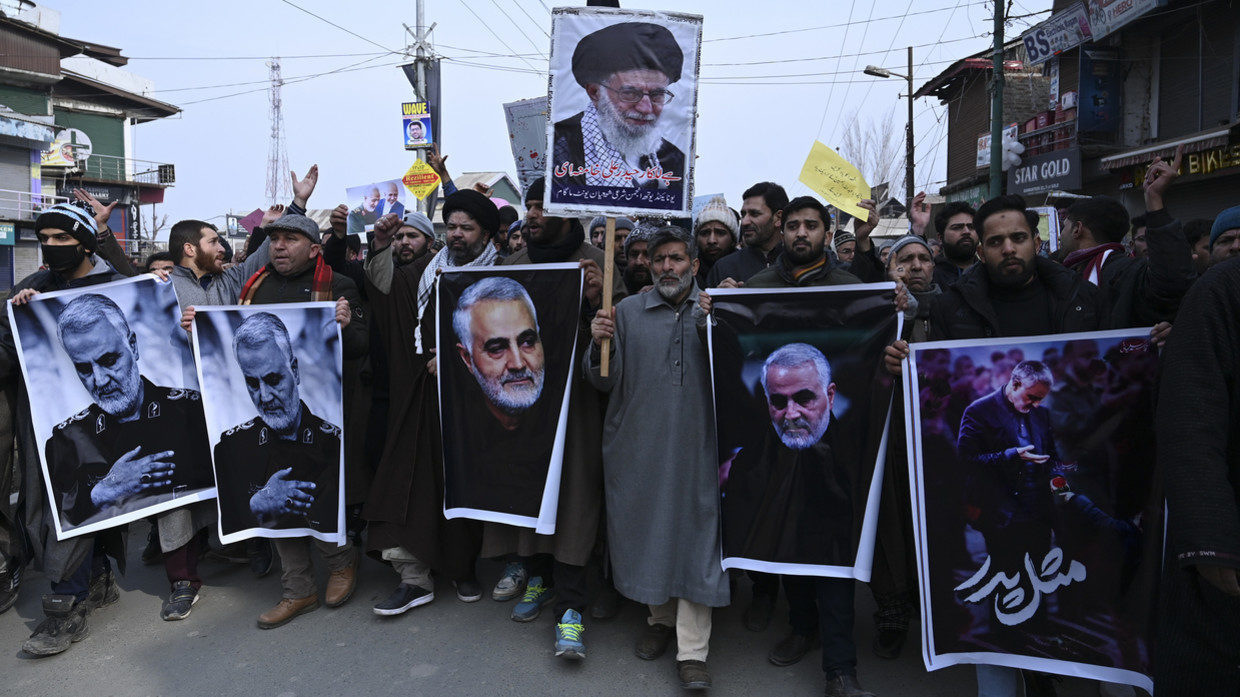
The footage shows the flag being carried up the steps of the mosque, with a portrait of slain Quds Force commander Qasem Soleimani placed on top of the banner in a solemn procession. The flag is then seen being raised over the mosque's dome.New details are emerging about the assassination itself. First, footage:
In Shiite tradition, the red flag symbolizes the unjust spilling of blood and a call to avenge the victim or victims. Its use goes back to the period of Imam Husayn ibd Ali, grandson of the Prophet Muhammad, who was beheaded at the Battle of Karbala in 680 AD along with dozens of his followers. The flag signifies the intent of Shia Muslims to avenge their slain leader.
According to observers, the flag had never been hoisted over the holy site before. It was taken to mean that the conflict between Iran and the US over commander Soleimani's assassination would escalate further.
The central HQ of IRGC's Qods Force issued a statement on Friday, recounting that during the attack of Americans in the early hours of the day, 10 people were martyred, 5 of them Iranians, including Lieutenant General Soleimani, and 5 of them Iraqis, including Abu Mahdi al-Muhandis, deputy commander of Iraq's Popular Mobilization Forces (PMF), or Hashad al-Shabi.A "hunter-killer" drone was used in the strike:
The 4 Iranians in Soleimani's entourage were Brigadier General Hossein Jafarinia, Colonel Shahroud Mozaffarinia, Major Hadi Taromi, and Captain Vahid Zamanian. The statement also dismissed the rumors that General Soleimani's son-in-law accompanied him or was killed in the attack.
...
The PMF media arm said the two were killed in an American airstrike that targeted their vehicle on the road to the airport. A PMF official said seven other people were killed by missiles fired by the US forces at Baghdad International Airport. He said the dead included PMF airport protocol officer, Mohammed Reda.
Modified Hellfire R9X 'Ninja' missiles were used by the US military to destroy Qasem Soleimani, the head of Iran's Islamic Revolutionary Guard Corps (IRGC)' elite Quds Force, Al Arabiya news network reports. Instead of an explosive warhead in the centre, the R9X missile has six swing-out sword-like blades designed to minimise collateral damage.Planning for the assassination allegedly started soon after Christmas:
The New York Times, in turn, reported that the missiles were launched by the US unmanned aerial vehicle (UAV) MQ-9 Reaper, which is capable of almost silently flying at a speed of 230 miles per hour with four R9Xs on board. The "hunter killer" drone was reportedly sent by US Central Command headquarters in Qatar.
The operation to kill General Soleimani was put together by a handful of Donald Trump's most senior aides in a matter of a few days, with the president approving plans to assassinate the Iranian commander shortly after the December 27 rocket attack on a US military compound in Kirkuk, northern Iraq, Bloomberg has reported, citing three people said to be familiar with the matter.This is what UK "partners" had to say:
...
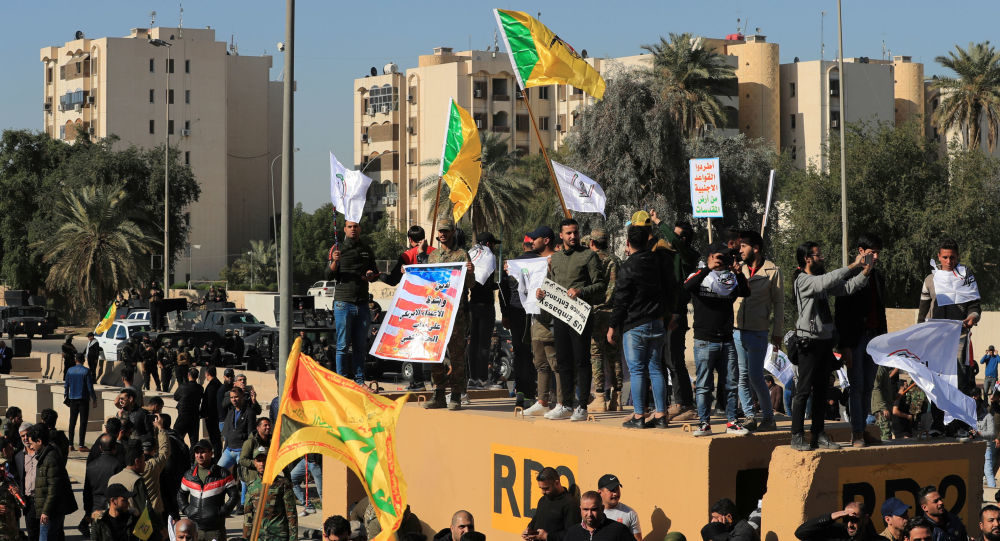
No group has claimed responsibility for the Kirkuk attack. The US has accused Kata'ib Hezbollah, an Iraqi Shia paramilitary force, but has yet to present evidence to back up its allegations. Prior to the strike on Soleimani, the US had already 'retaliated' against Kata'ib Hezbollah, killing dozens of militants and prompting Iraqis to try to storm the US's Baghdad Embassy compound.
The select group of advisors planning the strike on Soleimani reportedly included National Security Advisor Robert O'Brien, Secretary of State Mike Pompeo, Vice President Mike Pence and Acting Chief of Staff Mick Mulvaney, with the officials communicating by secure lines from locations across the US in the days after Christmas.
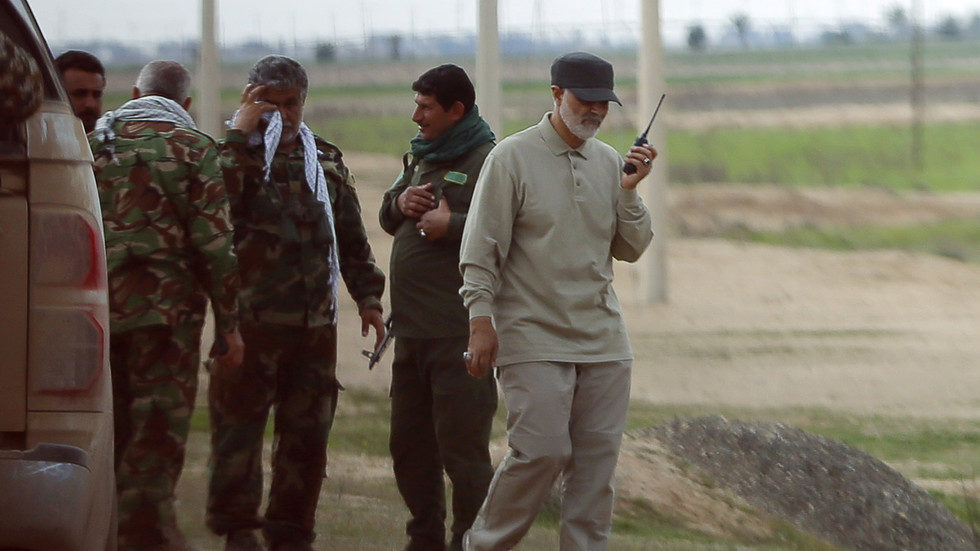
One US official said that the US military wasn't monitoring Soleimani directly on the night of the attack, but rather launched the strike on the basis of earlier-obtained information that he would be at Baghdad International Airport, on route to a third country - Syria or Lebanon, on Friday morning.
An official also said the Trump administration decided not to notify Congress about the attack ahead of time amid 'security concerns', with White House press officers similarly kept out of the loop. US allies were also left uninformed, leading to mild criticism from the UK.
Chairman of the Foreign Affairs Committee in the last parliament Tom Tugendhat has deplored that the US was routinely failing to inform the UK of such decisions in advance.And so the Americans murdered the man the Russian defense ministry described as essential to the defeat of ISIS:
"I've long believed that the purpose of having allies is that we can surprise our enemies and not each other, and it's been a pattern, sadly, which has been a bit of a shame, that the US administration of late has not shared with us, and that is a matter of concern," Tugendhat was quoted by BBC News as saying.
Urging the US administration to "share much more closely with allies" in the future, he added: "The government needs to make some very quick choices on the safety of citizens overseas and the security of British personnel."
The ministry slammed the assassination of the Iranian general, carried out on orders from Washington, calling it a "short-sighted" move that would lead to a "rapid escalation" of tensions in the Middle East. It also described Soleimani as a talented and experienced commander, who enjoyed "well-earned authority" throughout the Middle East.Aside from the sharp rise in oil prices, another immediate effect has been a dive in the US stock market, with Dow Jones and S&P 500 indexes posting lower-than-normal losses:
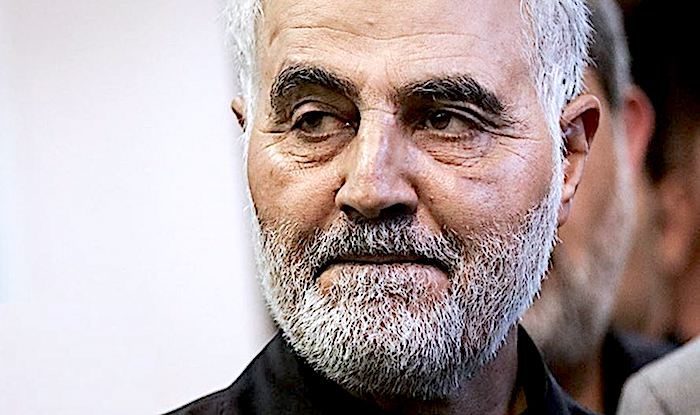
"It was under Soleimani's direct command that military resistance to the international terrorist groups Islamic State [IS, formerly ISIS] and Al-Qaeda was organized in Syria and Iraq, long before the so-called US-led 'international coalition' was formed."
In its statement, the ministry called the Iranian general's achievements in fighting international terrorism "undeniable" and warned that his death would be detrimental to the whole system of global security.
Soleimani was seen as a key strategist, coordinating the efforts of the Iranian advisers assisting both Syrian and Iraqi forces in their fight against terrorists. Iranian media reported that he'd personally assisted Baghdad in several counter-terrorism operations, including the liberation of the strategic city of Tikrit from IS jihadists in 2015.
See also:
As markets closed on Friday, the Dow Jones Industrial Average shed 233.92 points or 0.8 percent, in what was its biggest single-day drop in a month. The S&P 500 did not fare much better, plummeting more than 0.7 percent to close the day at 3.234.85 as renewed fears over of a large-scale conflict potentially breaking out in the Middle East soured investor mood.
Defense and aerospace shares surged, however, with Northrop Grumman (NOC) stocks rising 5.45 percent. Lockheed Martin, the maker of the beleaguered F-35 jets, saw its stocks jump 3.63 percent, their best showing in half a year. Missile-maker Raytheon also rallied at the news, adding around 1.5 percent.
Oil and gold stocks were also jubilant. Brent crude leaped 3.5 percent to over $68 a barrel, while US crude climbed 3.1 percent to reach $63.05 a barrel.
The US attack drove up gold prices, too. They rose to the highest level in four months.
General Gholamali Abuhamzeh, the Islamic Revolutionary Guards Corps (IRGC) commander in Kerman Province, said "The Strait of Hormuz is a vital point for the West and a large number of American destroyers and warships cross there." He said that Iran had identified "vital American targets in the region" and that "some 35 U.S. targets in the region as well as Tel Aviv are within our reach."
Chinese Foreign Minister Wang Yi spoke with Iranian Foreign Minister Mohammad Javad Zarif by telephone on January 4 and emerged urging the United States not to "abuse" the use of force and resolve issues "via dialogue," according to Reuters.
Wang also said Beijing would play a constructive role in maintaining peace and security in the Persian Gulf region.
French Foreign Minister Jean-Yves Le Drian said he had spoken with Wang and with German Foreign Minister Heiko Maas about the situation in the Middle East and that all agreed on the need to preserve Iraqi sovereignty and stability, Reuters reported.
Le Drian also said Paris, Berlin, and Beijing agreed on the importance of ensuring that Tehran does not violate the 2015 nuclear deal with world powers to trade sanctions relief for limits on Iran's nuclear activities.
Zarif also discussed the killing of Soleimani with Russian Foreign Minister Sergei Lavrov in a phone call on January 3, the Russian Foreign Ministry said in a statement.
"Lavrov expressed his condolences over the killing," according to the statement issued January 4. "The ministers stressed that such actions by the United States grossly violate the norms of international law."
Iran's ambassador to the United Nations, Majid Takht Ravanchi, said late on January 3 that the attack "in fact was an act of war on the part of the United States and against Iranian people. Last night they started a military war by assassinating by an act of terror against one of our top generals. So what else can be expected of Iran to do? We cannot just remain silent. We have to act and we will act."
Iranian Supreme Leader Ayatollah Ali Khamenei has warned of "severe retaliation."
Ali Fadavi, a top IRGC commander, told Iranian state television late on January 3 that the United States "resorted to diplomatic measures...on Friday morning" after the attack. He claimed that the Americans had "even said that if you want to get revenge, get revenge in proportion to what we did," according to AFP.
Mohsen Rezaee, secretary of Iran's influential Expediency Council, suggested that Israel had provided intelligence that contributed to the operation that killed Soleimani. "There is a high possibility that Israel had taken information from Syria about his flight and passed the intelligence to America."
Iran on January 3 sent a letter to the UN secretary-general and the Security Council stating that Tehran "reserves all of its rights under international law to take necessary measures" in response to the killings.
"And everyone has to have this disclaimer, 'Well, I know it's probably worse than North Korea, but the US government shouldn't get involved.' It's cowardice, because once the war starts, they can say 'Hey I never called for US intervention!' No, but you're a conveyor belt for propaganda. You're a conveyor belt to get the machine ginned up for war. And so you've got to stand up and take responsibility."McAdams has for years consistently operated in the hub of one of America's most forceful and effective branches of opposition to US interventionism, and he is absolutely correct here. On both sides of America's political divide, the primary objections you will see to this administration's campaign to delegitimize and topple the Venezuelan government are prefaced with a strong condemnation of Maduro followed by some feeble equivocations voicing vague objections to Trump's actions, if that.
"It is President Donald Trump's failed policy toward Iran that has brought us to this combustible moment," she wrote in a column for USA Today, adding that even "confronting Iran over its nuclear program and malign behavior elsewhere", the US has "maintained an uneasy coexistence in Iraq, where Tehran holds considerable sway."
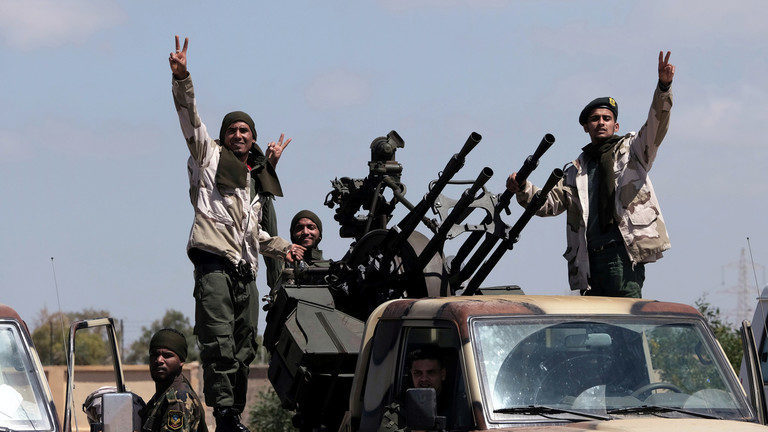
Comment: In Libya's elected government demands UN's usurper regime gone Joanne Morarity provides an overview of the two groups in Libya: For more on the situation, see: Turkey threatens to take Libya by force and install Turkish governor
Also check out SOTT radio's:NewsReal: Interview With The Moriartys - New Light on Benghazi, And Liberating Libya
UPDATE: 4th January @ 22:26
RT reports: