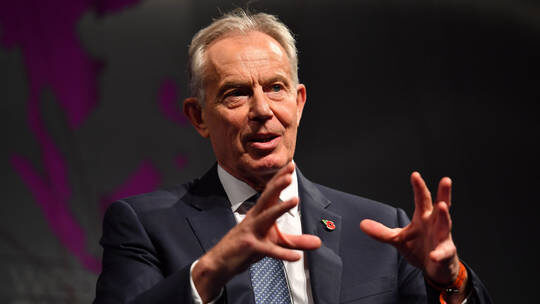
© Getty Images / Piaras Ó Mídheach
In British politics, Tony Blair is a highly controversial former prime minister and a polarizing figure.
His cheerleading and participation in the Iraq War of 2003, brandished upon the false premise that Saddam Hussein possessed 'weapons of mass destruction', is one of the most memorable features of his premiership. Coupled with the domestic policies of his 'New Labour' project, it illustrates that Blair, despite being a Labour prime minister, was a de-facto right-wing leader who embraced the political consensus of Thatcherism.
Blair was an ardent neoconservative, who represented the era of 'Pax Americana' in the 1990s and early 2000s, and engaged in military action more than any other British prime minister of modern times. Yet, for the British psyche, this is accepted as normal and Tony Blair is ultimately not disgraced for his foreign policy, even as his domestic politics ignites bitter divides in the Labour camp. Recently, Blair
made a speech at the Ditchley Annual Lecture, which focused on the challenges posed by Russia and China.
The address ultimately covered the need to maintain Western supremacy in a rapidly changing international environment. Blair brought up the collapse of the Soviet Union and the advent of Western unipolarity and attributed the domestic economic policies of both Ronald Reagan and Margaret Thatcher as being fundamental to the Western triumph - in other words, free market capitalism and neoliberalism. He proceeded to argue that poor economic choices since that time, and an ill-fitted response to the global financial crisis, had led Western politics to ultimately become "dysfunctional" and "ugly" through the rise of populism.















Comment: See also: Terrorist bombing of gov't building in breakaway Transnistria region, Russia says situation is 'concerning'