
© The Cradle
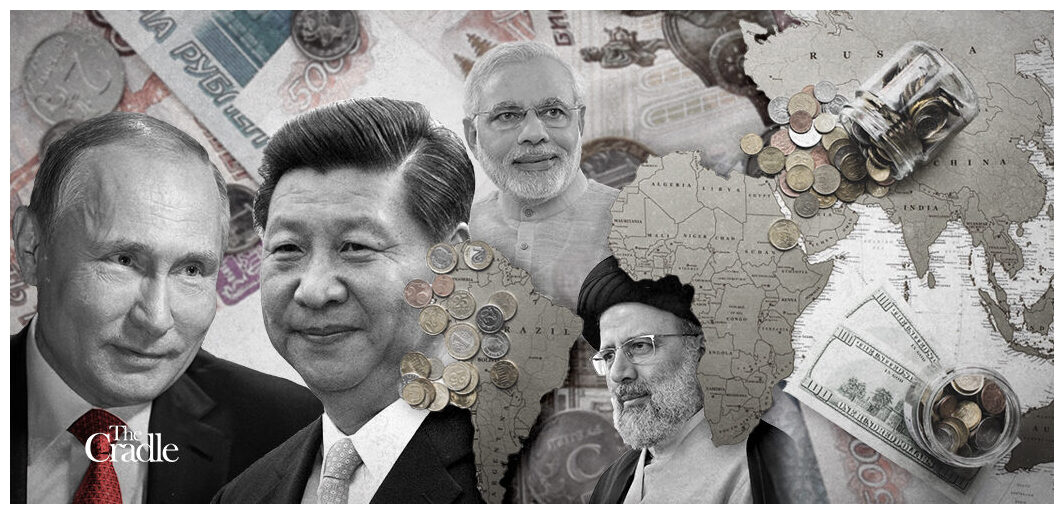
Through its regulatory body, the Eurasian Economic Commission (EEC), the EAEU has just extended a very serious proposal to the BRICS nations (Brazil, Russia, India, China and South Africa) which, crucially, are already on the way to turning into BRICS+: a sort of G20 of the Global South.
The system will include a single payment card - in direct competition with Visa and Mastercard - merging the already existing Russian MIR, China's UnionPay, India's RuPay, Brazil's Elo, and others.
That will represent a direct challenge to the western-designed (and enforced) monetary system, head on. And it comes on the heels of BRICS members already transacting their bilateral trade in local currencies, and bypassing the US dollar.
This EAEU-BRICS union was long in the making - and will now also move toward prefiguring a further geoeconomic merger with the member nations of the Shanghai Cooperation Organization (SCO).
The EAEU was established in 2015 as a customs union of Russia, Kazakhstan and Belarus, joined a year later by Armenia and Kyrgyzstan. Vietnam is already an EAEU free trade partner, and recently enshrined SCO member Iran is also clinching a deal.
The EAEU is designed to implement free movement of goods, services, capital, and workers between member countries. Ukraine would have been an EAEU member if not for the Maidan coup in 2014 masterminded by the Barack Obama administration.
Vladimir Kovalyov, adviser to the chairman of the EEC, summed it all up to Russian newspaper Izvestia. The focus is to establish a joint financial market, and the priority is to develop a common "exchange space:" "We've made substantial progress and now the work is focused on such sectors as banking, insurance, and the stock market."
A new regulatory body for the proposed joint EEU-BRICS financial system will soon be established.
Meanwhile, trade and economic cooperation between the EAEU and BRICS have increased 1.5 times in the first half of 2022 alone.
The BRICS share in the total external trade turnover of the EAEU has reached 30 percent, Kovalyov revealed at the BRICS International Business Forum this past Monday in Moscow:
"It is advisable to combine the potentials of the BRICS and EAEU macro-financial development institutions, in particular the BRICS New Development Bank, the Asian Infrastructure Investment Bank (AIIB), as well as national development institutions. This will make it possible to achieve a synergistic effect and ensure synchronous investments in sustainable infrastructure, innovative production, and renewable energy sources."Here we once again see the advancing convergence of not only BRICS and EAEU but also the financial institutions deeply involved in projects under the China-led New Silk Roads, or Belt and Road Initiative (BRI).












Comment: Of course such a ban would never be created in any Western country, who claim some kind of moral high ground over 'human rights'. And yet we'll only see perverse things like the Balenciaga scandal in the West. Not much of a moral high ground to grandstand upon.