Science & TechnologyS

Bulb

Living in the Mootrix: Russian cows try out VR headsets to lighten their mood

Cow with headset
© Ministry of Agriculture and Food of the Moscow Region
Theories that we all live in a simulated world are debatable, but it may actually become a thing for Russian cows as farmers believe virtual reality could be used to trick the animals into giving more milk.

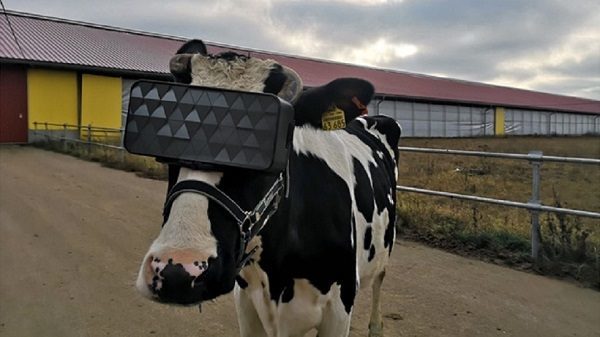
It was a cold and murky November day in the Moscow Region, but the cows at one farm were absolutely sure they were grazing a green field in the middle of summer.

The first trials of VR headsets, specially designed for the cattle, has shown a decrease in the level of anxiety and improved mood among the test subjects, an article on the website of the Ministry of Agriculture and Food of the Moscow Region said.

Info

Researchers discover mysterious protein central to the functioning of DNA

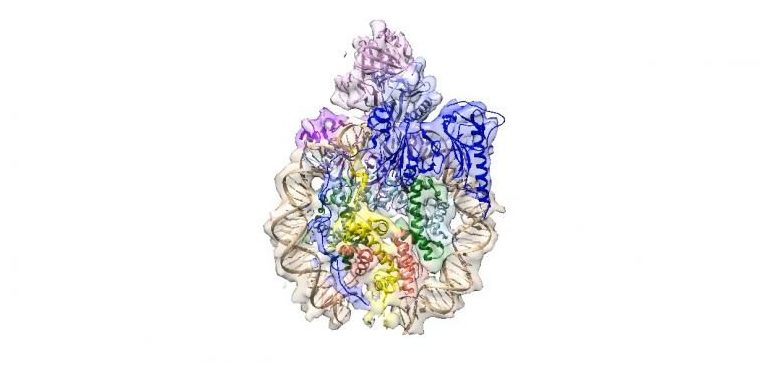
FACT Protein
© Karolin Luger
It's long been known that the proteins that package DNA โ€” like students at a high school dance โ€” require a chaperone. But what exactly that guardian looks and acts like has been a mystery โ€” until now.

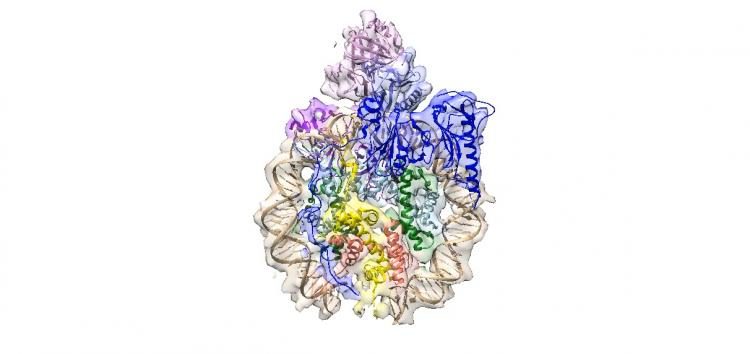
A team of researchers at the University of Colorado Boulder has cracked the puzzle of the 'Facilitates Chromatin Transcription' (or FACT) protein structure. This protein is partly responsible for making sure everything goes smoothly and no improper interactions take place when DNA temporarily sheds and replaces its guardian proteins, or histones.

These findings, which are the result of a project five years in the making at CU Boulder and out today in the journal Nature, will have ripple effects for not only our understanding of the genome and gene transcription, but for our understanding of cancer and the development of anti-cancer drugs.

"This is just the start for this protein. It's not the end," said Yang Liu, a research associate at CU Boulder and one of the study's lead authors.

Ever since its discovery in 1998, the FACT protein has been of great interest for those who study DNA, largely because of the possibilities it presents. But, despite decades of effort, many of the central questions of how the protein works remain unanswered.

Galaxy

Astronomers locate a galaxy containing three supermassive black holes at the center

NGC 6240
NGC 6240 is a puzzle to astronomers. For a long time, astronomers thought the galaxy is a result of a merger between two galaxies, and that merger is evident in the galaxy's form: It has an unsettled appearance, with two nuclei and extensions and loops.

NGC 6240 is about 400 million light years away, in the constellation Ophiuchus. Even though it's been studied intensely, it's a very dusty place, and certain details have been obscured. But a new study using the European Southern Observatory's (ESO) Very Large Telescope (VLT,) along with the advanced 3D MUSE Spectrograph, has opened up a new window into NGC 6240, and revealed a big surprise.

The galaxy is the result of not two galaxies merging, but three. And as a result, it's home to not two supermassive black holes, but three. "Up until now, such a concentration of three supermassive black holes had never been discovered in the universe." Dr Peter Weilbacher, Leibniz Institute for Astrophysics.

Sun

How the sun affects temperatures on Earth: Interview with Professor Valentina Zharkova

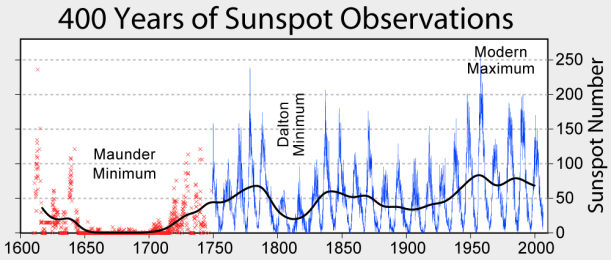
400 year of sunspots observations
© NOAA
The sun is going through a stage known as a solar or Maunder Minimum. This is where the solar activity that ignites solar flares or sun spots has decreased. It's a normal cycle and one that has been linked to the mini ice age that lasted more than 50 years starting in the mid-1600s.

According to space weather since 2015, the number of days without a recordable sun spot has been rising year over year. NOAA, NASA and others all appear to agree the sun is entering a solar minimum phase.

What it means is open to interpretation because as Professor William Happer pointed out when I asked him about the growing number of people and agencies that suggest a solar minimum could lead to a cooling off period, he directed me the Danish proverb: "It is difficult to make predictions, especially about the future."

It has been suggested that mathematics can establish patterns and back them up with empirical evidence to support a prediction. We reached out to Professor of Mathematics Valentina Zharkova of Northumbria University, one of the first people to raise awareness of the decrease in solar activity, for a Conversation That Matters about the sun, its reduced activity and her reading of the impact it will have on temperatures on earth.


Comment: Professor Valentina Zharkova explains and confirms why a "Super" Grand Solar Minimum is upon us


Butterfly

Best of the Web: Design from the beginning: It didn't take long for animals to master physics and engineering

Ctenophores
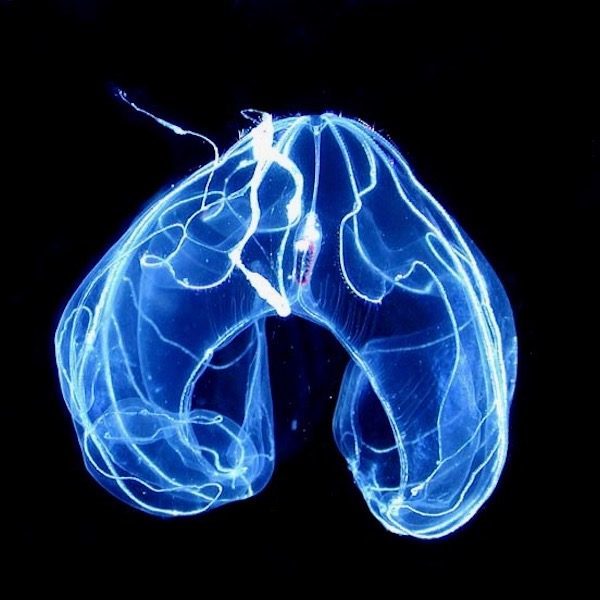
© Marsh Youngbluth [Public domain], via Wikimedia CommonsBathocyroe fosteri, a ctenophore: The first animal body plans were performing feats that fascinate โ€” and baffle โ€” research scientists.
Ctenophores: Flashing Paddles

Also called sea gooseberries and comb jellies, ctenophores (pronounced TEN-o-fours) are small centimeter-sized marine organisms with rows of cilia, called comb rows or ctenes, which function as paddles for swimming. Though gelatinous and transparent, comb jellies are unrelated to jellyfish (phylum Cnidaria); they have been classified into their own phylum, Ctenophora, characterized by eight of these comb rows. Scientists debate whether ctenophores are the earliest animals that appeared in the Cambrian explosion, as opposed to sponges (phylum Porifera). If so, they arrived with multiple tissues, a nervous system, and a digestive system. That's a lot to account for without any known transitional forms.

Up close, comb jellies look like alien spaceships with flashing lights. Rainbow colors race down the comb rows as the cilia beat in series. There's a puzzle: how do the cilia coordinate their movements? A recent paper in Current Biology by Jokura et al. shows it's not simple.

Comment: See also: And check out SOTT radio's:


Nebula

Surprising quantum effect discovered in exotic superconductor

Quantum
An international team led by researchers at Princeton University has directly observed a surprising quantum effect in a high-temperature iron-containing superconductor.

Superconductors conduct electricity without resistance, making them valuable for long-distance electricity transmission and many other energy-saving applications. Conventional superconductors operate only at extremely low temperatures, but certain iron-based materials discovered roughly a decade ago can superconduct at relatively high temperatures and have drawn the attention of researchers.

Exactly how superconductivity forms in iron-based materials is something of a mystery, especially since iron's magnetism would seem to conflict with the emergence of superconductivity. A deeper understanding of unconventional materials such as iron-based superconductors could lead eventually to new applications for next-generation energy-saving technologies.

Comment: See also:


Jupiter

Global storms on Mars launch dust towers into the sky

Mars
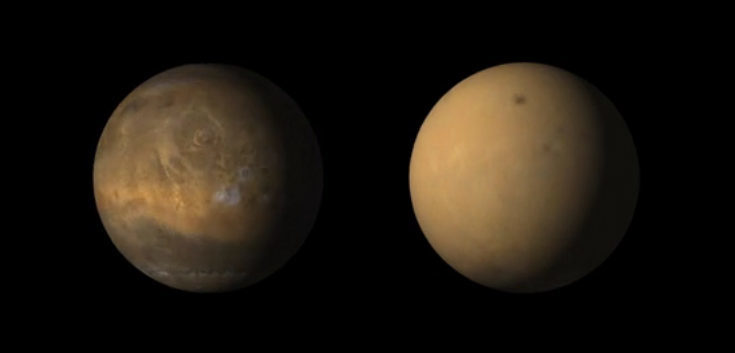
© NASA/JPL-Caltech/MSSSSide-by-side movies shows how the 2018 global dust storm enveloped the Red Planet, courtesy of the Mars Color Imager (MARCI) camera onboard NASA's Mars Reconnaissance Orbiter (MRO). This global dust storm caused NASA's Opportunity rover to lose contact with Earth.
Dust storms are common on Mars. But every decade or so, something unpredictable happens: A series of runaway storms breaks out, covering the entire planet in a dusty haze.

Last year, a fleet of NASA spacecraft got a detailed look at the life cycle of the 2018 global dust storm that ended the Opportunity rover's mission. And while scientists are still puzzling over the data, two papers recently shed new light on a phenomenon observed within the storm: dust towers, or concentrated clouds of dust that warm in sunlight and rise high into the air. Scientists think that dust-trapped water vapor may be riding them like an elevator to space, where solar radiation breaks apart their molecules. This might help explain how Mars' water disappeared over billions of years.

Dust towers are massive, churning clouds that are denser and climb much higher than the normal background dust in the thin Martian atmosphere. While they also occur under normal conditions, the towers appear to form in greater numbers during global storms.

Comment: Could part of the reason scientists don't understand these events be similar to why they can't accurately predict the weather on our own planet? And to do both is it that they need to factor in much greater influences such as the activity of our sun, as well as the electro-magnetic nature of such phenomena? And check out SOTT radio's:


Info

New type of transistor designed by engineering professor

Professor Yuping Zeng
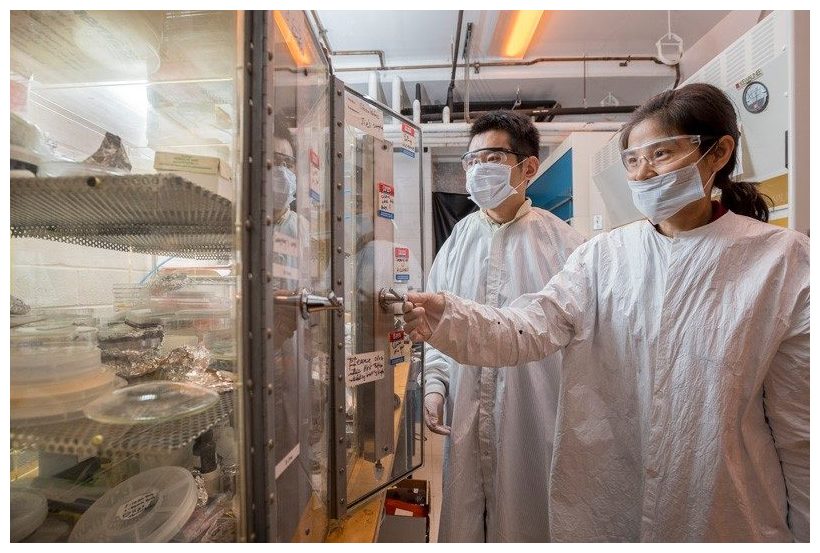
© Kathy F. AtkinsonProfessor Yuping Zeng (right) and graduate student Peng Cui have worked on designs for transistors that could enable cheaper, faster wireless communications.
Many of the technologies we rely on, from smartphones to wearable devices and more, utilize fast wireless communications. What might we accomplish if those devices transmitted information even faster?

That's what Yuping Zeng, assistant professor of electrical and computer engineering at the University of Delaware, aims to discover. She and a team of researchers recently created a high-electron mobility transistor, a device that amplifies and controls electrical current, using gallium nitride (GaN) with indium aluminum-nitride as the barrier on a silicon substrate. They described their results in the journal Applied Physics Express.

Among devices of its type, Zeng's transistor has record-setting properties, including record low gate leakage current (a measure of current loss), a record high on/off current ratio (the magnitude of the difference of current transmitted between the on state and off state) and a record high current gain cutoff frequency (an indication of how much data can be transmitted with a wide range of frequencies).

Better Earth

SOTT Focus: Draconian Climate Change Agenda: Back to The Medieval Green World

greens climate
Greens dream of a zero-emissions world without coal, oil and natural gas. They need to think what they wish for.

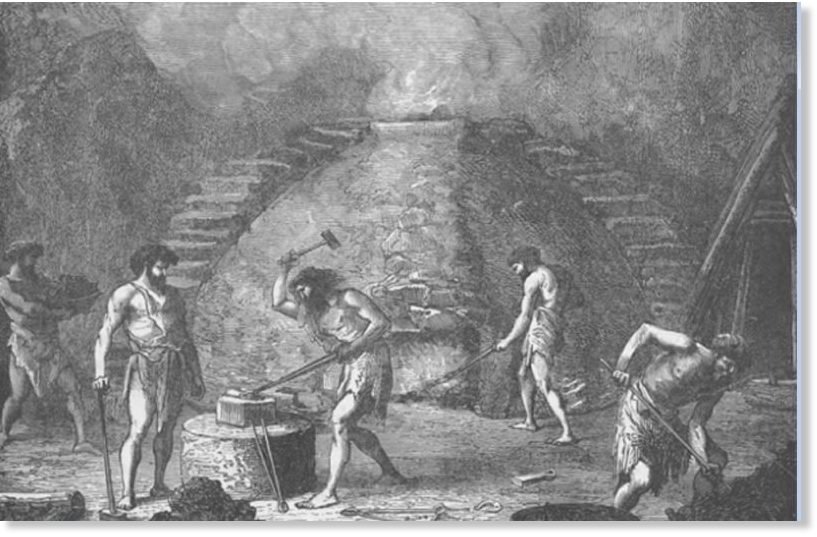
First there would be no mass production of steel without coke from coking coal to remove oxygen from iron ore. People could cut trees in forests for charcoal to produce pig iron and crude steels, but forests would soon be exhausted. Coal saved the forests from this fate.

We could produce gold and silver without using mineral hydro-carbons and with ingenuity we could probably produce unrefined copper, lead and tin and alloys like brass and bronze. But making large quantities of nuclear fuels, cement, aluminium, refined metals, plastics, nylons, synthetics, petro-chemicals and poly pipes would be impossible.

Attention

One of CRISPR's inventors has called for controls on gene-editing technology

gene tech
Regulators need to pay more attention to controlling CRISPR, the revolutionary gene-editing tool, says Jennifer Doudna.

One year on: Doudna, a University of California biochemist who helped invent CRISPR technology in 2012, wrote an editorial in Science yesterday titled "CRISPR's unwanted anniversary."

The anniversary is that of the announcement by a Chinese scientist, He Jiankui, that he had created gene-edited twin girls. That was a medical felony as far as Doudna is concerned, an unnecessary experiment that violated the doctor's rule to avoid causing harm and ignored calls not to proceed.

Comment: For more information on the Rogue Concerns of CRISPR Tech:

Objective:Health #30 - Gene Tech - What the Heck!?

CRISPR: It could revolutionize everything from medicine to agriculture

CRISPR9 Gene-Editing dangers cause a firefight:
Then we have a cautionary statement from one of the key researchers who helped discover CRISPR, Jennifer Doudna:
"I guess I worry about a couple of things. I think there's sort of the potential for unintended consequences of gene editing in people for clinical use. How would you ever do the kinds of experiments that you might want to do to ensure safety? And then there's another application of gene editing called gene drive that involves moving a genetic trait very quickly through a population. And there's been discussion about this in the media around the use of gene drives in insects like mosquitoes to control the spread of disease. On one hand, that sounds like a desirable thing, and on the other hand, I think one, again, has to think about potential for unintended consequences of releasing a system like that into an environmental setting where you can't predict what might happen."